Vasai-Virar: That Sinking Feeling
MUMBAI: Just beyond the reach of Mumbai, the Vasai-Virar region remained, until quite recently, a picturesque idyll. It was hard to believe that a landscape of rolling fields, the occasional gaothan (village settlement), and a smattering of low-rise buildings lay only an arm’s length from the hurly-burly of a mega city. Until it no longer did.
The setting up of the Vasai-Virar City Municipal Corporation (VVCMC) as recently as 2009 marked a turning point, a final admission that the urban chaos had seeped into these once-quiet townships on the northern fringes of Mumbai.
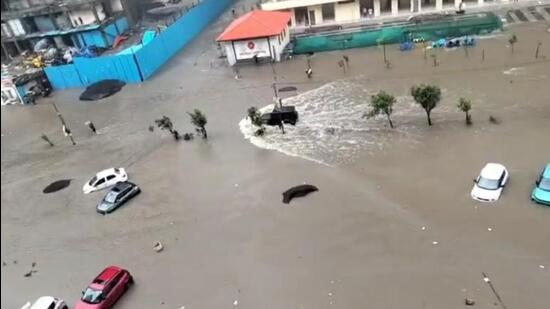
So, when unprecedented rain pounded the Mumbai Metropolitan Region (MMR) for five straight days, from August 15 to 19, Vasai-Virar sank. In just three days, rainfall breached the 500-mm mark. Residents flailed under four feet of floodwater, power supply was severed for 48 hours, and groceries began to run out. Three people died and hundreds had to be rescued.
Worst affected were Evershine City and Vasant Nagari in Vasai east, parts of Vasai west, Nallasopara and Virar including Bolinj, Manikpur and Gass village. Many places remained waterlogged even a day after the downpour stopped.
And it’s easy to see why. In the last 15 years – in development terms, the blink of an eye – the Vasai-Virar region had turned into a developers’ playground, pushed into a rapid urban sprawl. But while planners and administrators eyed the riches of the real estate boom, they overlooked clear warning signs and ignored the crucial question – where would the floodwaters go?
{{/usCountry}}And it’s easy to see why. In the last 15 years – in development terms, the blink of an eye – the Vasai-Virar region had turned into a developers’ playground, pushed into a rapid urban sprawl. But while planners and administrators eyed the riches of the real estate boom, they overlooked clear warning signs and ignored the crucial question – where would the floodwaters go?
{{/usCountry}}It’s why 65-year-old Tara Pandey and his family gazed out of their windows, wide-eyed, as the floodwaters kept rising that harrowing weekend. Living on the first floor of Madhuvan township in Vasai east, they watched in horror as rainwater first filled up ground-level shops and homes, then submerged cars, and threatened to rise even further. “We spent our life savings to buy this flat, believing we would have a better life. Look where we are now,” says Pandey.
The irony is impossible to miss. Madhuvan township was built on reclaimed salt pan land just five years ago. Before that, the area served as a natural sink, absorbing rain water and preventing flooding. With the salt pan gone, rainwater, with nowhere to drain, now rises vertically.
Lessons Not Learnt
Residents and local leaders point out that the VVCMC has refused to learn from an earlier catastrophic flood, in 2018. The civic body had then asked the National Environmental Engineering Research Institute (NEERI) and the Indian Institute of Technology-Bombay (IIT-B) to study what went wrong and recommend solutions.
The report suggested short-term as well as long-term measures. It said key drains across the twin townships must be widened, new drains built, encroachments near drains and nullahs removed, and sharp bends in drains and creeks realigned.
It also recommended the installation of automated gates at the mouth of the Vasai Creek to prevent tidal water from entering the city during heavy rains. Most importantly, it recommended the construction of a new lake called ‘Dharan Lake’ adjacent to Gokhivare and Umrale lakes.
The NEERI-IIT (B) report was never implemented.
As a result, urban settlements across Vasai-Virar are submerged for three to four days during the monsoon every year. As an eyewash, locals say, the VVCMC spends crores of rupees making cosmetic changes such as increasing the height of roads and repairing the walls of drains. None of this has eased waterlogging.
Local BJP leader Manoj Patil has written to the VVCMC more than once, urging that the NEERI-IIT (B) report be implemented. The then guardian minister of Palghar, the late Vishnu Savra, too had pushed the VVCMC to make on-ground changes to reduce waterlogging. Still, the corporation paid no heed.
Natural Drainage
The Vasai-Virar region comprises the towns of Vasai, Virar, Nallasopara, Naigaon and areas under the erstwhile Navghar-Manikpur Municipal Council. Before builders rushed in, the region was dotted with natural holding ponds, large areas that would fill with rainwater that would seep into the earth, draining the land and recharging the water table.
“Now, sprawling townships stand on many of these natural sinks – retention ponds, salt pans and mangroves,” says Dhananjay Gawde, a social activist. He points to Madhuvan township in Vasai east, Yashwant Smart City, also in Vasai east, Global City in Virar west, MHADA Colony at Bolinj in Virar west, and Santosh Bhavan in Nallasopara west, all of them developed in the last five years. Other retention ponds are either encroached or filled with earth, Gawde says.
When pressure mounted to find a solution to the persistent flooding, the VVCMC in 2019 decided to create a holding pond at Nilemore in Nallasopara west. The civic body had allocated 19,860 sq m for the pond and a proposal was drafted. But, like the NEERI report, the proposal was filed away and never resurrected.
Civic sources say the Nilemore site had, over the years, been filled in with mud. The VVCMC, instead of spending money on excavating and removing the soil, had an ingenious workaround. “We invited tenders regarding an Expression of Interest (EOI) to excavate the mud, which could be taken away by contractors who needed it, at their own expense. But there was no response to the tender,” says an official with the civic Public Works Department. Sources reveal that an EOI had been floated four times and it still drew a blank.
Another retention pond was to be developed in an open space near Vasant Nagari in Vasai east. That plan too met the same fate.
Profit Over Planning
When real estate prices in Mumbai edged beyond the reach of the city’s growing middle class, and connectivity with Vasai-Virar improved, development began to spill over into the twin townships a couple of decades ago. Offering the prospect of cheap housing, these once-tranquil towns began to awaken to the spectre of unplanned development, tempting administrators into alliances with opportunistic builders – prioritising profit over planning.
Now innocent folk are paying the price. On Tuesday night, Ramabai Apartments, a four-storey residential building, came crashing down. Seventeen people died. The building was declared unauthorised only a year after it was built in 2011 and, just 14 years old, it was already on the VVCMC’s list of dilapidated and dangerous buildings.
Also taking the fall were around 2,500 families who recently lost their homes in Vasai east. They were displaced between November 2024 and January this year, when Agarwal Nagar, a township of 41 buildings was demolished on court orders as the entire enclave was declared illegal.
The rot had set in so deep that former VVCMC commissioner Anil Pawar was arrested earlier this month for heading a cartel of senior civic officials, builders, architects, chartered accountants and local politicians engaged in illegal construction in the region and beyond. Also arrested was YS Reddy, deputy director in the VVCMC’s town planning department. Reddy was previously posted with CIDCO, the region’s planning authority, and then transferred to the VVCMC when the corporation was established in 2009.
As shocking details of institutionalised corruption tumble out, it has left home buyers in Vasai-Virar rattled.
In the last couple of decades, development in Vasai-Virar has accelerated so much that it has also stretched basic infrastructure such as the region’s drainage system beyond its limits. Now the question is: will anything change?
VVCMC commissioner, Manoj Suryavanshi, said, “We surveyed the area during the recent flooding and have taken note of the problem areas and pressure points. We will do what it takes to make sure such a situation does not arise again. However, at present, we are working on short term solutions like combating water-borne diseases such as malaria, dengue and leptospirosis, which are an immediate threat to the region.”
Stay updated with all the Breaking News and Latest News from Mumbai. Click here for comprehensive coverage of top Cities including Bengaluru, Delhi, Hyderabad, and more across India along with Stay informed on the latest happenings in World News.
Stay updated with all the Breaking News and Latest News from Mumbai. Click here for comprehensive coverage of top Cities including Bengaluru, Delhi, Hyderabad, and more across India along with Stay informed on the latest happenings in World News.