E-Paper



Why, despite BMC’s warning, did GRP not take billboard down?
Following Monday’s tragedy, the BMC flagged 179 illegal billboards. All of these are GRP land which allows the operators to bypass BMC permissions

 Prefer HTon Google


Mumbai: Less than a week before the crash of the mega-hoarding at Ghatkopar that killed 14 people, the Brihanmumbai Municipal Corporation wrote to the Government Railway Police (GRP) on whose land the billboard was erected, to take it down. “We were in the process of verifying the permissions when the tragedy struck,” said a GRP officer who asked not to be named.
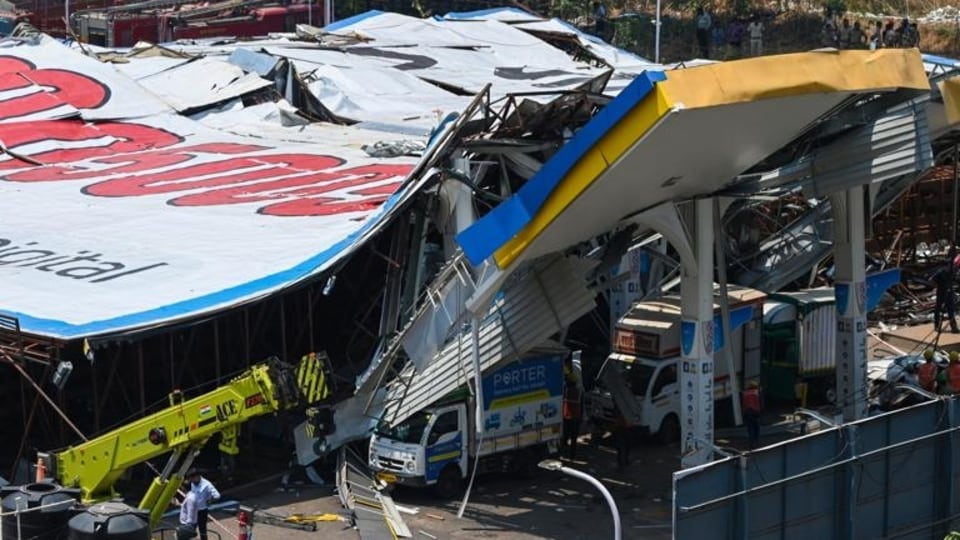
The owner of Ego Media Private Limited, the company that had erected the mega-sized hoarding, is on the run even as various agencies in the city scramble to apportion blame.
The man, Bhavesh Bhinde who contested the 2019 assembly election as an independent candidate, was earlier booked by Mulund police for poisoning several trees on the Eastern Express Highway so that the trees would not obstruct the view of the hoarding. Earlier this year, he entered this particular hoarding for Limca Book of Record as the largest billboard in India (17,040 sq.ft). In Mumbai, the maximum permissible size as mandated by the BMC is 40 by 40 feet. Ego Media’s Ghatkopar hoarding was 120 by 120 feet, thrice that. But in a city where showbiz and brand-visibility are a critical component of success, the bigger your bragging platform, the better. The Ghatkopar hoarding cost over ₹2 crore a month to rent and was the most profitable billboard in Ego Media’s portfolio. Mumbai, which has the lion’s share of the country’s ₹4700 crore outdoor media business according to a Ficci-EY report, is also host to number of illegal hoardings that compete with the forest of concrete skyscrapers. According to the owner of one of the outdoor media agencies who spoke off-the-record, the unorganised outdoor media business is an additional ₹4000 crore.
Following Monday’s tragedy, the BMC flagged 179 illegal billboards. All of these are GRP land which allows the operators to bypass BMC permissions.
Mumbai’s civic chief Bhushan Gagrani revealed the BMC had been pursuing the matter of the illegal hoarding at Ghatkopar with the GRP for nearly two years. On July 8, 2021, GRP (which comes under the home department of the concerned state or UT) wrote in response to BMC’s complaint—a copy of which is with HT-- that they did not need the civic body’s permission to let Ego Media erect the hoardings. By Tuesday evening, however, the remaining three billboards by Ego Media at Ghatkopar on GRP land had been brought down. Gagrani told the media that he had ask for all hoardings erected without BMC permissions to be dismantled.
Kiran Dighavkar, deputy municipal commissioner (special), told HT that there are two types of hoardings in Mumbai-- those where BMC issues permissions and others which stand on GRP premises and don’t need BMC permission as their land falls under the purview of the state’s home department. GRP issues the permission for these.
“The BMC has stated repeatedly that their stand is inappropriate, and regardless of the land, it is mandatory for anyone conducting business to seek permission from the BMC,” added Gagrani.
To be sure, it isn’t clear why two units of the same government -- BMC and GRP both come under the state government -- couldn’t sort things out.
Ravindra Shisve, commissioner of the GRP told HT that since they had got the BMC’s notice less that a week prior to the tragedy, they did not have sufficient time to resolve the issue of the hoarding’s legality.
BMC has issued permission for a total of 1025 hoardings while the GRP has issued permission for 179 hoardings where the BMC has no role, including the one that crashed. Two years ago, Dighavkar revealed, the BMC filed a case against GRP, seeking to exert control over the hoardings on their land but the Bombay High Court ruled against them. The matter remains on appeal in the Supreme Court. “If we are allowed to collect taxes, grant other permissions and issue structural stability certificates on railway premises, then all rules applicable for hoardings on other lands should also be applicable to those on railway land,” said Dighavkar.
Why this was crucial, he stressed, was because the BMC routinely checked for structural stability of the hoardings it gave permissions to, preventing possible disasters. In fact, the crash site revealed that the giant hoarding which crashed stood on a much smaller foundation than required by law.
“The hoarding was 120x120feet which is three times the prescribed size. In case when BMC issues permissions, there is a provision of submitting the structural stability report every two years. In this case, it was not applicable as it was on railway land,” said Dighavkar.
The GRP commissioner, for his part, said they had their own safety norms and in the this particular case, the department had begun an internal inquiry on the possible safety lapses.
“The base of the hoarding was without concrete and just filled up with mud and there should have been at least a 20- meter diagonal support to bolster it. That could have withstood Monday’s storm,” said senior architect Shirish Sukhatme, member of Practising Engineers, Architects and Town-Planners Association (PEATA) who visited the spot after the crash.
The Bombay High Court has frequently criticised the Maharashtra government, police, BMC, and other municipal bodies for their handling of the issue of illegal hoardings.
In 2017, the court instructed the Maharashtra government and municipal bodies to remove all illegal hoardings, but this directive was never fully implemented. Subsequently, HC initiated a contempt plea due to the lack of compliance with the 2017 order.
The court’s directive included provisions such as police protection for municipal officers tasked with removing illegal hoardings, nomination of senior police officers as nodal officers in various commissionerates to oversee enforcement, and the establishment of a toll-free number and SMS facility for citizens to report all violations.
During one of the hearings on the contempt plea in December 2023, the HC once again rebuked the Maharashtra government, stating that it had failed to effectively address the problem of illegal hoardings. The court emphasised that such hoardings not only mar the city’s appearance but also pose a safety hazard.
In February again this year, the HC issued strict directives regarding the proliferation of illegal hoardings across the city, during a hearing of a Public Interest Litigation (PIL) filed by Suswarajya Foundation, Satara. BMC informed the court that it had already removed a significant number of illegal hoardings, including 10,839 political hoardings and 4,551 commercial hoardings among a total of 32,481 unauthorized hoardings. Additionally, the BMC reported 410 instances of illegal hoardings to the police, resulting in 22 FIRs being registered.
But Bhinde’s monstrosity was allowed to stand because BMC had no control over it till Monday evening, when it no longer stood.