The Navi Mumbai International Airport Limited (NMIAL) that is developing Navi Mumbai International Airport (NMIA) has incorporated the Bombay Natural History Society’s (BNHS) suggestion to protect the water bodies in the interest of air safety.
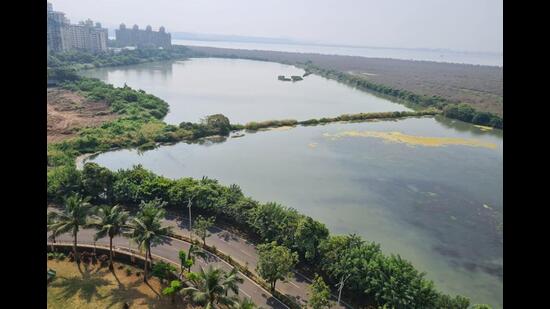
“Any changes in the current state of these areas (the wetlands) will result into more erratic movement of the birds in the landscape between feeding and roosting sites, which may jeopardise the air safety of NMIA,” NMIAL said in its Environment Impact Assessment (EIA) study, quoting BNHS, submitted to the Union Ministry of Environment, Forest and Climate Control.
Appreciating this, NatConnect Foundation director BN Kumar expressed the hope that the wetlands will be conserved, which has also been desired by the State Mangrove Foundation.
The EIA study, done by a Hyderabad-based lab, pointed out that BNHS “strictly suggests” that project proponent should protect and conserve the biologically-important habitats – Wetlands at NRI Complex, Delhi Public School, Training Ship Chanakya, Panje, Nhava Sheva Police Station and Jasai where large aggregation of birds are observed.
Sunil Agrawal of Save Navi Mumbai Environment Forum, who has been fighting a legal battle to save the twin wetlands of NRI and TS Chanakya, said the admission by the Adani-NMIA report is a positive development and “vindicates our stand” to save the biodiversity properties.
{{/usCountry}}Sunil Agrawal of Save Navi Mumbai Environment Forum, who has been fighting a legal battle to save the twin wetlands of NRI and TS Chanakya, said the admission by the Adani-NMIA report is a positive development and “vindicates our stand” to save the biodiversity properties.
{{/usCountry}}BNHS has been appointed by CIDCO to do the periodic baseline survey of avian fauna and quarterly as well as annual reports placed on the CIDCO website. CIDCO and BNHS have also signed a 10-year MOU (up to 2028) to track bird movements and advice regarding overall development of Navi Mumbai to ensure adequate habitats are maintained for the sustenance and growth of birds and do not endanger flight movements.
“The study indicates that there is a high probability of bird movement between the study sites and it appears that tidal height and water depth in temporary water pools created by local fishermen govern this movement. The movement of tidal-influenced birds is very high during high tide and they congregate at these sites to feed and rest. During our study, apart from tidal birds, there were large populations of non-tidal birds that moved less between the sites as they did not influence the tide, at NRI and Panje Funde,” the BNHS report as quoted in the EIA report said.
On a single day, the average maximum number of birds counted at all the sites listed by BNHS was about 10,860. Therefore, looking at this large number of birds and their local movements, NMIA authorities are advised that they should be cautious during high tide from December to February so as to avoid bird-hit calamities, BNHS said according to the EIA.
NMIAL submitted the EIA study as part of its application for fresh Environmental and CRZ Clearance for this project in lieu of expiry of the previous permissions in November last.
Stay updated with all the Breaking News and Latest News from Mumbai. Click here for comprehensive coverage of top Cities including Bengaluru, Delhi, Hyderabad, and more across India along with Stay informed on the latest happenings in World News.
Stay updated with all the Breaking News and Latest News from Mumbai. Click here for comprehensive coverage of top Cities including Bengaluru, Delhi, Hyderabad, and more across India along with Stay informed on the latest happenings in World News.