
 E-Paper



41 Maoists, including 32 with ₹1.19-crore bounty, surrender in Chhattisgarh’s Bijapur
With this surrender, a total of 790 Maoist cadres have given up arms in Bijapur district since January 2024

 Prefer HTon Google


Raipur: Forty-one Maoists — including 32 cadres carrying a collective bounty of ₹1.19 crore — surrendered before senior police officers in Chhattisgarh’s Bijapur district on Wednesday.
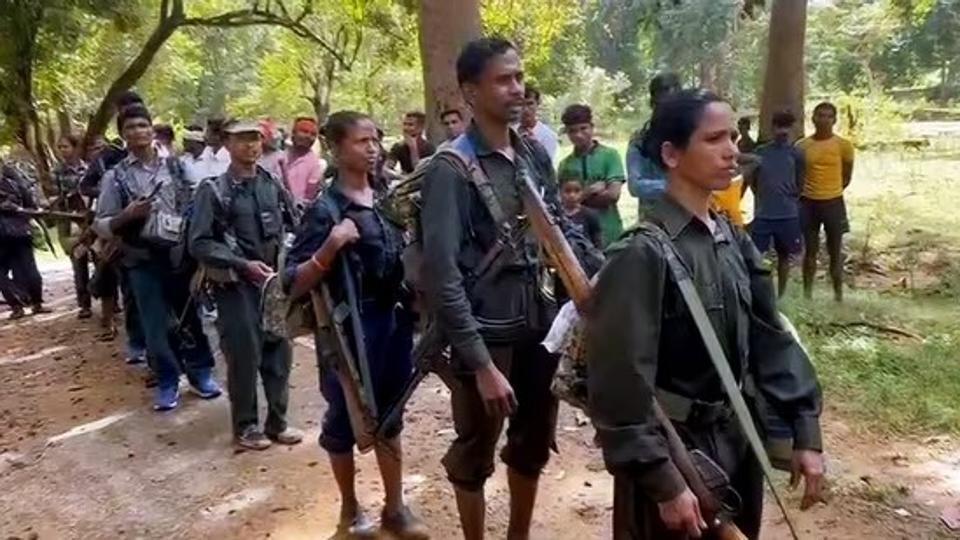
According to Bijapur Superintendent of Police (SP) Jitendra Kumar Yadav, the surrendered Maoists said they were influenced by the state government’s new surrender and rehabilitation policy and the Bastar police’s “Poona Margham” initiative aimed at social reintegration.
The police said that among the surrendering cadres were four members of the PLGA (People’s Liberation Guerrilla Army) Battalion Number 1 and various Maoist companies, three from area committees, 11 platoon and area committee party members, two PLGA members, four militia platoon commanders, one deputy commander, six militia platoon members, while the remaining were from frontal outfits of the outlawed CPI (Maoist).
Thirty-nine of the 41 cadres were from the South Sub-Zonal Bureau of the Maoists and were associated with the Dandakaranya Special Zonal Committee, Telangana State Committee, and the Dhamtari–Gariaband–Nuapada divisions, police officers said.
Among those who surrendered, Pandru Hapka alias Mohan (37), Bandi Hapka (35), Lakkhu Korsa (37), Badru Punem (35), Sukhram Hemla (27), Manjula Hemla (25), Mangali Madvi alias Shanti (29), Jairam Kadiyam (28), and Pando Madkam alias Chandni (35) carried a reward of ₹8 lakh each.
In addition, three cadres had a bounty of ₹5 lakh each, 12 cadres ₹2 lakh each, and eight cadres ₹1 lakh each.
Yadav appealed to those still active to abandon the path of violence. “Maoists should shed misleading and violent ideologies and return to society without fear. The Poona Margham drive ensures a secure, respectable and self-reliant future for those who surrender,” he said.
“The cadres expressed faith in the Constitution and pledged to lead a safe and dignified life within the democratic framework. Each of them received financial assistance of ₹50,000 under the rehabilitation policy,” he added.
With this surrender, a total of 790 Maoist cadres have given up arms in Bijapur district since January 2024. During the same period, 202 Maoists were killed in encounters and 1,031 cadres arrested in the district.
Across Chhattisgarh, more than 2,200 Maoists, including several senior leaders, have surrendered in the last 23 months, according to police.
-kW0H-U20214218012MgB-250x250%40HT-Web.jpg)


