E-Paper



As India eyes hosting rights for 2036 Olympics, Gujarat plans mega sports infra
The Sardar Vallabhbhai Patel Sports Enclave, currently under development in Motera, Ahmedabad, at a projected cost of ₹6,000 crore, is set to be a cornerstone of Gujarat’s bid to host major international events

 Prefer HTon Google


The Gujarat government plans to develop international level sporting infrastructure in Ahmedabad and Gandhinagar and has set up a special purpose vehicle, the Gujarat Olympic Planning and Infrastructure Development Corporation Limited (Golympic), to host major international sporting events.
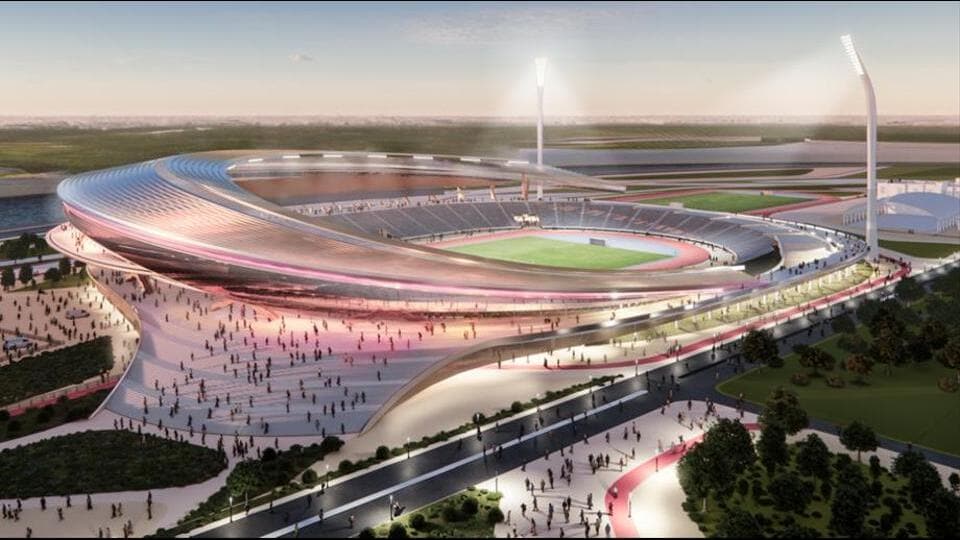
According to officials involved in the planning, the Sardar Vallabhbhai Patel (SVP) Sports Enclave, currently under development in Motera, Ahmedabad, at a projected cost of ₹6,000 crore, is set to be a cornerstone of Gujarat’s bid to host major international events.
“The 2036 Olympics will feature about 35-40 sporting events, including cricket, which will make its Olympic comeback after 128 years at the Los Angeles 2028 Games. The Sardar Vallabhbhai Patel Sports Enclave will house the Narendra Modi Stadium, the world’s largest cricket venue,” explained a senior official. “The Olympic selection process is now in a phase of ongoing dialogue. Following the initial informal discussions, we have entered a phase of continuous dialogue, which will soon transition into targeted discussions.”
India has advanced its quest to host the 2036 Summer Olympics and Paralympics Games by submitting a formal Letter of Intent to the International Olympic Committee’s (IOC) Future Host Commission on October 1. This letter formally expresses India’s commitment to hosting the Games and marks the beginning of a more structured process with the IOC.
The Karai Complex
The latest game-changer is a transformative project at the Gujarat Police Academy in Karai, Gandhinagar, which will convert 143 acres into a premier sports hub, featuring a state-of-the-art athletics stadium and multiple world-class facilities. This ambitious initiative will incorporate reclaimed land from the Sabarmati Riverfront Project, enhancing both the available space and aesthetic appeal of the area.
At the core of this ₹1,200-1,500 crore project lies a state-of-the-art athletics stadium, designed to seat 30,000 to 35,000 spectators. For larger international events, the stadium can expand to accommodate between 50,000 and 55,000 attendees through temporary seating arrangements, according to officials. This flexibility ensures preparedness for significant sporting events, with the stadium slated to host Rugby 7s and key football matches.
The facility will accommodate various athletics events including running, long jump, hurdles, and other track and field sports. Complementing the athletics stadium will be an indoor multipurpose arena featuring retractable seating, offering a versatile space for various events. The arena, designed to seat 5,000 to 6,000 spectators, will host weightlifting events among others, catering to a diverse array of sports and entertainment functions.
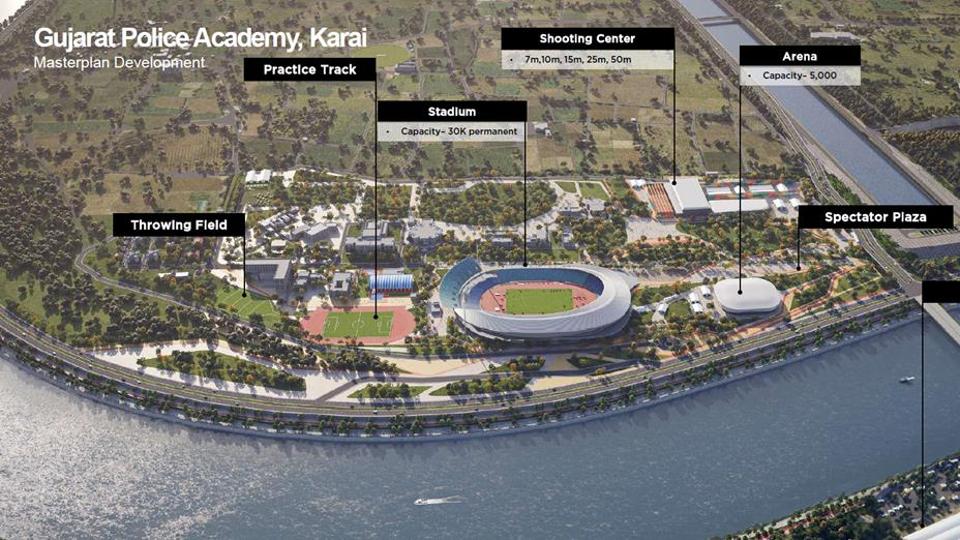
“The development will also include an integrated shooting centre, equipped to meet the needs of both amateur and professional shooters. This shooting centre will serve both large-scale sport events and legacy purposes at the Gujarat Police Academy Campus,” said an official.
The project, set to commence in 2025 with completion targeted for 2027, includes comprehensive roadworks to ensure efficient traffic flow and accessibility. Its masterplan has been designed by Australia’s Populous, world-renowned architects who have been associated with all Olympics Games since 1996 and are also master planners for SVP Sports Enclave, according to officials.
SVP Enclave, Naranpura Stadium and Other Sports Infrastructure
The Naranpura Sports Complex, another state-of-the-art sports facility under construction, has been built at a cost of ₹800 crore and is expected to open in January. “It’s going to be India’s largest multi-sport complex when opened next month,” revealed a senior official close to the development.
The complex features dedicated aquatics facilities, an Indoor Multisports Arena, Centre for Sports Excellence and Community Sports Centre with both mobile and fixed seating capacity. It is designed to accommodate sports such as aquatics, badminton, squash, table tennis, tennis, basketball and volleyball (Indoor).
The Sardar Vallabhbhai Patel Sports Enclave is being designed to host major international events. It will feature a combination of permanent and temporary venues to accommodate a wide range of sports including gymnastics, skateboarding, softball and tennis, officials said.
A village for athletes’ accommodation is being planned around the enclave, with land parcels already identified. At Sanskardham educational institute in Ahmedabad, infrastructure is being developed for combat sports, while a velodrome is under construction in Gandhinagar for cycling events. Officials indicate that the Mahatma Mandir Convention Centre at Gandhinagar will house an international broadcasting centre and main press centre for major international sport events.
All major sporting events will be held within a 30-kilometer radius, as per Olympic standards. The Gujarat government is also considering developing satellite venues in cities like Somnath, Statue of Unity and Shivrajpur to accommodate all Olympic sports, following modern Olympics practice. The Sabarmati Riverfront is being considered for rafting events, while other water and sea sports are planned for Somnath, Ekta Nagar near Statue of Unity, and Shivrajpur beach near Dwarka.
Advantage Gujarat?
While Prime Minister Narendra Modi formally announced India’ intent during the 141st International Olympic Committee (IOC) session in Mumbai in October 2023, Union home minister Amit Shah has voiced support for Gujarat’ bid, with his constituency Gandhinagar playing a central role in preparatory efforts. To be sure, the letter of intent by India does not mention any city for hosting the Games.
Ahmedabad’s historic significance is internationally recognised, with its walled city being India’s first UNESCO World Heritage Site. “This prestigious designation underscores the city’s unique blend of cultural heritage and modern development. The city’s infrastructure backbone is robust, highlighted by the Mumbai-Ahmedabad High-Speed Rail Corridor, India’s first bullet train project, which will be operational by 2028. This is complemented by an international airport, extensive road networks, and efficient intra-city transport through the Metro system and BRTS,” explained an official at the Ahmedabad Municipal Corporation.
Beyond transportation, Ahmedabad showcases exemplary urban planning with its smart city initiatives, sustainable development practices, and modern amenities. The city’s hospitality sector is well-developed, with numerous international hotels and a growing service industry.
The Ahmedabad Municipal Corporation (AMC) and the Gandhinagar civic body are aligning their development plans with the Olympic vision. Ahmedabad has revised its town planning schemes to include dedicated sports infrastructure and open spaces, while the 2024-25 draft budget focuses on crucial infrastructure upgrades including a comprehensive traffic master plan and enhanced utility systems.
Environmental sustainability is a key priority, with initiatives aimed at making the cities “net zero” through rainwater harvesting, improved transportation, and green waste management policies. Ahmedabad’s development plans also include iconic structures, such as a ₹350-crore barrage and bridge on the Sabarmati River, enhancing both connectivity and urban aesthetics.
The Bharatiya Janata Party (BJP)’s 2022 Gujarat Assembly election manifesto promised to establish a “Gujarat Olympics Mission,” aimed at creating world-class infrastructure to host the Games.
The state is planning to secure the 2028 U20 World Athletics Championship and is pursuing bids for the 2027 World Combat Games, 2029 World Police and Fire Games, 2030 Youth Olympic Games, and 2033 Asian Youth Games, said an official.
“There are several other countries contesting for the 2036 Olympics and the results would be known maybe one or two years down the line,” a senior official noted. “Even if Gujarat and Ahmedabad does not make it as the host city for 2036, the state government will continue its pursuit to develop world-class infrastructure. After all, it was the vision of the Prime Minister, who started the Khel Mahakhumbh in Gujarat in 2010, that the state must excel in sports.”