
 E-Paper



Between borders and blackboard: Myanmar refugee children fight to study in Mizoram
Andrew Lalremkima, principal of Neuhof School in Aizawl, told HT that he had admitted over 30 refugee children and faced several hurdles in teaching them.

 Prefer HTon Google


When John Mama was admitted to a government primary school in Mizoram, the first challenge was not the curriculum, but the language medium used in Indian schools. “On his first day at school, he just cried,” his class teacher said.
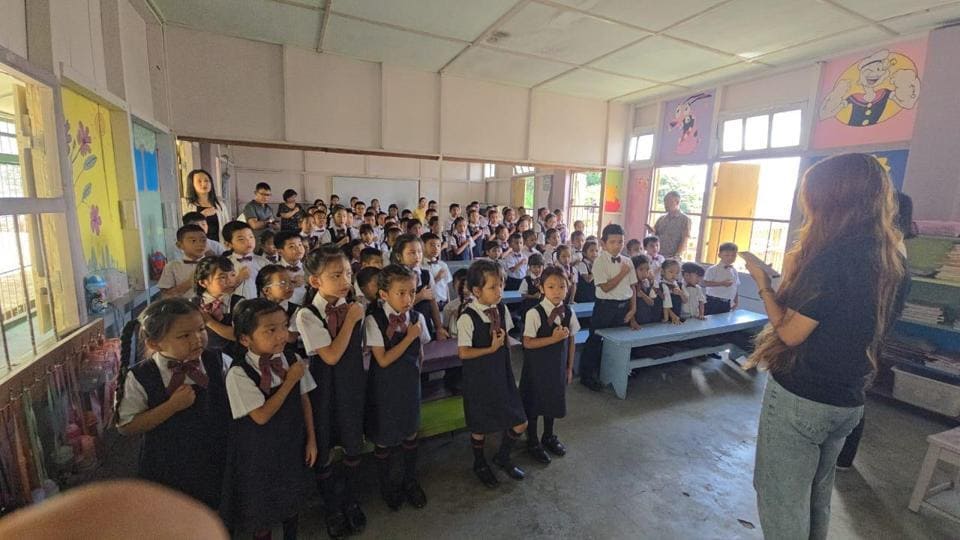
John and his family of five fled their hometown near Hakha Township of Myanmar’s Chin Hills in 2022. Unlike many who sought shelter in Mizoram, John and his family are Bamar and do not speak the ethnic dialect spoken by Chin tribes, which makes it even more difficult for him to adapt to his new environment.
John Mama, a name given by his class teacher, joined L Buana Memorial Primary School in the Chhinga Veng locality of Aizawl in 2023. He did not understand a word of what was being taught as the lessons were in Mizo and English, while he spoke only Burmese.
With extra effort at home and after attending remedial classes organised by his teachers, John Mama is now ranked ninth in his latest examination.
“We gave him a pseudonym — John Mama. He couldn’t write his Burmese name in the Roman script. He is a fast learner; he’s catching up on English and Mizo, which are the main mediums of teaching here at our school, and he excels in mathematics,” said his class teacher Mary Renthlei.
Since 2021, the Mizoram government has allowed children of refugee families to continue their education in government-run and private schools.
According to the Mizoram State Education Department, more than 7,000 refugee and internally displaced (IDP) children are currently enrolled in state-run schools. Behind the numbers, however, lie stories of overcrowded classrooms, language barriers, limited learning resources, and uncertain prospects for recognition of their education back in Myanmar.
According to Zonuna, a leader of the Network for Unity — an organisation working for the welfare of Chin refugees in Mizoram — very few refugee children have access to the full cycle of education, from pre-primary to secondary levels.
“We estimate that one-third of the refugee children don’t have the opportunity to go to schools, and it gets progressively more difficult to access education as they get older,” Zonuna said.
Under the Indian education system, every child needs a Permanent Education Number, which can be obtained only by bona fide citizens of India.
Andrew Lalremkima, principal of Neuhof School in Aizawl, told HT that he had admitted over 30 refugee children and faced several hurdles in teaching them.
“Even though we share the same ethnicity, some students are weak in English and do not speak the same dialect that is spoken here. The communication barrier has made it difficult to teach these children,” Andrew said.
“Integration of refugee education into the local system is quite technical. We are not trained for such a drastic change in teaching methods, and it demands humanitarian sensitivity while educating them,” he added.
Most of the refugee children come from the most neglected states in Myanmar, where education systems are weak and struggle to provide quality learning opportunities, Andrew said.
Mizoram opened its borders to Myanmarese refugees and has been providing them refuge from severe abuses since the fall of democracy in 2021. The state already shelters roughly 40,000 Chin refugees who fled clashes between pro-democracy resistance forces and the Myanmar Army.
“Over 7,000 children from Myanmar are currently receiving education in government schools across different parts of Mizoram. The government provides education on humanitarian grounds; our government does not discriminate against children based on nationality,” said Dr Vanlalthlana, Mizoram’s school education minister.
The minister added that his department had not received any additional funds for refugee children but had managed to handle the situation and ensure they received an equal share of government-provided educational benefits.
“Child refugees and migrant children are among the most vulnerable populations in humanitarian crises. The ZPM government is committed to ensuring protections grounded in the best interests of the child,” Vanlalthlana said.
However, despite the Mizoram government providing elementary education, parents and Chin refugee leaders remain apprehensive about their children’s future and prospects for higher education.
With hopes of returning home fading amid relentless military offensives, these young refugees now face another kind of battle — to continue their education.
While the Mizoram government has opened its schools to refugee children, it must also balance compassion with Indian policy constraints.
“The barriers that prevent them from accessing learning become harder to overcome as they grow older,” said Zonuna of Network for Unity, adding that it is mandatory for every student to have an Aadhaar number to sit for board exams such as Classes X and XII.
This means that the older a refugee child gets, the less likely they are to be enrolled in higher education.
Rosiama, who fled his hometown Kawlkulh Tahan in 2023, enrolled his two daughters at L Buana Memorial Primary School. Although he is content with the care his children receive, he remains worried.
“The teachers are giving them everything. I need not worry about their midday meals, but it’s their future that troubles me,” Rosiama said.
“We face the dilemma of uncertainty about whether their education will be recognised back in Myanmar,” he added.
Rosiama, father of two daughters — 9-year-old Esther Lalrinmawii and 7-year-old Ruthi Lalremruati — takes each day as it comes, but soon, the reality he fears may arrive.
They might not receive college certificates but will rely on the education imparted by their Indian teachers to face their future.
“We are refugees; we do not have the luxury of choice. But my prayer is that this education will provide knowledge and skills for independent, productive lives, fostering self-reliance,” Rosiama said.
Despite the Mizoram government’s assurances that no child will be discriminated against or denied education, financial constraints force many poor refugee families to prioritize survival.
“We already have a few dropouts. While some students adapt to the new curriculum, others often struggle to learn in a new language,” said Tlani Hmar, a teacher at Chhinga Veng Primary School.


