New Delhi
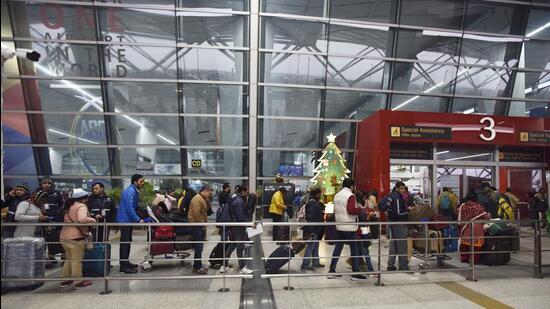
Full-body scanner trials will commence at the Indira Gandhi International (IGI) Airport in May, with two each to be deployed at Terminal 1 (T-1) and T-3, airport operator Delhi International Airport Limited said on Friday.
The trial will last for three to four months, officials said.
“The IT interface for these machines is being finalised, and upon completion of the three-to-four-month trial, a Bureau of Civil Aviation (BCAS) led committee will evaluate the findings and establish a Standard Operating Procedure (SoP) for full-scale implementation,” a DIAL spokesperson said on Friday.
DIAL said the scanners will use millimetre-wave technology and are aimed at enhancing security, while simultaneously ensuring passenger privacy.
“Unlike conventional X-ray scanners, they do not emit radiation, making them safe for all travellers, including pregnant women and individuals with medical implants. Importantly, these scanners are designed to expedite passenger movement, ensuring a more seamless airport experience with reduced wait times,” the spokesperson said.
The scanner will be able to detect both metallic and non-metallic threats, including explosives, significantly improving upon traditional metal detectors, the spokesperson said.
The technology is already in use at major international airports in the US, Canada and Australia. “With each scan taking just three seconds and a maximum throughput of 1,200 scans per hour, it can dramatically improve efficiency while minimising passenger inconvenience,” the spokesperson said.
{{/usCountry}}The technology is already in use at major international airports in the US, Canada and Australia. “With each scan taking just three seconds and a maximum throughput of 1,200 scans per hour, it can dramatically improve efficiency while minimising passenger inconvenience,” the spokesperson said.
{{/usCountry}}Body scanners were trialled at the Delhi airport in the past too, but there were flaws, with equipment unable to detect coins, blades, 9mm bullets and items placed five centimetres below the ankle or above the chin area. In one of the previous trials, equipment was unable to detect items if the passenger was wearing a saree.
Officials said the testing period allows agencies to assess the effectiveness of the scanner in detecting different types of items in a real setting. Subsequently, all suggestions and recommendations are shared with BCAS, which eventually decides whether the body scanner is implementable or not.
Videh Kumar Jaipuriar, CEO of DIAL, said the body scanners could be a “game changer” for security screening, by allowing for swifter checks without compromising privacy. “Our focus is on making air travel more convenient for passengers, and these trials, planned in accordance with government guidelines, will help us evaluate the system’s efficiency before a full-scale roll-out,” he said.