The mapping of the eco-sensitive zone (ESZ) around the Turtle Wildlife Sanctuary in the Ganga, spanning Prayagraj, Bhadohi and Mirzapur, has been completed, paving the way for a new conservation and management roadmap for the 30-km stretch.
The proposal to demarcate the ESZ with a 500-metre buffer from the riverbank has been recommended for submission to the state government for approval and further action, officials said.
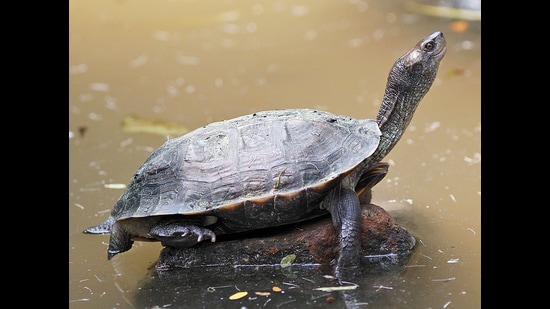
The sanctuary, notified in 2020 to conserve aquatic biodiversity in the Ganga, provides a habitat to several threatened turtle species, including the striped roofed turtle, black-spotted turtle, softshell turtle, red-crowned roofed turtle and brown roofed turtle.
Prayagraj divisional forest officer (DFO) Arvind Kumar said the mapping was carried out to strike a balance between conservation of aquatic wildlife and local development. “It will help identify the area around the sanctuary that needs protection to ensure turtle habitats and other aquatic species are not adversely affected,” he said.
The mapping exercise began in December 2025 and covered the sanctuary and surrounding areas across Prayagraj, Bhadohi and Mirzapur. The sanctuary area encompasses villages in all three districts, and surveys were conducted to identify the zone’s geographical and ecological features.
A recent meeting chaired by Prayagraj district magistrate Manish Kumar Verma reviewed the sanctuary’s geographical extent, ecology, and wildlife, along with Supreme Court directions issued from time to time and the concept of eco-sensitive zones.
{{/usCountry}}A recent meeting chaired by Prayagraj district magistrate Manish Kumar Verma reviewed the sanctuary’s geographical extent, ecology, and wildlife, along with Supreme Court directions issued from time to time and the concept of eco-sensitive zones.
{{/usCountry}}The DM said a delimitation proposal had been recommended for forwarding to the government for necessary approval and further action. The proposal envisages a 500-metre buffer from the Ganga riverbank, he added.
Once the ESZ is notified, the demarcation is expected to provide greater clarity on activities that may need to be prohibited, restricted or regulated around the sanctuary. These include large-scale mining, sand mining, setting up of polluting industrial units and certain construction activities. The regulation of hotels, resorts and plantations in sensitive areas may also be examined under the notified framework.
Officials said precise mapping would help identify riverbanks, erosion-prone areas, forests and wetlands requiring protection from pollution and unregulated human activity. It is also expected to reduce disputes and confusion over the extent of restrictions on construction, agriculture and basic infrastructure in areas surrounding the sanctuary.
Under the procedure for notifying an ESZ, the state forest department, in coordination with the district administration, prepares a proposal for demarcation. The proposal is examined by the National Board for Wildlife’s standing committee, which makes recommendations to the state government. The Union environment, forest and climate change ministry subsequently issues the final notification.
Turtles are considered important components of river ecosystems as they feed on dead animals, decaying organic matter and other biological waste. Their presence helps check the accumulation of organic material and supports the ecological health of river water.
Officials said the final notification of the ESZ would provide a clearer legal framework for protecting the sanctuary while allowing regulated development in areas where it is considered compatible with conservation.