The Western Command of the Indian Army has launched Humanitarian Assistance and Disaster Relief (HADR) operations flood relief and rescue operations across Jammu, Punjab, and Himachal Pradesh, demonstrating a swift and coordinated response to the recent floods.
The operations, which began on August 16, involved 47 army columns, including engineers, medical teams, and communication personnel, working in close collaboration with the civil authorities, the National Disaster Response Force (NDRF) and the State Disaster Response Force (SDRF). A total of 27 tonnes of relief material, including food, medicines and essential items, has been delivered to cut-off villages through both ground and aerial drops.
A round-the-clock flood control and water level monitoring cell has been established to oversee water levels at critical points like the Bhakra Nangal and Ranjit Sagar Dams, said the army. The operations are being conducted in close coordination with civil administration, NDRF, and SDRF. Lieutenant General Manoj Kumar Katiyar, Army Commander, Western Command informed that there is seamless coordination among all agencies.
The information was shared with the media by Major General Puneet Ahuja at the Western Command Headquarters in Chandimandir on Monday.
{{/usCountry}}The information was shared with the media by Major General Puneet Ahuja at the Western Command Headquarters in Chandimandir on Monday.
{{/usCountry}}Colonel Iqbal Singh Arora informed that 47 Army columns have been mobilised, comprising personnel from engineers, medical detachments, and communication teams. He said that a total of 20 aircraft, including advanced light helicopters and Chinooks, have been deployed for round-the-clock HADR missions. So far, more than 250 flying hours have been logged, leading to the rescue of more than 5,000 civilians and 300 paramilitary personnel.
In Punjab, districts like Gurdaspur, Amritsar, Firozpur, and Kapurthala are the most affected. The army is also working to restore fences washed away by the floods. On August 27, communication teams laid over 2 km of optical fibre cable to restore mobile connectivity. Two days later, army engineers constructed a Bailey Bridge over the Jammu Tawi river in just 12 hours, restoring a vital link to the city.
While the water levels at Pong Dam and Madhopur Barrage were at a danger level, the army stated that water flow at some crucial locations is now reducing. The meteorological department will provide further weather forecasts, but the operations are expected to continue for a few more days, they said.
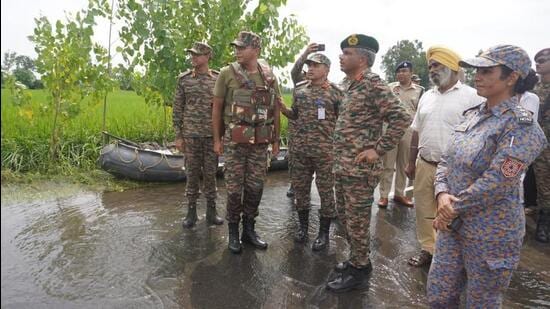
On August 30, Western Command Army Commander Lieutenant General Manoj Kumar Katiyar visited areas along the Ravi and Chenab rivers to review the ongoing efforts.