The deaths of three newborns in a fire at Amravati District Women’s Hospital on Monday have exposed a critical gap in Maharashtra’s government hospitals, where passing a fire audit or installing safety equipment does not necessarily mean effective disaster preparedness on the ground.
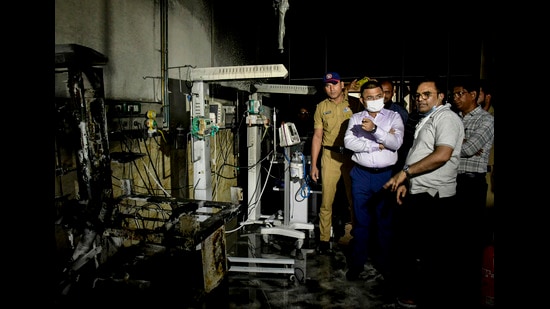
A fire broke out around 3.15 am on Monday in the neonatal unit on the third floor of the hospital, where 39 newborns were admitted. Thirty-six babies were rescued, while six critically affected infants were shifted to a nearby super-speciality hospital. Three newborns died. A ventilator is suspected to have triggered the fire, although the exact cause is yet to be established.
Amravati district collector Ashish Yerekar said the hospital was compliant with regular audits and had applied for a fresh audit with the public works department’s electrical wing.
“The fire audit for last year was conducted, and they have also applied for this year’s fire audit with the PWD electrical wing. I have seen the documents myself, so it is not the case that the fire audit was skipped. Fire audits have been conducted regularly,” Yerekar said.
The incident has now raised questions about the functioning and maintenance of fire alarms, sprinklers, extinguishers, electrical systems, and medical equipment in critical-care areas.
{{/usCountry}}The incident has now raised questions about the functioning and maintenance of fire alarms, sprinklers, extinguishers, electrical systems, and medical equipment in critical-care areas.
{{/usCountry}}The incident assumes significance against the backdrop of the state public health department’s latest fire-safety data.
A report dated August 13, a copy of which Hindustan Times exclusively accessed and reviewed, shows that 528 of 530 operational public health institutions had undergone fire audits. However, fire-safety system installation had been completed at only 442 institutions, and just 372 had obtained fire No-Objection Certificates (NOCs).
While fire audits have covered almost the entire government health network, 88 institutions still did not have completed fire-safety system installations, and 158 lacked fire NOCs.
The report shows that all 18 public health institutions listed under Amravati had undergone fire audits and completed fire-safety system installation, while 16 had obtained fire NOCs.
The figures also reveal sharp district-wise differences. In Pune, all 31 operational public health institutions had undergone fire audits and completed fire-safety system installation, but only four had obtained fire NOCs. The district conducted 52 mock drills in 2024.
In Beed, all 18 institutions had undergone fire audits, but none had completed fire-safety system installation or obtained a fire NOC. In Bhandara, nine of 10 institutions had completed installation and obtained NOCs.
Yerekar said the investigation would focus on the equipment suspected to have triggered the fire and whether there had been any administrative or maintenance lapse.
“Our main issue here is the equipment, specifically the unit that triggered the automatic alert, and we need to examine what fault lies within it. We have already initiated our investigation. If any administrative lapse comes to light, no one will be spared,” Yerekar said.
Health activists said Amravati deaths raise a larger question about what fire-safety compliance actually guarantees. “An audit can establish whether systems have been installed and whether a facility meets prescribed requirements at the time of inspection. It cannot, by itself, guarantee that a fire alarm, sprinkler, electrical system, medical device, or emergency response mechanism will function months later when an actual emergency occurs,” said Sharad Shetty, a health activist who has been a whistleblower in exposing the irregularities in the health department.
The incident has revived concerns raised after the Bhandara hospital tragedy in January 2021, when 10 newborns died in a fire at a Sick Newborn Care Unit. A government inquiry had identified a defective electrical circuit in the control panel of a radiant warmer as the probable cause. The tragedy prompted the state to order fire-safety audits and installation of firefighting systems across public healthcare facilities.
The Amravati hospital itself had reported a fire in the newborn intensive care unit of its old building about four years ago. A short circuit was suspected, while nurses on duty reportedly controlled the fire and rescued 22 babies.
Dr Sunita Golhiat, health department joint director (hospitals), said medical equipment is maintained and calibrated by manufacturers during the warranty period and by agencies appointed by the state government thereafter. Hospitals also have teams responsible for calibration.
Following the Bhandara tragedy, public healthcare facilities were directed to conduct fire audits and install firefighting systems. “Whether the fire alarm and the sprinklers started or did not start will be found after the investigation,” Golhiat said.
Hospitals are also expected to conduct mock drills every quarter. The state report records 1,723 mock drills across 530 institutions in 2024. If every institution had conducted the prescribed four drills during the year, the number would have been 2,120.
Chandrashekhar Bawankule, revenue minister and Amravati guardian minister, said the investigation would have to establish whether the firefighting equipment was properly maintained and why the sprinklers may not have operated.
“We need to check whether the fire extinguishers and fire cylinders were properly maintained. We also need to find out why the water sprinklers did not start or whether there was a maintenance lapse. Whether the system was installed properly or whether there were lapses in maintenance has to be checked,” Bawankule said.
Health minister Prakash Abitkar, who inspected the hospital, said the incident was particularly serious because the building was relatively new.
“Two years ago, this new hospital was started, and all modern facilities were made operational. Such an incident should not have happened,” Abitkar said.
The government has appointed a seven-member committee headed by health commissioner Sanjay Katkar to conduct a detailed inquiry and recommend measures to prevent such incidents. The committee has been asked to submit its report within eight days.
Abitkar said the government would also review fire-audit compliance in government and private hospitals and take up the issue with senior officials in Mumbai.
The government has announced an ex-gratia payment of ₹5 lakh for the families of the three newborns who died. The treatment expenses of the injured children will also be borne by the government.