The next municipal elections are coming up in early 2022. I look forward to the manifestos and different visions for our city that the main protagonists will come up with. We hope they will respond to the public’s urgent needs to heal from the Covid-19 impacts, and improve the city’s natural environment.
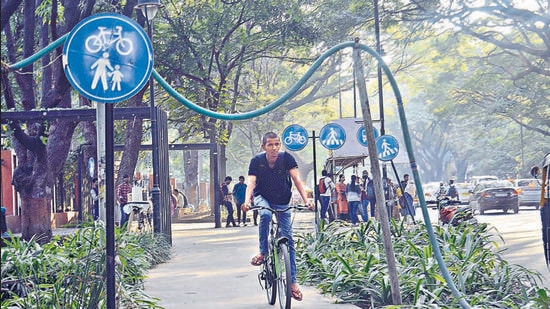
From the public’s point of view, surely, traffic and transport deserve to be an election issue.
As the city opens up, the same old congestion, air pollution and lack of road safety are returning, but we must do better.
We would do well to generate some report cards and expectations related to walking, cycling, shared transport and the public bus service, to feed into the election manifestos.
Let’s focus on the cycle first, which is the most elegant, clean, sustainable mobility mode, usable by most people. It is also highly appropriate in Covid-19 times to keep us healthy and to maintain safe distance.
The Cycle Plan
In December 2017, Pune became the first city in India to have a city-wide Comprehensive Bicycle Master Plan, passed by the General Body. Full marks for the plan. But, what marks should be given for implementation? It would be an achievement to be proud of at a global scale, provided Pune does comprehensive implementation!
NMT Cell
{{/usCountry}}NMT Cell
{{/usCountry}}The first provision of the Cycle Plan is that the city government should have adequate and dedicated staff to implement the plan. Initially, a Bicycle Department was created. After some months, the Road Department was awarded the responsibility of implementing the Cycle Plan through a Non-motorised Transport Cell. This is appropriate since cycling infrastructure has to be part of road design.
The expectation from the Road Department is that it will be a proactive lead agency to implement the cycle plan. It must coordinate with other departments and agencies like Traffic Police, PMPML and MahaMetro to ensure cycles are given space and connectivity with other mobility modes. For this, the Road Department must have adequate resources, including staff qualified in non-motorised transport planning and design.
Cycle infrastructure
The most critical provision in the Cycle Plan is the creation of a safe, connected, comfortable and attractive cycle-track network of over 800 km. However, over the last three-and-a-half years, only about 25km of cycle tracks have been made.
Over 800 cycle parking locations were also identified. The PMC and Traffic Police did well to put up signage for cycle parking. However, both cycle tracks and cycle parking need to be protected for cyclists’ use.
Monitoring and enforcement
Participatory monitoring and assessment of the cycle tracks is a provision in the Cycle Plan. Since the city government did not organise any participatory assessment, local NGO Save Pune Traffic Movement (SPTM) went ahead and conducted a survey.
SPTM’s study shows that in the early mornings, most cyclists prefer to use the road. Later in the day, as traffic increases, more cyclists use the cycle tracks at JM road, FC road, Ganeshkhind road and parts of Karve road.
One reason cyclists ride on the carriageway is the huge number of bollards placed on the cycle tracks to prevent motorised vehicles. The cure seems worse than the disease here!
Cyclists prefer that bollards be placed only at critical locations. Neither the municipal corporation nor the traffic police have implemented the Cycle Plan provision for cycle wardens and CCTVs to monitor cycle tracks and challan the offending motorcyclists.
Bicycle share
Public Bicycle Share system (PBS) is a term for a service that provides cycles to commuters without them having to own and maintain cycles. Often people mistake the Bicycle Share Scheme with the Cycle Plan.
The Cycle Plan made a policy provision for multiple options of how the PBS may be run – as a government-owned system, a partially-supported or privately-run system with government regulation. In all cases, the city government has to create an inviting and facilitating environment for PBS to operate.
In Pune, four private companies set up PBS services in 2017-18 with several thousand public bicycles. For a few months, it was a joy to see the yellow, green, orange and blue coloured public bicycles in many parts of the city.
Unfortunately, they vanished with equal speed. The PBS was run by private companies and no taxpayers funds were used in 2017-18. The PMC needs to revive the public bicycle share system in Pune, with a different model.
Ranjit Gadgil, from Parisar says, “The dockless system introduced by private companies gave Pune the experience of PBS. The downside is that they could and did pull out when the financials didn’t work out for them due to complex global financing. PBS has worked where cities themselves invested money and planning effort, such as Paris, London, New York etc. We can learn from the free pilot we got - what worked, what didn’t”.
Pune could be a cycling city again. Will our elected representatives give us a city-wide bicycle tracks network, cycle parking, public bicycle share and the required administrative, regulatory and public engagement mechanisms in place?
The election promise I would most like to see is, “We will make Pune a cycling-friendly city where cycling is safe, comfortable, convenient, attractive and enjoyable”.