
 E-Paper



Experts discuss fourth-year rollout under NEP at GIPE workshop
The Gokhale Institute and Shikshan Setu held a workshop on NEP 2020's fourth year, focusing on autonomous colleges and enhancing undergraduate education.

 Prefer HTon Google


The Gokhale Institute of Politics and Economics (GIPE), in collaboration with Shikshan Setu, organised a one-day workshop on April 28 focusing on implementation of the fourth year under the National Education Policy (NEP) 2020 with special emphasis on autonomous colleges. The workshop brought together academic leaders, principals, and administrators to deliberate on the structural, academic, and regulatory aspects of transitioning to four-year undergraduate programmes, including honours and research pathways.
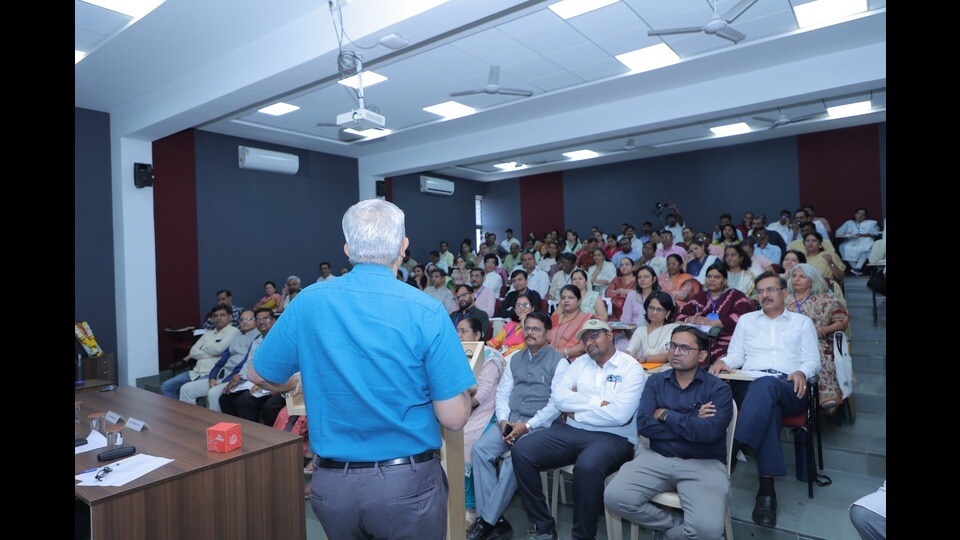
In the inaugural session, Krishna Bhanadalkar, founder of Shikshan Setu and senate member of the Savitribai Phule Pune University (SPPU), set the context by outlining the evolving framework of undergraduate education under the NEP and the need for a student-centric approach.
Delivering the keynote address, vice-chancellor (VC) of Mumbai University, R D Kulkarni, provided an overview of NEP implementation, highlighting the implications of the four-year undergraduate structure for autonomous institutions, particularly in terms of academic flexibility and institutional preparedness.
Nitin Karmalkar, former VC of the SPPU, stressed that “the fourth year must develop a distinct academic identity rather than mirroring postgraduate studies for the inclusion of research methodology, subject-specific depth, and socially relevant research, while also the importance of stronger academia–industry collaboration and the inclusion of professors of practice”.
Adding to the discussion, Arun Gaikwad, principal of Sangamner College, said, “Institutions with a strong work culture and clear operational guidelines would be better positioned to implement the fourth year effectively. There is a need for sensitisation among students, teachers, and institutions; and clarity in eligibility criteria, admission processes, examination patterns, intake capacity, and fee structures for honours and honours with research programmes.”
B N Kesur, dean of the faculty of humanities at M J College, Jalgaon, said, “Clarity in eligibility criteria, admission processes, examination patterns, intake capacity, and fee structures is essential to avoid ambiguity during implementation. The development of regional academic ecosystems is equally important, where resource-sharing and collaborative models can support institutions in semi-urban and rural areas.”
The workshop featured thematic panel discussions involving principals of autonomous colleges, IQAC coordinators, and controllers of examinations. Key issues discussed included institutional readiness for NEP implementation, administrative restructuring, infrastructure planning, and human resource requirements. Deliberations also covered regulatory alignment with UGC norms, governance challenges, quality assurance frameworks, and maintaining a balance between institutional autonomy and compliance.
Participants explored curriculum design for the fourth year, including structuring advanced coursework, integrating multidisciplinary approaches, and ensuring both academic rigour and flexibility. Discussions also addressed ground-level implementation challenges, expected student learning outcomes, and progression pathways.
A strong focus was placed on industry alignment and employability, with participants highlighting the importance of internships, skills development, and research relevance in meeting employer expectations. The fourth year was widely envisioned as a ‘finishing stage’ that prepares students for both higher education and the job market.
A tentative academic structure comprising research methodology, research projects, field practice, and major specialisation tracks was deliberated upon during the sessions.


