
 E-Paper



IUCAA develops indigenous PhotonSync tech for quantum communication
The development comes after 2025 was observed by UNESCO as the centenary year of quantum mechanics, marking a new phase for quantum science and technology worldwide.

 Prefer HTon Google


PUNE: City-based Inter-University Centre for Astronomy and Astrophysics (IUCAA) has developed an indigenous technology called ‘PhotonSync’ that can convert ordinary telecom optical fibres into ultra-stable quantum channels. The development comes after 2025 was observed by UNESCO as the centenary year of quantum mechanics, marking a new phase for quantum science and technology worldwide.
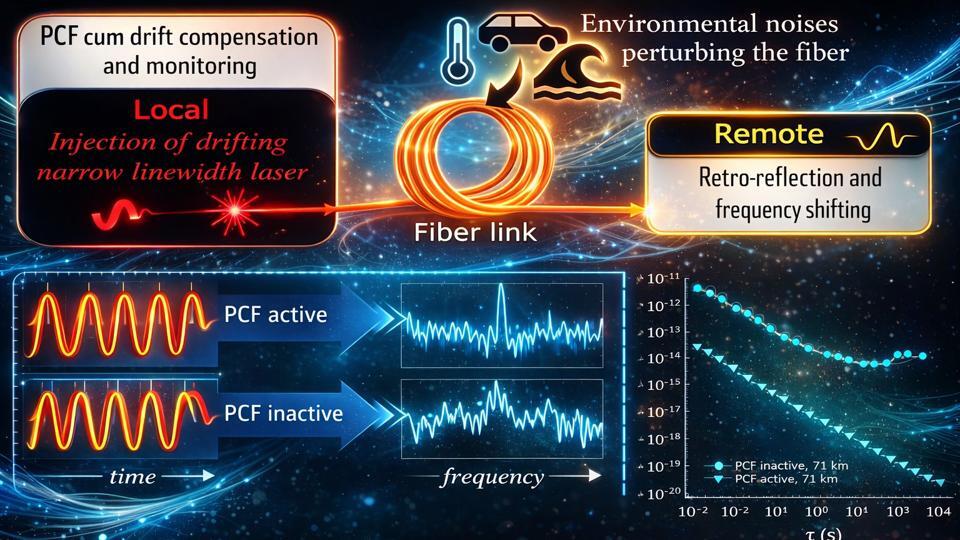
One of the biggest challenges in building quantum networks is that normal optical fibres are affected by temperature changes, vibrations, seismic activity and other environmental factors which add noise to photons travelling through these fibres, making it difficult to transmit quantum information accurately. PhotonSync creates a phase coherent fibre (PCF) link and actively stabilises the phase and frequency of light travelling through optical fibres, allowing photons to maintain their precise properties over long distances. PhotonSync makes it possible to transfer data using photons with extremely high accuracy. Compared to normal fibres, the PCF link achieves up to 47.5 dB reduction in phase noise.
The research results have been published in the journal, Communications Physics and PhotonSync has been granted a trademark. The system has been tested successfully on real field-deployed optical fibres up to 3.3 km and on fibre spools up to 71 km. As per a study carried out by researchers from Jaypee Institute of Information Technology (JIIT), PhotonSync can reduce the quantum bit error rate (QBER) by nearly 73 times compared to unstabilised fibres, making long-distance and secure quantum communication more practical.
Professor Subhadeep De said, “The PhotonSync is a core technology that is useful for carrying information and accurate synchronisation among precision sensors, quantum nodes, long-distance teleportation and many more. The phase stabilised optical fibres upon employing this technology therefore act like a quantum channel. Indigenisation of this technology is dedicated to the national effort towards Viksit Bharat.”
Professor Anirban Pathak from JIIT said that in today’s India, almost every citizen is a user of cryptography as they use different facilities like UPI for transactions and end-to-end encrypted messaging apps like WhatsApp. However, none of these schemes are unconditionally secure. Consequently, the Government of India has initiated programmes like the National Quantum Mission (NQM) with a target of building a fibre-based quantum communication network of about 2000 km. Quantum key distribution (QKD) can be carried out over 1000 km without trusted nodes if twin field QKD (TFQKD) can be implemented but TFQKD requires high quality phase stabilisation. This problem is addressed in the present work carried out by scientists from IUCAA and JIIT.


