The scene was usual. Rains for a short period of time resulted in heavy waterlogging at various areas of Pune on Sunday. The rain was brief, but intense. Roads were flooded, housing societies complained about water gushing into their premises. The Ambil Odha – a stream starting from Katraj lake – was overflowing. It brought memories of the dreaded September 2019 flash floods back as the tragedy completed three years.
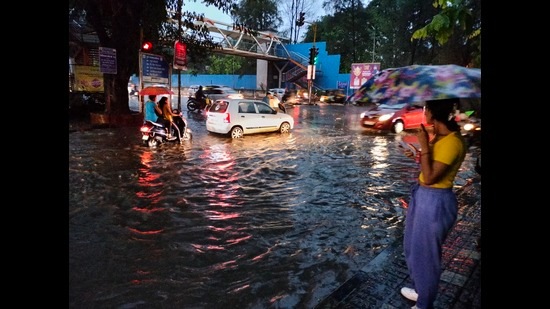
The residents, mostly from suburbs, were rather concerned about power cuts and chaos on streets.
Their Sunday evening, which many had reserved for outing after a heavy dose of annual immersion procession that took record 29 hours this time, was spoiled. Within two hours, Pashan recorded 55 mm rainfall while Magarpatta and Bibwewadi witnessed 91 mm and 86 mm rainfall respectively. The overall effect was rush of food delivery boys in front of restaurants to complete their orders as rains abated by evening. However, they were struggling to get out of places to reach destinations.
Although we did not see boats on roads or CEOs taking ride on tractors to reach offices, but the images from the streets drew resemblance to what we recently saw in Bengaluru when more than half the city was under water. The city was flooded by merely two hours of rain. And Pune, like Bengaluru, is not just any other city.
It’s the largest municipal corporation in terms of area and second most important city in the state with IT revenues next to Bengaluru and at par with Hyderabad. Its population has grown from less than half a million in 1950s to about seven million now if Pimpri-Chinchwad is to be included.
{{/usCountry}}It’s the largest municipal corporation in terms of area and second most important city in the state with IT revenues next to Bengaluru and at par with Hyderabad. Its population has grown from less than half a million in 1950s to about seven million now if Pimpri-Chinchwad is to be included.
{{/usCountry}}If the 2019 flash floods left a trail of death and destruction that was unprecedented, there were no lessons learnt. Even as much of the destruction three years ago had centered around the Ambil Odha, the natural stream that runs through localities such as Aryaneshwar, Parvati and Sahakarnagar, encroachments have largely remained untouched even in 2022.
The residents here have accepted the fact that the city doesn’t have a civilian airport. It’s mass transport - Metro rail – is taking time to expand. But do they not deserve better at least on their existing roads?
The roads – over 1,400 kilometres in length – are perennially dug up for one thing or an another. The long traffic jams are something citizens have accepted as part of their lives. To address the issue of traffic, ministers like Chandrakant Patil has suggestion of converting all of city’s streets from tar to concrete, something that increases the possibility of flooding every time there is intense rainfall, a phenomenon seen quite often in view of climate change.
To say that local administration, or civic authorities or politicians in power are solely to be blamed for the mess may not be right. To call Pune an orphaned city will also be an over statement even as it requires chief minister to stuck in traffic jam for authorities to wake up and start planning on reducing bottlenecks.
It’s a fact that Pune has largely been ignored by politicians in power (in top positions) since they did not have much of stakes here, as Shekhar Gupta has recently commented on state of affairs in big cities. The Pawars who controlled politics in Maharashtra and shared power for many years made Baramati an ideal town but Pune which is a few kilometres away, remained largely ignored.
Similarly, the BJP ruled the state between 2014 and 2019 and controlled PMC for five years till recently, but there was no qualitative change witnessed on ground expect that it brought some big projects in the city.
However, we have to also keep in mind that big cities like Pune have not been built in a way to handle as many people living in them today. Decentralisation or building smaller cities can be a way forward.