After the convoy of chief minister Eknath Shinde was stuck in traffic at Chandni chowk on August 26, civic authorities announced measures to decongest the chowk. The anger among residents over traffic issues is so high that Shinde, often looking for an opportunity to make populist announcements, visited Chandni chowk to review the situation and instructed officials to demolish the old bridge.
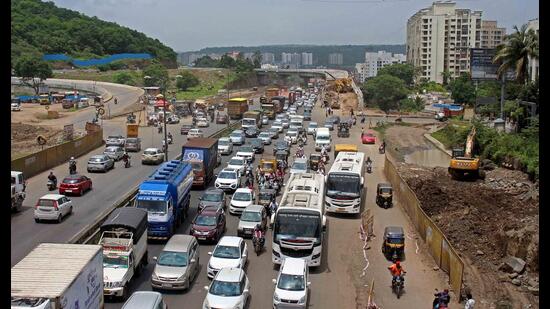
Punekars are not sure if these measures which include demolishing the old bridge, deploying 100 wardens and opening service lanes can offer any respite and reduce travel time, currently three times higher than regular time.
Known to be the most important gateway on the western part of the city, Chandni chowk is symptomatic of most other entry and exit points of Pune facing a similar problem. A large number of vehicles impatiently wait for hours to enter or exit from these points but bottlenecks block their movement. In Chandni chowk’s case, the National Highway Authority of India (NHAI) is building a flyover though delay in construction after the slow land acquisition process due to resistance from locals has complicated the issue.
The main problem is when traffic from Mumbai side and Kothrud reaches Chandni chowk, the nine lanes are reduced to three because of the flyover work, resulting in a bottleneck. The NHAI now plans to demolish the old bridge connecting NDA road to Bavdhan and Kothrud since the new one is coming up. However, the new flyover will take time and till that period, Punekars are likely to face more chaos.
{{/usCountry}}The main problem is when traffic from Mumbai side and Kothrud reaches Chandni chowk, the nine lanes are reduced to three because of the flyover work, resulting in a bottleneck. The NHAI now plans to demolish the old bridge connecting NDA road to Bavdhan and Kothrud since the new one is coming up. However, the new flyover will take time and till that period, Punekars are likely to face more chaos.
{{/usCountry}}The stretch is mostly used by those commuting to Hinjewadi IT park and Mumbai-bound traffic. Even as most restrictions related to working from office have been lifted after the Covid wave ebbed, some IT firms still prefer most of their employees to work from home, at least three days of the week. If these firms start calling their employees on regular basis, the problem is set to worsen.
The story is no different on other entry points, be it Wagholi on Ahmednagar road, Nashik phata in Pimpri-Chinchwad, Navale bridge on the southern part and Manjri on Solapur road. The picture looks similar to other big places like Delhi, Mumbai, and Bengaluru where long queues are seen on routes connecting cities.
In Pune, all these points have reduced to bottlenecks where long traffic jams are a regular affair.
The only solution that can offer partial respite is to enhance and expand public transport without any more delay. The state government along with the Pune Municipal Corporation (PMC) has already undertaken the Metro project but the snail’s pace with which it is moving is only adding woes in day to day lives of people with the construction of Metro lines blocking the road on the three lines which are underway.
London got Metro train in 1863; New York in 1904. In India, the Metro trains arrived first in Kolkata in 1985 and Delhi in 2002. In Pune, it took almost 20 years – from conceptualisation to execution - for this dream to become a reality earlier in March this year. Even as Pune missed the bus earlier and embarked on the Metro journey late, it is high time the work on other corridors is expedited and the Metro network is expanded to other areas so that it is utilised to its optimum. Otherwise, it will only remain a showpiece.
Coming back to Chandni chowk, the sooner the state and Centre approve the extension of Vanaz to Ramwadi line till Chandni chowk and the quicker Maharashtra Metro Rail Corporation Limited (Maha-Metro) executes the plan, there will be no relief. At the same time, there is a need to move ahead on other extension routes, including Warje, Khadakwasla, Hadapsar, Kharadi, and Wagholi for which Maha-Metro has already submitted a detailed project report (DPR) to the civic body.