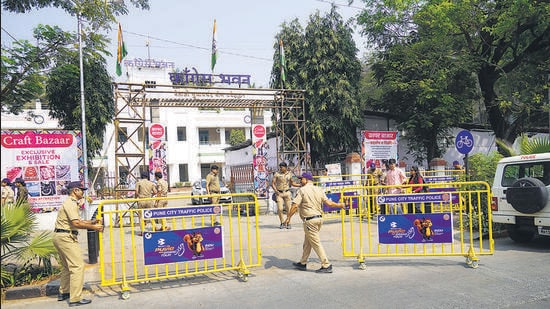
By evening on Sunday, the stretch outside Congress Bhavan in Shivajinagar looked familiar again—police vans parked, party workers loitering, and broken glass marking the end of a protest that began as a show of strength and slid quickly into violence. It was loud, televised, and it will likely be forgotten by the next news cycle.
That defines the characteristics of protests these days in Pune and rest of Maharashtra. They are getting louder, but thinner.
Street protests in this city once carried a sense of civic urgency. They were about water cuts, power shortages, unaffordable education, land acquisition, or the state of public transport. People marched not because they were told to, but because something in their daily life had gone wrong. Today, many protests appear detached from everyday concerns, driven more by political messaging than by public need.
Sunday’s clash outside Congress Bhavan fits into a pattern that has become hard to ignore. The optics are familiar: party flags, rehearsed slogans, social media clips uploaded within minutes, and blame game.
What is often missing is a clear outcome or even a clearly articulated demand that matters beyond party lines.
This is not new. In July 2024, BJP workers marched towards Congress Bhavan, protesting against statements made by Congress leaders. The situation was tense but police intervention prevented a clash. The protest came, slogans were raised, traffic was disrupted, and the city moved on. No civic issue was resolved, no public debate deepened.
{{/usCountry}}This is not new. In July 2024, BJP workers marched towards Congress Bhavan, protesting against statements made by Congress leaders. The situation was tense but police intervention prevented a clash. The protest came, slogans were raised, traffic was disrupted, and the city moved on. No civic issue was resolved, no public debate deepened.
{{/usCountry}}In April 2025, the BJP’s youth wing gathered near Balgandharva Chowk to protest against the Congress over the National Herald case. Again, the location was strategic—close to Congress Bhavan, visible, and symbolic. Yet for the average Punekar navigating potholes, erratic water supply, or rising property taxes, the protest meant little beyond a longer commute that day.
Go back further. In May 2022, party workers from the Bharatiya Janata Party and the Nationalist Congress Party clashed at the Balgandharva auditorium during a book release event attended by Union minister Smriti Irani. Members of the NCP women’s wing entered the auditorium to submit a memorandum; BJP workers objected, leading to a fracas. Allegations of assault followed, police stations were visited, statements were made. The city watched another political confrontation play out inside a cultural space meant for dialogue, not disruption.
What connects these episodes is not ideology or urgency, but choreography. The locations are predictable. The slogans are interchangeable. The anger appears instant, but shallow. Protests are no longer built over weeks of public mobilisation; they are assembled quickly, often around controversies that dominate television debates rather than neighbourhood conversations.
This shift has consequences. Pune’s citizens have grown weary of protests that block roads but do not address issues that affect daily life. When every protest looks like a rehearsal for the next election, people stop paying attention, often resulting into cynicism—a sense that protests are no longer tools of accountability, but instruments of political signalling.
Contrast this with the muted response to genuine civic distress. When footpaths disappear under encroachments, when flooding follows every spell of heavy rain, or when the Pune Municipal Corporation announces unpopular tax hikes, the streets remain largely quiet. There are press notes, social media outrage, and token morchas that fade quickly. Sustained, issue-based public mobilisation is rare.
Political parties will argue that protests are necessary to keep issues alive. But protests lose credibility when they are frequent, performative, and disconnected from public interest. Violence, like what unfolded on Sunday, further erodes whatever legitimacy remains. Once stones are thrown, the issue that triggered the protest becomes secondary. The spectacle takes over.
For a city that prides itself on being politically aware and civically engaged, this is a worrying trend. Pune does not lack issues worth protesting over. It lacks protests that are rooted in citizens’ lives rather than party scripts.
If protests continue to be reduced to noise without substance, citizens will retreat further into silence. And a city where people stop believing that the street can be a space for meaningful dissent is poorer for it—not just politically, but democratically.