
 E-Paper



Pune’s air quality deteriorates, cloudy weather to continue
On Sunday, the air quality worsened from moderate to poor levels and Shivajinagar, Bhosari, and Bhumkar Chowk areas experienced the highest air pollution in the city. An orange alert has been issued by SAFAR-IITM


The city’s air pollution level is deteriorating with both Particulate Matter (PM) 10 and Particulate Matter (PM) 2.5 levels higher than the standard limit decided by the Central Pollution Control Board (CPCB).
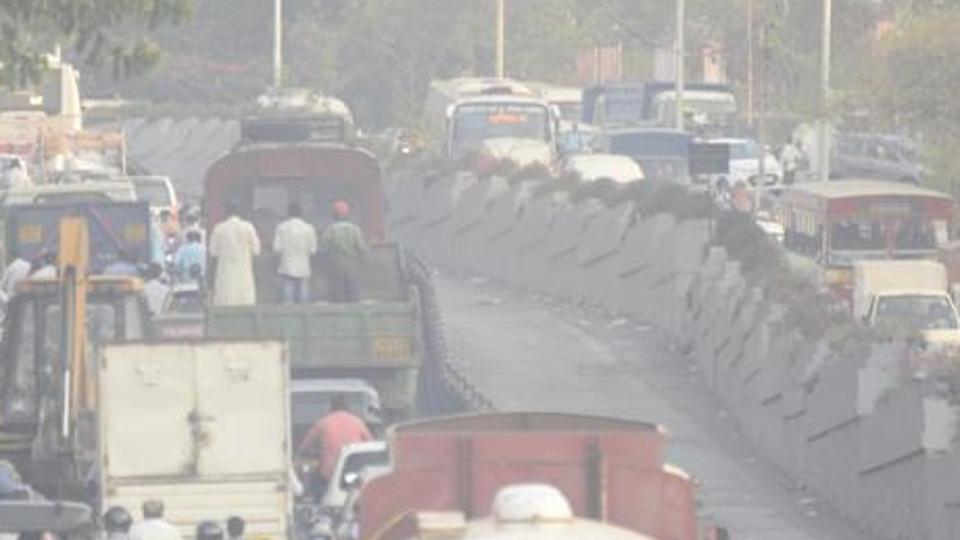
On Sunday, the air quality worsened from moderate to poor levels and Shivajinagar, Bhosari, and Bhumkar Chowk areas experienced the highest air pollution in the city. An orange alert has been issued by SAFAR-IITM.
The Air Quality Index (AQI) in the city was 180 at 6 pm, while the PM 10 was 146 and PM 2.5 was 91. On Saturday, the PM 10 level was at 142 while PM 2.5 was recorded as 88, respectively.
The PM 2.5 and PM 10 levels in Bhosari was 201 and 138 respectively, Bhumkar Chowk recorded 301 PM 2.5 and 170 PM 10 levels, while Shivajinagar recorded 301 and 153, PM 2.5 and PM 10 levels.
With the current weather conditions, where the sky is partly cloudy, the city is experiencing smog and haze.
Speaking on the current weather conditions, BS Murthy, project director, SAFAR, IITM, said, “In the absence of rain, the soil becomes dry and the dust on the ground gets lifted due to vehicular movement that causes a reduction in visibility. At the same time, this dust gets mixed up with vehicular emissions and converted into smog (smoke, dust and fog).”
The smog and haze conditions are harmful to the air quality in the atmosphere. It also hurts human health, if exposed for a long time, say experts.
As forecasted by scientists from the India Meteorological Department (IMD), “Partly cloudy sky and increased humidity are likely to continue this week, as a cyclonic circulation and a low-pressure system is expected to put an impact on the weather in South-Central Maharashtra. As a result, Pune will continue to experience cloudy weather in the upcoming days.”
Therefore, the air quality of the city will likely continue at a moderate level. There are chances of a slight reduction in the pollutants as the city will likely receive light rains around November 7 and 8.
Speaking about the air quality forecast for the Diwali period, the officials from SAFAR-IITM said, “It is too early to forecast the air quality for Diwali festival days as the current system can give forecast up to only three days. A clearer picture will be available in the next two or three days.”
Meanwhile, despite the constant increase in air pollution in Pune city, no constructive steps have been taken to mitigate the problem.
Nitin Shinde, sub-regional officer, MPCB, said, “The board provides time-to-time guidance to the Pune Municipal Corporation ( PMC), issued directives and also took regular follow-up on the implementation action plan under the National Clean Air Programme.”
“There is no area-specific mitigation plan for now, several long-term efforts are going on to mitigate the pollution issue in the city. Apart from this, the PMC is also planning to install water-based mist fountain systems at several locations, it will be installed soon,” said Mangesh Dighe, environment officer, PMC.
Vaishali Patkar, director, Climate Collective Pune Environmental Foundation, said, “The PMC should think about planting grass and plants that can observe the dust in the atmosphere. This easy, affordable, and sustainable solution can contribute significantly to air pollution reduction.”


