
 E-Paper



Refused to quit: A startup’s journey from idea to impact
Set up in 2018, Agrograde experimented with failures, disappointments, pivots and breakthroughs before being recognised as one of the top agritech startups in the country. Founders Kshitij and Rakesh share their journey.

 Prefer HTon Google


Pune: Every startup begins with a reckoning moment: a spark or a struggle. For Kshitij Thakur, it started with both.
The founder CEO of Agrograde said, “I didn’t start out thinking I would build a company. I just wanted to solve a problem that felt too personal to ignore.”
That problem was the quality of agricultural produce. Kshitij was working in industrial automation, where they build systems that use computer vision to identify defects on a manufacturing or assembly line. One of their clients in the food processing sector told them about the regular disputes between their procurement teams and suppliers regarding the quality of onions.
He said, “The quality standards of fresh produce are very subjective, and there were no tools or technologies to evaluate the quality. I was under the impression that these challenges would have already been solved since we see a lot of advanced machine videos on YouTube.”
Kshitij’s family grew mango and rice on a small farm in Dighode, Uran, near Navi Mumbai. They quit farming in 2009 as it became financially unsustainable because of rising labour costs and regular losses due to low prices and weather conditions affecting yields. He realised then that these problems were yet to be resolved. That was in 2018.
“I thought then that the technologies we develop for manufacturing can be used in agriculture to create a huge impact in terms of adding transparency to the supply chain and enabling fair price discovery,” Kshitij said.
Meeting co-founder
Around the same time, he met Rakesh Barai, an electronics and instrumentation engineer, at CIBA, a startup incubator in Navi Mumbai. Rakesh came with the experience of building sophisticated automation systems for a startup. While conversing, both realised their commonality: building sophisticated machines for industries that already had plenty of solutions. Agriculture, however, was the sector that actually needed this kind of technology and barely anyone was building for it.
Kshitij said, “We wanted to work on 0-to-1 problem statements where the industry had no existing solution and was desperately looking for a suitable technological solution. So, we started asking a simple question: Could you actually build a machine that grades quickly and accurately while still handling the produce gently enough not to damage it?
Starting point
That question was the starting point of Agrograde. Kshitij and Rakesh set it up together in Mumbai in October 2018.
“What followed was not a straight path to success, but a series of experiments, failures, pivots, and breakthroughs that slowly evolved into a full-fledged startup,” said Kshitij.
Both Kshitij and Rakesh knew that Indian crops have different challenges that do not seem obvious to an outsider. Kshitij said, “Our machines would have to be deployed in challenging conditions to handle high variations in input quality. This is why imported technologies fail miserably, as they were not designed for Indian crops and operating conditions.”
The duo built six prototypes and piloted four in the field before the commercial launch. Their machines were deployed at packhouses and mandis in Nashik, which drew a lot of encouraging inputs from the FPOs and exporters.
Kshitij said, “What works in lab conditions often fails in actual deployment conditions. We get a very heterogeneous quality of produce in mandis, and, hence, our machines had to be robust enough to handle these challenges. Every product design starts from the field - understanding the crop, challenges, expectations, and feasibility.”
No funds, no roadmap
Like many founders, their journey, too, began without funding, mentorship, or a clear roadmap. What was there in abundance was conviction.
“I remember working out of cramped spaces, juggling multiple responsibilities, and constantly questioning whether this would work,” Kshitij said. “In the early days, progress was measured in small wins - getting the first user, refining the first prototype, and hearing the first piece of honest feedback. Every step forward felt hard-earned.”
However, the idea evolved rapidly itself. What started as a rough concept soon became a structured solution, shaped by real-world testing and user input.
“We didn’t build in isolation. Every version of our product came from listening keenly to the people we wanted to serve,” Kshitij said.
Against all odds
However, they had to constantly battle challenges that kept popping up one after the other. From financial constraints to technical roadblocks, the team faced continuous pressure. So much so that there were moments when quitting seemed like the logical choice.
“There were days we had zero clarity and even less confidence,” Kshitij said. “But, what kept us going was the belief that the ‘problem’ mattered more than anything else.”
Agrograde operated in an environment where competition was growing and expectations were high. Without the luxury of large capital reserves, the team had to be resourceful to be successful.
“We learned to do more with less. Every mistake cost us, but it also taught us faster,” Kshitij said.
Resilience soon became a defining characteristic of the company’s culture. Every journey has a defining moment, the point where persistence begins to pay off.
“I still remember the first time we saw real traction. It wasn’t just numbers, it was validation. Users weren’t just trying the product; they were staying, engaging, and advocating for it. Word-of-mouth began to replace cold outreach. Growth, though still fragile, became organic,” Kshitij said. “That’s when we knew we weren’t just building ‘something’. We were building ‘something’ people actually needed.”
First product
Their first product was a mobile-based quality assessment app that enabled digital quality assaying remotely to solve the problems of subjective quality assessment and disputes between buyers and sellers. They deployed the app at multiple FPOs, collection centres, and packhouses near Nashik, Narayangaon and Mumbai.
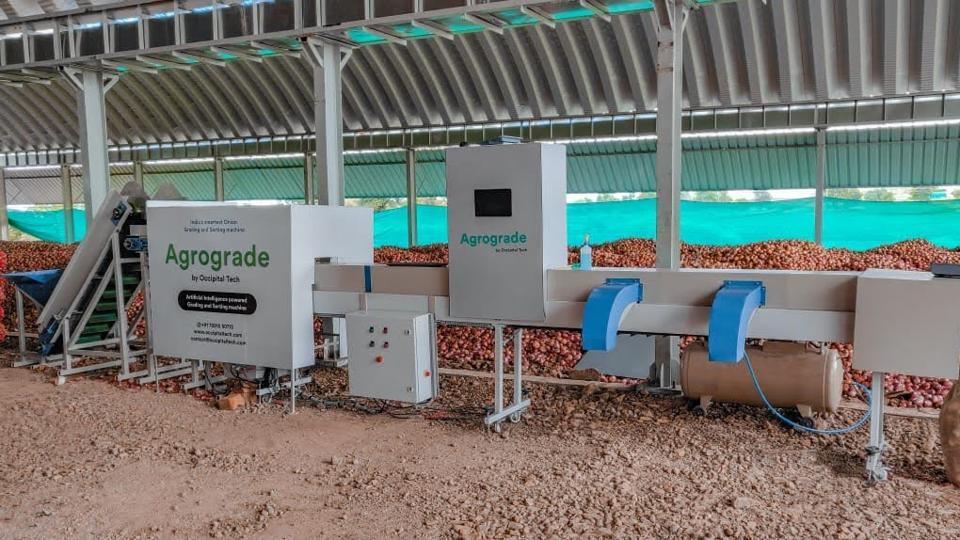
“Our first AI-powered onion grading and sorting machine was installed at Godadarna FPC in Nashik. It was the first AI-powered optical onion grading and sorting machine deployed in India,” Kshitij said.
Currently, their major challenge is scaling their manufacturing capacity. Their machines are designed and manufactured in-house, and, hence, it takes 2 to 3 months lead time for any new product.
Kshitij said, “We are trying to reduce the time. We are also trying to develop technologies in other crops and are looking for mechanical and robotics engineers to join our team to fast-track these developments.”
Scaling right
With traction came new challenges: scaling operations, hiring the right people, and maintaining product quality.
“The hardest part wasn’t starting, it was scaling up without losing what made us unique,” Kshitij said. “Everyone talks about scaling fast, but we focused on scaling right.”
This meant taking difficult decisions, prioritising long-term value over short-term gains, and sometimes saying “no” to opportunities that didn’t align with the core mission.
According to Kshitij, what made the path easier was his supportive team. “I was lucky to find people who didn’t just work for the company, they also believed in what we were building.”
The company culture evolved organically, rooted in transparency, accountability, and adaptability. “We encouraged questioning, experimentation, and even failure, as long as we learned from it. This approach helped the team stay agile in a constantly changing environment,” Kshitij said.
Lessons learned
Looking back, he now reflects on the lessons that defined the journey. “First, clarity comes from action, not overthinking; second, resilience matters more than brilliance; and third, your users will always teach you more than any strategy document,” Kshitij said.
Today, Agrograde stands as a testament to the team’s persistence and purpose. What began as a small idea has grown into a platform with meaningful impact. But, for Kshitij and Rakesh, there are still miles to go.
“We’re still learning, still evolving… If anything, this is just the beginning,” Kshitij said. “It’s easy to get distracted by growth, but we always remind ourselves why we started.”
And, that is why their story is compelling. A story that reflects not just the high points of entrepreneurship but also its uncomfortable side - the uncertainty amid the growth.
As Kshitij said, “I don’t think a startup is about having all the answers. It’s about being willing to keep going, even when you don’t want to.”
Sourcing funds
The resilience paid off. Agrograde has been recognised among Top 9 Agritech Startups by Mahindra Startup Leap, featured in NITI Aayog’s Compendium of 75 Agri Entrepreneurs and Innovators, and selected for the IGCC PHL Innovations Cohort.
It has also won the BigLeap and Social Alpha Quest for Agritech Innovations, received the Government of India’s RKVY-RAFTAAR Grant, and recognised among BSE’s Top 10 Impact Ventures and the Maharashtra State Innovation Society’s Top 100 Startups.
Today, Agrograde is supported by leading incubators, including IIMA Ventures, Villgro, Social Alpha, CIBA, IGKV and Chitkara Innovation.
It is part of initiatives such as the NVIDIA Inception Program, Bosch DNA Accelerator, NASSCOM 10,000 Startups, and the IAIN initiative backed by the Bill and Melinda Gates Foundation, Tata Trusts, and IIT Kanpur.
It has also filed a patent for its machine design.
As for funding, Kshitij revealed that they raised funds from angels and social impact investors for product development and pilot runs.
Looking ahead
Looking ahead, Kshitij said they want to make fresh produce packhouses completely autonomous and transparent.
“Imagine collection centres turning into mini mandis where everything - aggregation, quality checks, cleaning, grading, sorting, price discovery, and market linkage - happens under one roof. Right now, we are focusing on crops like onion, potato, and tomato. Soon, we will be venturing into leafy vegetables and spices,” Kshitij said, adding that they focus not on the losses they incur on the way, but on building on the lessons learnt.
After all, ‘building’ is their shared passion. It’s what they thrive for.


