Medieval times have mostly been violent. A series of invasions and battles which affected Pune in the 17th and early 18th century, however, ceased after the dawn of the Peshwa period.
The period between 1730 and 1760 was peaceful for Pune, with trade, commerce and development at its zenith. The battling centres moved to north and south India, where the Marathas sardars (commanders) conquered territories and expanded the boundaries of the Maratha confederacy.
Balaji Bajirao Peshwa, alias Nanasaheb, struck an alliance with the Mughal Emperor and offered his protection in exchange for Malwa.
An eminent danger loomed around the north-west frontiers of India in the form of Ahmedshah Durrani (Abdali), who launched several invasions since 1748.
In the midst of major political events, Maratha assistance was sought by the Mughals and the Marathas agreed to defeat external and internal aggressions against India by signing an agreement in 1752. The Mughal Emperor was reduced to a figurehead with substantial power in Maratha hands.
{{/usCountry}}In the midst of major political events, Maratha assistance was sought by the Mughals and the Marathas agreed to defeat external and internal aggressions against India by signing an agreement in 1752. The Mughal Emperor was reduced to a figurehead with substantial power in Maratha hands.
{{/usCountry}}Nanasaheb was appointed Governor of Ajmer and Agra and the Marathas were granted the rights to collect chauth (taxes) from various Northern provinces. However, the conquest of Lahore and Peshawar by Raghunathrao Peshwa (younger brother of Nanasaheb) led to a conflict between the Marathas and Ahmedshah. The advent of Marathas and power over Delhi was not received well by Delhi nobles and northern rulers and they invited Ahmadshah to check the growing Maratha power.
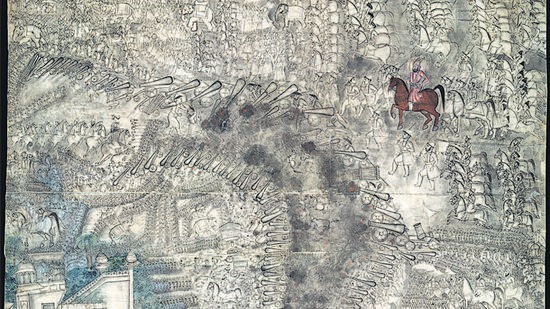
Ahmedshah launched a final invasion in 1759 to strike at the core of India, targeting the Marathas. Marathas launched a united front under Sadashivrao Bhau (son of Chimaji Appa and a cousin of Nanasaheb), along with the Holkars, Shindes, Gaikwads and Bundeles. Nanasaheb’s elder son, Vishwasrao, accompanied Sadashivrao Bhau to the battlefield.
Between 1759 and 1761, several skirmishes took place between the Maratha alliance and the Abdalis. As the final battle took place on battlefields of Panipat near Kurukshetra, the alliance saw fractures; Abdali allies built a solid front and diverted many local rulers to his side. In spite of great valour and bravery, the internal factions, superior artillery of Abdulshah and delay in reinforcements, the Marathas suffered a heavy defeat in the third battle of Panipat on January 14, 1761.
Abdali’s troops ransacked and butchered the Maratha camp and pillaged territories in the region.
Nanasaheb Peshwa who had begun marching to bring in reinforcements had failed to provide them on time. He received the terrible news of defeat at Panipat along with death of Sadashivrao Bhau, his beloved son Vishwas and several generals.
“Two pearls (Sadashivrao and Vishwas) were broken, 27 mohars (generals) were lost and there was no count of how many rupees (soldiers and other non-combating folks) were gone”, is how the loss has been described.
“1.25 lakh bangles were broken” (125,000 women were widowed) is how the loss has been cited.
“Panipat” became synonymous to “complete destruction”! Personal, political and military loss to Maratha power was incomprehensible!
Nanasaheb was heartbroken on hearing the dreadful news and dejectedly returned to Pune on June 4, 1761. Nanasaheb had taken ill. Yet, on returning, he commissioned his last major work for Pune’s development in the form of a bridge across the river Mutha.
Before this, there was only one low-lying causeway on the bund near Kumbharwada, which would submerge in the annual floods. It forms the main and only entrance to medieval Pune from across the river. Nanasaheb was insistent that the bridge be completed without delay and hence, it was decided that it should be built using timber. Choice of wood as building material gave the name to the bridge as “Lakdi Pul” and it has stuck even today, in spite of later renovations in stone and concrete.
Peshwa records inform us that Nanasaheb visited the site personally every day to oversee development.
As per one anecdote, the new bridge was built in haste to allow an alternative route for defeated troops returning from the battlefield and save the embarrassment of entering the city from the main entrance.
However we do not find any substantiating reference to this explanation. On the contrary, the new wooden bridge literally paved the way for the city’s growth and expansion.
When Lakdi pul degenerated due to floods over the years, collector Eastwood rebuilt it in stone in the 1840s, with crowd funding.
An ailing Nanasaheb Peshwa had become a recluse after Panipat and grieved at Parvati during his last days. On June 23, 1761, the definitive architect of glorious urban Pune, Nanasaheb Peshwa, breathed his last in one “Sahanechi kholi” on his beloved Parvati hill complex.
On June 24, 1961, his last rites were performed by his second son, Madhavrao Peshwa, on the banks of the river Mutha near Lakdi pul.
Peshwai paraphernalia was offered to 16-year old Madhavrao Peshwa over his uncle Raghunathrao Peshwa’s claim and Maratha power got a new Prime Minister. The series of catastrophes did not end for Pune yet, as ambitious Raghunathrao was turning defiant against Madhavrao. The Nizam of Hyderabad lurching after the loss of Panipat to benefit from weakened Maratha power started conspiring to attack Maratha territories.
Maratha sardars such as Janoji Bhosale of Nagpur and Gopalrao Patwardhan of Miraj had joined the Nizam.
Marathas, including Raghuanthrao, in the face of an anticipated attack, came together to salvage the scattered troops and rallied against the Nizam. Raghunathrao, along with Madhavrao, moved towards Miraj and later to Aurangabad. As the Nizam moved to attack them at Aurangabad, Marathas under Raghunathrao moved to Varhad and then to south towards Hyderabad via Paithan.
In order to beat the Marathas at their game, the Nizam turned towards Pune in three flanks and started pillaging territory from Nasik to Pune. A big sum of Khandani (compensation) was demanded by the Nizam’s troops as they pillaged Pune.
Peshwa record report severe loss and destruction by Nizam’s troops at Fort Lohagad and Rajmachi. Khandani was extracted at Chinchwad, Ravadi, Talegaon and Wafgaon by the Nizam’s sardars.
Gopalrao Patwardhan had joined the Nizam as he resented Raghunathrao. He, however, did not envisage the attack on Pune and the Peshwa family residing at Shaniwarwada. He warned Gopikabai Peshwa, wife of Nanasaheb about the forthcoming attack.
The Deshmukhs, Deshpandes of Pune and Gopikabai were issued a warning that Pune will be looted and plundered if the khandani demands are not met. Gopikabai refused to pay Khandani and informed the Nizam sardars to pursue matter with Madhavrao Peshwa.
Pune, then, was under the administration of Subhedar Naro Appaji Khire (Tulshibaugwale), who tried to salvage the situation by offering Rs1 lakh khandani to Janoji Bhosale and Yamaji Sakhdev.
In return, he requested that city of Pune be spared however, his request was not heeded.
Defenceless Pune without a proper army to protect it was looted by the Nizam’s sardars over days.
Most temples were raided, idols, Shivlinga were smashed. Parvati idols were broken. Sarkar wada and the dharmashala built to house 40,000 Brahmins during the Ramna ceremony were ransacked. The fire lit near Sardar Panse’s tofkhana (artillery) near present day Khadakmal Ali had spread till area near the Nagjhari stream. Mansions belonging to traders and noblemen were burned to the ground in Somwar and Mangalwar peth. The faraskhana of the Peshwas was looted. Pune burned for many days in April and May, 1763.
Marathas enraged by the act, clashed with Nizam’s troops at Rakshasbhuvan and served a smashing defeat to finally eradicate the threat.
Pune found its saviour in a young, but able Peshwa, Madhavrao I, who finally turned the tide for a long suffering Pune, as well as Maratha power. We shall trace the reign of Madhavrao Peshwa next.