Name “Nana Phadnis” evokes multiple reactions in Marathi cultural sphere especially due to his grey and multi-shaded character epitomised by popular Marathi Play: Ghashiram Kotwal. The play, not exactly based on the historical facts, highlights the hegemonic brahmanical power play and comments on hypocritical orthodoxy of Peshwa times. The real Nana Phadnis as reflected through the Peshwa period documents however makes for a different story. But, by no means a simple straightforward one!
Balaji Janardan Bhanu’s (Nana Phadnis) family originally belonged to village Velas in Raigad, from where his ancestors migrated to Desh, along with Balaji Vishwanath Bhat Peshwa to explore greener pastures. On insistence of Balaji Vishwanth, Phadnishi (financial accounting) was granted to Nana’s grandfather, Hari Mahadji Bhanu, and the occupation “Phadnis” soon was adopted as surname.
Balaji Janardan completed his education at Shaniwarwada in the company of Vishwasrao and Madhavrao I and received his “Phadnishi” robes at an early age of fourteen. His career began under Nanasaheb Peshwa whose vision for the urban city and public welfare works left a deep impression on the young Nana.
However, very soon, Nana Phadnis also participated in battle at Panipat only to return dejectedly after a crushing defeat. But, he resolved to work towards building the Maratha Empire through his constant support and assistance of Madhavrao Peshwa I. No wonder, within less than 12 years of Madhavrao’s administration. Marthas recaptured the lost territories in the north and also amassed significant revenue.
It was Nana Phadnis who acted wisely through disastrous events of murder of Narayanrao Peshwa and mitigated strategic loss of Maratha Empire by managing Raghunathrao’s travesty. It was Nana Phadnis who finally headed the Barbhai conspiracy to reinstate young Sawai Madhavrao Peshwa on Peshwa seat at Pune.
{{/usCountry}}It was Nana Phadnis who acted wisely through disastrous events of murder of Narayanrao Peshwa and mitigated strategic loss of Maratha Empire by managing Raghunathrao’s travesty. It was Nana Phadnis who finally headed the Barbhai conspiracy to reinstate young Sawai Madhavrao Peshwa on Peshwa seat at Pune.
{{/usCountry}}Out of three and a half wisemen (“Sade-teen Shahane”) within Maratha Empire, Nana Phadnis was named half for his lack of military abilities. He had suffered due to a damaging fall from falling of a horse at young age which rendered him weak of stature.
Nana Phadnis was not particularly known for his prowess on battlefield, but he more than made up for it through his shrewd politics, strategic diplomacy and meticulous administration. For the same reason his abilities were grudgingly admitted even by the enemies through epithets such as “Maratha Machiavelli” and “collected wisdom of all Empire”!
In spite of fall of many able ministers and commanders, Nana Phadnis proved to be the able statesman to hold the enemies of Maratha Empire at bay, be it Nizam of Hyderabad or East India Company.
Nana was known as “Navkot Nana” for he had accumulated great wealth through profitable investments. He owned various properties cross the state and was proud owner of valuable treasures. It was known that Nana had a stash of ready money at various places all across the state. It is for the same reason; Bajirao II hounded his youngest and only surviving wife, Jiubai. The young widow Jiubai, escaped Pune to move from Lohagad to Panvel to ultimately settle down at Phadnis wada at village Menavali near Wai and was guarded by 400 Arabs.
Nana built his residential mansion next to Shaniwarwada in 1780.
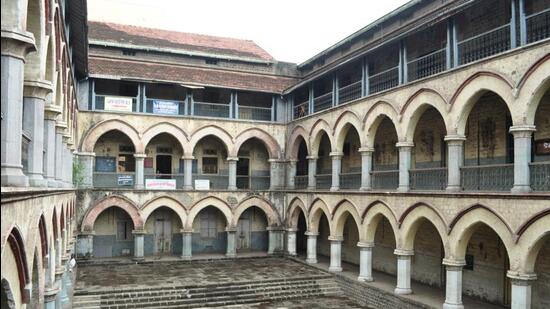
It was built in typical Maratha architectural style prevalent during later Peshwa period. The wooden pillars raised over stone platform formed the structure which was filled with book shaped bricks and partitions between modular “khunn”. The roof was slopping and there existed not less than two open courtyards. The façade is finely decorated with wooden elements but is plainer as compared to Vishrambaugwada.
New English School began operating in the wada around 1907. This was run by the Deccan Education Society (DES), which was founded by Gopal Ganesh Agarkar, Mahadev Ballal Namjoshi, Vaman Shivram Apte, VB Kelkar, MS Gole, and NK Dharap in 1884.
The first court, however, was rebuilt sometime during the British period and one sees an eclectic mix of two different architectural styles in two main courtyards. The first courtyard is bigger and has colonnades of arched pillars running all along the three sides. The exterior windows on the rooms of this court are typical Palladian windows with distinct semi-circular arched openings.
The second courtyard with fountain and overlooking the Meghdambaris (decorated dome shaped window) was slightly private in nature. It had a Basil plant Vrindavan and hence was named as “Tulshicha chowk” thus, served as a space for auspicious occasions, festivals and rituals. The hall above the entrance served as main reception hall completed with surudar khamb (cypress pillars), highly ornate ceiling panels and decorative niches in stucco along the walls. The wall facing the inside court is covered with exquisite painting which have not survived elsewhere except at entrance of Shaniwarwada. These quintessential Maratha paintings were drawn on red brick colour background with white line work. They mainly feature scenes from Mahabharata, Ramayana and Puranas such as Dashavatara.
Wada once housed the important state records of Nana Phadnis, including his personal financial records. Though, the most important records were burned by Nana himself (to save it from falling into wrong hands), remaining part of his archives were confiscated by Bajirao II.
The records further taken by British and after scrutiny by Inam commission, only part of the records was returned to be further distributed at Maratha museum at Deccan College, Bombay archives and Menavali Daftar at Manavali near Wai.
Few days back, an underground passage was discovered between Nana wada and Shaniwarwada when Pune Municipal Corporation undertook the digging of the road in between.
DES Society, later, sold the property to Pune Corporation in 1953. Nanawada suffered heavy damage when it was leased to various schools during this time. However, a decade back, Pune Municipal Corporation undertook restoration of Nanawada as and when funds were made available under various government schemes. Though the restoration efforts leave much to desire, Nanawada is slowly shedding its old skin to now house a freedom fighters’ museum which will showcase Pune’s contribution to freedom struggle.
There is more to Nana Phadnis’ contribution to Pune as well as to art and culture of 18th century which we shall explore in the next column.
Saili Palande-Datar is an indologist, environmentalist, history researcher and farmer. She can be reached @ sailikdatar@gmail.com