The railway in India helped Indians and Europeans travel much more extensively than they were accustomed to in the pre-railway era. It also brought forth several problems that the government needed to solve, the primary being that of the consumption of food during travel.
One of the first to demand Refreshment Rooms in India was William Walker, who, using the nom de plume Tom Cringle, wrote a letter in a Bombay newspaper on October 7, 1862, and asked railway companies to start hotels on or near railway stations. He complained that over the “whole range of stations, from Bombay, to Julgaum (Pls confirm the name), there was not a single place where a modest woman could go in to partake of refreshments or to enjoy any toilette convenience”.
Railway companies in India were cautious in entering the hotel business on their account because British railway companies were criticised in Britain for enlarging the scope of their business.
Refreshment Rooms were established after the late 1850s at most of the important Indian stations. These public spaces were reserved for Europeans, and a few decades later, separate Refreshment Rooms were built for Hindu and Muslim travellers at some railway stations. Information given in several travel guides published between 1865 and 1930 indicates that they were more popular in towns where conventional hotels and restaurants were few or non-existent.
The Refreshment Rooms were managed by the catering departments of the respective railway companies, which granted the operating and catering to firms like Kellner’s, Sorabjee’s, or Brandon’s.
{{/usCountry}}The Refreshment Rooms were managed by the catering departments of the respective railway companies, which granted the operating and catering to firms like Kellner’s, Sorabjee’s, or Brandon’s.
{{/usCountry}}In 1873, Lord Hobart, Governor of Madras, Lady Hobart, and Colonel and Mrs Silver visited Poona by train on their way back to Madras from Delhi. They were accompanied by His Excellency’s staff and Dr Michael Cudmore Furnell, his doctor. They alighted at Kirkee and visited the Governor’s House in Ganeshkhind. Furnell had expected it to be a sort of oriental palace, such as one read of in the Arabian Nights; a place of “barbaric splendour, gold and pearls and precious stones”.
From Ganeshkhind, it was a pleasant drive to the Poona Railway Station. Furnell was impressed by the “large handsome town with some fine buildings and many comfortable looking villas; a river running through it spanned by a substantial bridge; many bullock bandies, natives with good turbans and ample cloths wrapped round them”.
They reached the railway station in the evening, where they dined before proceeding on their journey. They were joined by Captain Hope, then in the Bombay Staff Corps, who came to see Lord and Lady Hobart. The dinner, according to Furnell, was a disaster with Hope’s presence the “only pleasant reminiscence of that wretched repast”. Furnell, in his travelogue, wrote in exasperation – “What a dinner! Kellner & Co, why have you deserted us?”
Kellner & Co were known in India and Europe for the excellent cuisine in the Railway Refreshment Rooms and dining cars managed by them.
Messrs GF Kellner & Co, Wine Merchants, Agents, and Proprietors of Railway Refreshment Rooms, was originally founded by George Ferdinand Kellner. The first Refreshment Room was opened by the firm in 1853 at Burdwan, and from then on, they gradually advanced as the railways opened up the country. By the early twentieth century, the refreshment rooms of the firm extended from Howrah to Simla in the North, to Jabalpore and Nagpur in the West, and Vizianagaram in the East. These rooms covered a mileage of over 4000 miles of railways and embraced the East Indian Railway, the Bengal-Nagpur Railway, the Delhi-Ambala-Kalka and Simla Railways.
The magnitude of the work undertaken and the staff employed to successfully carry on these Refreshment Rooms, over fifty in number, could be gathered from the following numbers in 1904: European staff, 45; native staff, 862. The consumption of the principal items of food for one month was also interesting reading; over 6500 lbs of beef, 6000 lbs of mutton, 27000 eggs, 15000 loaves of bread, 4400 seers of milk, 2500 fowls, 375 lbs of tea, 250 lbs of coffee, and 4000 lbs of sugar.
Besides the Refreshment Rooms, the firm was the pioneer of railway dining cars in India, having run the two dining cars between Howrah and Bombay, and vice versa, since October 1897. Flattering testimonials appearing in tourist guides and journals in the early twentieth century proved how well those were managed and how much appreciated by the travelling public.
Kellner’s Catering Department also served the camps of the Government of India, the Army, the Cavalry, the World and Indian Press, the Provincial Governments and those of the Maharajas of Kashmir, Indore, and Pudukottai during the 1911 Delhi Durbar. They were the Royal Calcutta Turf Club’s caterers for years.
According to a report published in a Bombay newspaper on 14 September 1925, several requests were put forth by Indian and European gentlemen to the railway authorities between 1885 and 1925 to grant Kellner’s the contract to manage other Refreshment Rooms in India as well, especially at Bombay and Poona.
The Refreshment Rooms at Bombay, Poona, and other stations on the GIP were managed by Brandon & Co. This firm was owned by Messrs Croft, Mody & Co, Merchants and Agents, and established in 1872. They exported bone meal and bone dust to Europe, America, Japan, Australia, and South Africa.
Apart from managing Refreshment Rooms, Brandon’s had also secured the contract in connection with the dining car service on the GIP and IM Railways in the early 1900s. According to “The Cyclopaedia of India” (1907), their catering became deservedly popular and was managed “most satisfactorily by the firm at great cost”. The members of the firms were Charles Brandon Boileau, Nusserwanji Jamsetji Mody, and Kekshushru Jamsetji Mody.
Poona had a waiting and a refreshment room built in the 1870s. I do not know who managed it till 1902 when Brandon & Co took over its management. The travel guides from those years rarely mentioned the Poona Refreshment Room and advised travellers to partake of their meals at the Napier Hotel. A hotel for Hindus was started in 1902 in front of the railway station.
At the turn of the twentieth century, the GIP was running services for Poona to special events of varying kinds: horse races, agricultural and poultry exhibitions, Easter, and Christmas holidays. Indians were learning to sweep aside their fear of pollution during rail travel. Demand for Hindu and Muslim Refreshment Rooms at Poona grew louder.
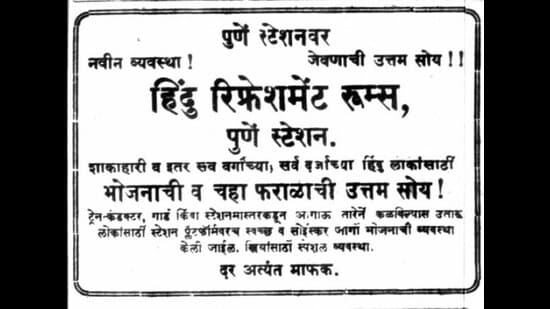
A Hindu Refreshment Room providing vegetarian meals was started on the Poona Railway Station in December 1927. It was open for Hindus of “all classes” and the passengers were required to inform either the station-master or the guard in advance if they wanted to avail the facilities. There was a separate section for women.
By the 1930s, Spencer & Co, originally based in Madras, had taken over Brandon’s of Bombay and Kellner’s and Sorabjee of Calcutta, along with several other big firms. It became the largest catering company in charge of Refreshment Rooms all over India, including Poona.
Imperialists and colonisers have often used technology as a tool to overwhelm and lure their subjects towards subjugation. In India, the railway served as a technological symbol of modernity. Firms like Kellner and Spencer made sure it was also known for its cuisine.