
 E-Paper



‘Testbed’ centres to study extreme weather events: MoES official
The three-day conference is organised jointly by MoES, IITM, the Abdus Salam International Centre for Theoretical Physics (ICTP), the Swedish Meteorological and Hydrological Institute (SMHI), and the World Climate Research Programme (WCRP)


Pune: To study extreme events and generate data required for forecasting models, the ministry of earth sciences (MoES) with the help of various atmospheric science research institutes in India has set up “testbed” centres to study extreme weather events.
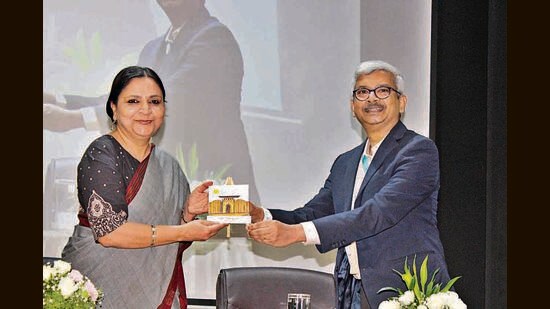
“Studying these events, collecting data, and incorporating it with models will help in extreme event forecast in the coming years,” said Kamaljit Ray, advisor, MoES.
The official interacted with the media during the ICRC-CORDEX 2023 inaugural conference (International Conference on Regional Climate-Coordinated Regional Climate Downscaling experiment) held at the Indian Institute of Tropical Meteorology (IITM) on Tuesday.
R Krishnan, director, IITM, and J Sanjay, project director, Centre for Climate Change Research (CCCR), IITM were present.
Ray said, “Heatwaves, lightning and floods have increased in the last few years. It’s important to focus on extreme event forecast that is happening because of climate change. These events mostly occurred on regional and sub-regional levels and there is a need for more studies to be carried out to enhance extreme event forecasting.”
She said various models are being experimented at IITM and other institutes.
“We have set up ‘testbed’ centres to study these events, including one at Bhopal (Madhya Pradesh) to study heatwave events and another at Balasore (Odisha) for thunderstorm occurrences. The data generated from these centres will help in model development,” Ray said.
Krishnan said, “We used multiple models to understand climatic changes, but the presents models will cover both past data and future forecast. We plan to use the IITM Earth global model (atmosphere grid size 27 km) to generate high-resolution forecast and the project is expected to be ready in two years. The facility will be a huge value addition for people working in agriculture, hydro projects, industries, and other sectors. Although there is a need for more resources like supercomputers, we are able to manage it with existing resources.”
The three-day conference is organised jointly by MoES, IITM, the Abdus Salam International Centre for Theoretical Physics (ICTP), the Swedish Meteorological and Hydrological Institute (SMHI), and the World Climate Research Programme (WCRP).


