Driving on the road through the southern sector of Corbett Park on the eve of Maha Shivaratri last week, I passed saffron clad Kanwariyas , some in groups, some alone, some striding purposefully, some trudging wearily, and one limping badly. They were on the last stage of their return journey from Haridwar. What, I wondered, could inspire millions of others to undergo such hardship? Was it genuine piety, was it exhibitionism, the desire to demonstrate piety, was it just following a fashion which has spread far and wide since the 1980s?
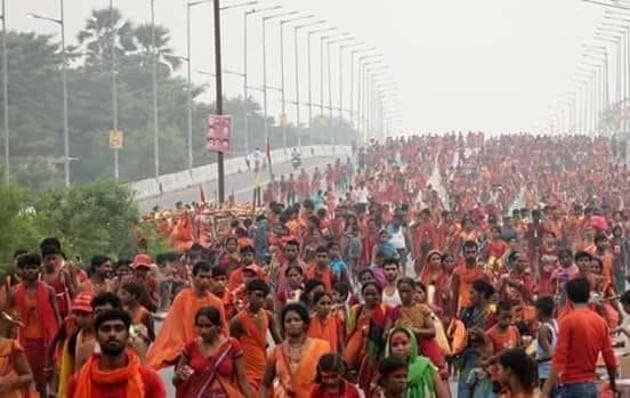
One Kanwariya told me he had walked 50 kilometres a day. He regarded the walk as a Tirtha Yatra, a pilgrimage. India has a very long history of pilgrimage to the Tirthas covering the country from Kanyakumari in the south to Amarnath in the north, from Dwarka in the west to Kamakhya in the east. According to the renowned Harvard scholar, Diana Eck, pilgrimage in India “reaches back many hundreds of years and brings us an astonishing picture of a land linked not by the power of kings and governments but by the footfall of pilgrims”. It is not just Hindus who go on pilgrimages in India. Going on the Hajj pilgrimage is one of the pillars of Islam and many Muslims also travel extensively in India visiting shrines like those of Hazrat Nizamuddin Aulia and Moinuddin Chishti. In Jhansi, the shrine of St Jude, the patron saint of lost causes attracts, Christian pilgrims, while Buddhist pilgrims from around the world come to India to visit the places where the Buddha was born and where he lived.
Surely, the Kanwariyas should be given a place among the millions of pious Hindus,Muslims, Christians and Buddhists who go on pilgrimages. But there are reasons for questioning that. Many see the Kanwariyas as unruly nuisances bringing traffic to a standstill and spreading chaos. Last year, Kanwariyas caused so much trouble that the Supreme Court stepped in, saying their riotous behaviour was creating a grave situation and telling the police to act against those “indulging in vandalism or taking the law into their own hands”. This year too there have already been cases of vandalism. In Muzaffarnagar, Kanwariyas trashed a car which had brushed one of them while passing. But is it right to deny Kanwariyas are pilgrims because some of them misbehave?
{{/usCountry}}Surely, the Kanwariyas should be given a place among the millions of pious Hindus,Muslims, Christians and Buddhists who go on pilgrimages. But there are reasons for questioning that. Many see the Kanwariyas as unruly nuisances bringing traffic to a standstill and spreading chaos. Last year, Kanwariyas caused so much trouble that the Supreme Court stepped in, saying their riotous behaviour was creating a grave situation and telling the police to act against those “indulging in vandalism or taking the law into their own hands”. This year too there have already been cases of vandalism. In Muzaffarnagar, Kanwariyas trashed a car which had brushed one of them while passing. But is it right to deny Kanwariyas are pilgrims because some of them misbehave?
{{/usCountry}}Kanwariyas are part of a marked increase in religious observance since the 1980s. The public manifestation of this trend is seen in the loud and lavish celebrations of an ever increasing number of festivals, ostentatious ceremonies to mark the passage of life. These are passed off as signs of religiosity. That is defined in the Oxford standard dictionary as morbidly religious. But to think of all Kanwariyas as suffering from morbidity is a sweeping condemnation favoured by those who see no good in religion.
The explosion in the number of people undertaking the Kanwar Yatra took place when the Ram Mandir issue was gathering momentum. Political and religious fervour came together, and there is no doubt that they still do. Nationalism has now been added to the mix. But it would be a misleading oversimplification to attribute the Kanwariyas’ motive to politics alone. They are pilgrims in the long line of pilgrims inspired by religious motives. Professor Vikash Singh of Montclair State University in America has walked with the Kanwariyas and just published a book analysing their motive, (Uprising of The Fools: Pilgrimage as Moral Protest In Contemporary India). In an interview with the website, scroll.in, he said, “Religion has always provided us with a way to give meaning to our, life, relations and suffering.” Explaining why so many people find that meaning in walking along the Kanwar road, he says it is because “they live in a society with desire propelled by the cantankerous bombardment of images of consumption from across the world but with very limited opportunities of gainful employment to satisfy any if their cravings.” So, professor Vikash Singh sees the Kanwar pilgrimage as a religious answer to the frustrations of modern India’s consumerist society, frustrations inevitably felt by many in any society where the market is God.
The views expressed are personal