Watching children play at a preschool opposite my house is a great stress-buster. The school operates from a single-storey bungalow and has no playground, slides or swings. But the children improvise. In the small cemented backyard, they play hide-and-seek, dodge ball, or just run around deliriously.
It won’t be long before life becomes a serious business for them. Most parents, who consider playing a waste of time, would send their kids to private tuition instead. Others would enrol their little ones in professional sports academies with the hope that they make successful careers out of the chosen game.
As life becomes increasingly structured, even play time is becoming more scheduled and target driven. Parents would rather have their child learn a competitive sport that earns her medals, a place in a top college, and eventually fame and money, than run around aimlessly.
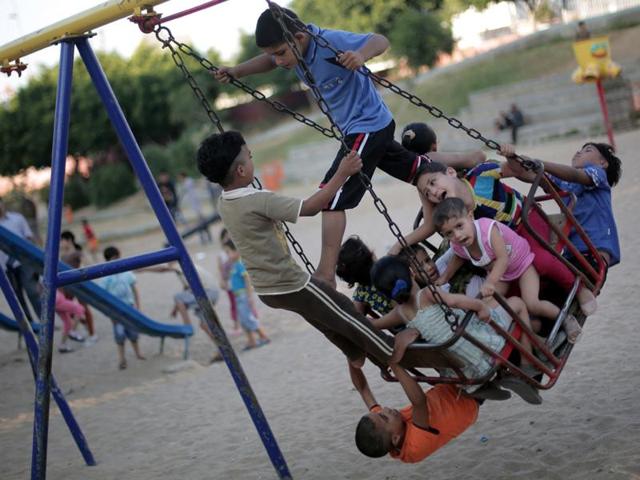
Play theorist Bob Hughes described free play as one that is “freely chosen, personally directed, and intrinsically motivated, that is, performed for no external goal or reward”. Free play does not come with a promise of medals or a great career. But it is essential to the cognitive, physical, social, and emotional well-being of children.
Two years back, researchers at the University of Colorado tracked daily schedules of seventy 6-7-year-olds and found that the more time these children spent in less-structured activities, the better their self-directed executive functioning. The opposite was true of structured activities, which predicted poorer self-directed executive functioning. Executive functioning is a set of cognitive skills that help you get things done. Regimented, result-driven activities are more like work than play, and we all know how Jack became a dull boy.
{{/usCountry}}Two years back, researchers at the University of Colorado tracked daily schedules of seventy 6-7-year-olds and found that the more time these children spent in less-structured activities, the better their self-directed executive functioning. The opposite was true of structured activities, which predicted poorer self-directed executive functioning. Executive functioning is a set of cognitive skills that help you get things done. Regimented, result-driven activities are more like work than play, and we all know how Jack became a dull boy.
{{/usCountry}}A 2010 study by Butterflies, a child right’s group, found that from the 4,000 municipal and private schools in Delhi, more than 500 did not have playgrounds and open spaces that were fit for children. The more recent fatalities in schools — a five-year-old falling into a septic pit in Kapashera and a six-year-old drowning in a water storage tank in Vasant Kunj last month, and an 11-year-old killed by a javelin in C R Park in 2013 — suggest that they have progressively turned into death traps.
Delhi has the highest child population in any metro in India. It also has 14,500 parks, gardens and green areas. But every third park is an ornamental garden, where playing is not allowed. Others have been taken away by encroachment, mostly to accommodate parking lots, garbage stations, power transformers or wedding events. That leaves out only 126 parks with some kind of facilities for children. Even there, tragedies such as a six-year-old girl’s death when a swing crashed on her in 2014 raise serious safety concerns.
The gated communities in Delhi and its suburbs offer facilities such as swimming pools, tennis courts, gymnasiums, and play areas set aside in their manicured lawns. But the access is limited to residents and those who can afford to pay the charges. In the un-gated neighbourhoods, children rarely venture out because of fear of heavy traffic and rising crime.
In 2012, the sports ministry started the come-and-play scheme to put to use stadiums that were renovated for the Commonwealth Games.
In December last year, the AAP government instructed schools to open up their playgrounds for local kids after the school hours. The space-starved residents supported the idea. But the project hasn’t taken off.
Opening schools and stadiums for public use alone would anyway not have compensated for the lack of playgrounds in the city. While these facilities would have benefited those interested in serious sporting activities, millions of children would still have needed safe open space to play as they like.
In a world strictly organised by adults, free play is the only opportunity we can give our children to develop their creativity, imagination, and physical and emotional strength. No amount of professional sports training or academics can compensate for that.
It is time parents, schools and the city authorities recognise that reality. Children don’t always need coaching. They also deserve opportunities to find, and be, themselves.