Captain Ben Stokes and bucking the all-rounder’s curse
Kicking off England Test captaincy against New Zealand, his country of birth, Ben Stokes must revive a listless team and prove that all-rounders do lead well
Four weeks ago, Ben Stokes checked into the Riverside Ground at Chester-le-Street in Durham to be announced as England’s new Test captain. Wearing a black-and-white jacket as he drove in on a chilly morning, he quickly changed into the England training kit before fulfilling a series of media commitments. He began by speaking to the England and Wales Cricket Board (ECB) while cameras followed him around for behind-the-scenes footage.
With Joe Root, the man he replaced as skipper, Stokes was England’s leading attraction given his all-round skills and flamboyant game. (Action Images via Reuters)
“This is my first day on the job. Apparently, I have got to do stuff like this now. So, you can follow me around while I speak to the media,” Stokes, gazing straight-faced into the camera, said.
The 30-year-old all-rounder will have all eyes trained on him from here on. With Joe Root, the man he replaced as skipper, Stokes was England’s leading attraction given his all-round skills and flamboyant game. The scrutiny will be all the more intense now.
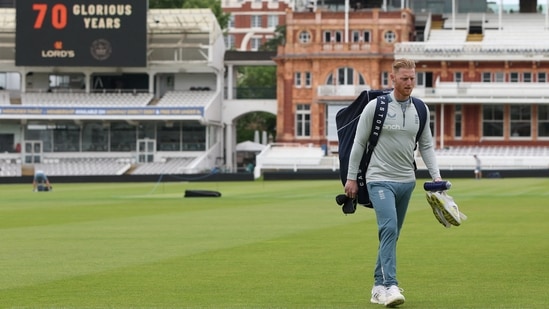
His first assignment as England Test captain starts on Thursday against New Zealand at Lord’s. He takes over a side that has won just one of its last 14 Tests. The Black Caps, on the other hand, are world champions in the format and won a two-Test series in England 1-0 just 12 months ago.
It’s a baptism of fire Stokes, 30, is not unfamiliar with. His Test career began in Australia in 2013-14 when left-arm pacer Mitchell Johnson was unleashing a barrage of bouncers and scything through the England line-up time and again. Stokes, just 22 then, showed the resolve to stand up to the snarling Aussies and carved out an excellent hundred in Perth, albeit in a losing cause.
He will have to show similar characteristics as a leader to pull England out of the current rut. Not one to shy away from a challenge, Stokes had no second thoughts about taking on the role.
“Did you have any hesitation?” former England fast bowler Steve Harmison recently asked him in an interview for talkSPORT. “None. I don’t think it’s a job you can ever turn down,” he replied.
While the lure of captaincy is impossible to overlook, great England all-rounders of the past did not find success as leaders. Stokes is often compared with Ian Botham and Andrew Flintoff, for swagger and similarity in playing styles—they are the only England cricketers with more than 3,500 runs and 150 wickets in Tests. But Stokes will hope he can fare better than the other two in the role.
Botham’s tenure as skipper lasted just over a year during which England lost four and drew eight of 12 Tests. His captaincy was brought to a quick closure after he bagged a pair in the second Ashes Test at Lord’s in 1981. He was too precious a player for England to let him be weighed down by the distractions of captaincy.
Botham resigned, and a remarkable turnaround followed. Free of the baggage of captaincy, Botham went on to achieve immortal status in English cricket with series-defining performances with bat and ball in what came to be known as Botham’s Ashes. England, down 0-1 after the first two Tests which Botham led, rallied to win 3-1, after Botham’s 199 runs and seven wickets marked the turnaround with England winning the third Test at Leeds.
Flintoff’s spell as captain—the tenure began in Nagpur in 2005 after Michael Vaughan’s knee injury on the eve of the Test—was equally wretched. It culminated in a 0-5 whitewash against Australia in the 2006/07 Ashes. He lost seven of the 11 Tests in charge while his own form nosedived. His Player-of-the-Series performance in the 2005 Ashes at home under Vaughan rapidly lost its lustre.
These instances just show how the pulls and pressures of captaincy can drag down even the most flamboyant of personalities. Stokes though isn’t worried about history repeating itself. “I’ve had to live with the tag of Andrew Flintoff and Sir Ian Botham since I was 18,” he told Sky Sports News. “But I’ve always maintained that I’ve never tried to be Flintoff or Botham. I’m Ben Stokes.”
Stokes’s mental well-being will also be brought up as he negotiates the responsibility of captaincy. He took a break from the game last August citing mental health issues and returned only in December, ahead of the Ashes. Instead of seeing it as a downside, he feels he is now better equipped to help others going through a similar low.
“There’s always a negative feeling around mental health,” he said. “But I took my break, went and spoke with people; I will continue to do that. I see it as a positive with me being in this role now. I’ve got a huge amount of experience in what the game and life can throw at you. I’ve always felt that I was someone that senior players and younger players could come and speak to.”
Eventually, Stokes would know that it will be the cold numbers and results that he will be judged on. Stuart Board has added an attractive mode of playing to that short list after none of the five days of the first Test at Lord’s against New Zealand were sold out.
Stokes has already been at the centre of some of England’s great cricketing moments over the last decade, the 2019 World Cup and the Ashes in England that followed being the biggest of them.
The New Zealand-born player’s career had almost derailed after a late night brawl in Bristol in 2017. He and Alex Hales were charged with affray and fined for bringing the game into disrepute, but escaped bigger punishment after a court hearing.
Stokes has since set his career on the right path. Rescuing a struggling England will turn the rebel into a true leader.
Vivek Krishnan is a sports journalist who enjoys covering cricket and football among other disciplines. He wanted to be a cricketer himself but has gladly settled for watching and writing on different sports.Read More


 Live Score
 Cricket Teams
 Cricket Players