The Sano International Cricket Ground has been given a proper makeover. Temporary seating has been erected to accommodate a large number of fans expected, VIP enclosures have been built and ticket gates have been installed at the venue.
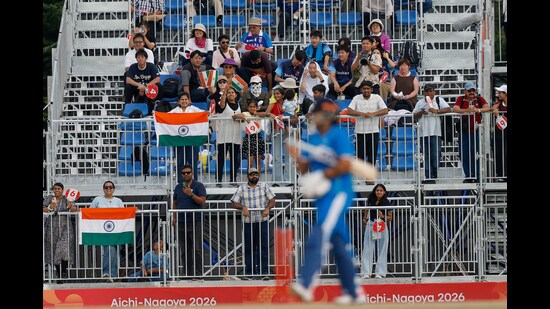
The purpose of this rapid transformation is the historic T20I between hosts Japan and reigning T20 world champions India, for the Suzuki Cup, on Tuesday.
“The boys are excited. This kind of opportunity doesn’t come around very often,” Japan Cricket Association (JCA) Chief Operating Officer Alan Curr told select media over a call from Sano.
Deep Dive
How is Japan preparing to host a T20I match against India?
Why is hosting a T20I against India significant for Japanese cricket?
What are Japan's long-term cricket ambitions beyond the T20I match with India?
For JCA, it’s a monumental undertaking. A small, dedicated team has been working round the clock doing everything from pulling pitch covers and setting up tents to coordinating security protocols with a UK-based consultant who has managed World Cups and The Hundred.
The journey to hosting global cricket’s powerhouse began 18 months ago. While relaying the turf square at Sano, the JCA sourced local clay identical to the material used for the newly built cricketing facilities in Nagoya, the host city for the ongoing Asian Games.
This move allowed Sano to present itself as a training hub for International Cricket Council’s (ICC) Full Member nations looking for facilities to prepare before heading to Nagoya. The proposal caught the attention of Board of Control for Cricket in India (BCCI) in June, leading to rapid and fruitful discussions.
{{/usCountry}}This move allowed Sano to present itself as a training hub for International Cricket Council’s (ICC) Full Member nations looking for facilities to prepare before heading to Nagoya. The proposal caught the attention of Board of Control for Cricket in India (BCCI) in June, leading to rapid and fruitful discussions.
{{/usCountry}}Playing the No.2 ranked team in the world is guaranteed to pique local curiosity, but Curr is realistic about cricket’s current footprint in baseball-mad Japan.
Over the last dozen years, the sport has experienced a quiet but robust expansion. Registered players have nearly tripled, growing from 3,000 to 8,800. Domestic tournaments have mirrored this explosion. The Japan Cup, a regional T20 competition, has expanded from a dozen teams in 2014 to over 80 today.
Despite this grassroots momentum, penetrating the mainstream Japanese sporting consciousness remains an uphill battle. A primary obstacle is Japan’s entrenched Bhukatsu school system, which demands early, year-round specialisation in a single sport from the age of 12.
With only a handful of schools currently offering cricket as a Bhukatsu, the sport relies heavily on the visibility afforded by multi-sport events and corporate backing such as JCA’s recent partnership with major Japanese sports brand Mizuno.
“The Asian Games is something that is entrenched in the Japanese sports psyche,” Curr said in a call facilitated by FanCode, which will broadcast the India versus Japan clash on Tuesday.
“Cricket being in these sporting events gives the sport legitimacy that it didn’t have before. For any kid growing up wanting to follow in the footsteps of their heroes, they need that opportunity to see them.”
Even on the fringes, the Japanese national team has shown marked improvement on the pitch, recently securing victories over established Associate sides like Papua New Guinea, Bahrain, and Kuwait.
This upward trajectory is fuelled by two distinct developments. First, affiliation with the Japanese Olympic Committee (JOC) has unlocked crucial human resources, including strength and conditioning coaches and analysts. Furthermore, joining the Asian Cricket Council (ACC) in 2023 has provided a consistent, competitive 12-month calendar, replacing years of sporadic international fixtures.
Second is the vital infusion of overseas talent. Following Japan’s maiden U-19 World Cup appearance in 2020, there has been a surge of mixed-race players with Japanese heritage, raised in traditional cricketing strongholds like Australia, England and New Zealand, reaching out to represent the country.
“They are reconnecting with their Japanese heritage through cricket,” said Curr, emphasising that these players bring an ingrained cricketing knowledge that when combined with local discipline, elevates the entire squad’s standard.
Looking beyond Tuesday’s clash and the subsequent Asian Games campaigns for the men’s and women’s teams, Japan’s ambitions remain sky high. The immediate focus will shift to the East Asia Pacific (EAP) regional finals next year, the first step towards qualifying for the 2027 T20 World Cup.
The JCA hasn’t shied away from its ambitions, especially after narrowly missing the previous tournament due to a structural qualification reshuffle. “We’re ambitious and we want to keep trying to strive for the heights that we believe we can get to,” he said.
However, before looking to 2027, Japan must survive Tuesday, and the weather. A typhoon looming south of the country threatens to wash out the Suzuki Cup. With the Japanese squad scheduled to board a bus for a seven-hour overnight journey to Nagoya immediately after the match to play a 9am Asian Games fixture, there is zero flexibility for a reserve day. “Right now, a success would be getting a game on,” admits Curr with a smile.
But even if the skies open up, JCA has already scored crucial victories off the pitch. Securing India’s participation, generating unprecedented domestic media coverage and showcasing the nation’s passion for the sport are major steps forward.
Much like the Japanese women’s team, who recently earned widespread praise on social media for their conduct and accessibility, the men hope to showcase a culture of respect and joy.
Ultimately, for Japanese cricket, this historic week is about shedding the novelty tag once and for all. “It would be a great success to not have to see comments about how shocked people are that Japan even plays cricket. We’ve been playing for a very long time... it’s great now that we are above sea level and actually visible to a few more people,” concluded Curr.