


 Live Score
 Cricket Teams
 Cricket Players
How Vaibhav Sooryavanshi’s golden U19 World Cup campaign stacks up against Virat Kohli’s memorable 2008 run
A look at India's two very unique Under-19 World Cup campaigns - 18 years apart - highlighted by two superstars.

 Prefer HTon Google


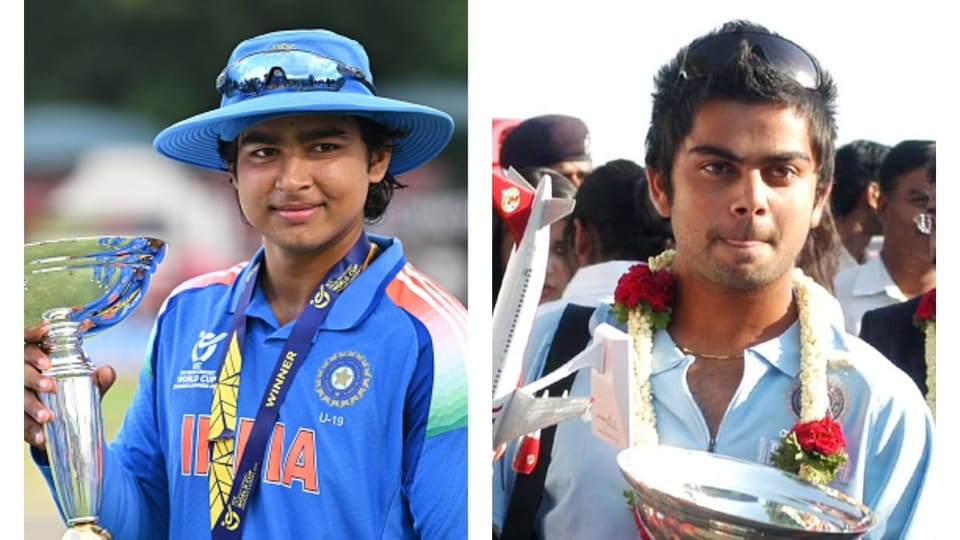
Virat Kohli’s U19 World Cup in 2008 was a captain’s campaign – controlled, repeatable, built for winning tight games. Vaibhav Sooryavanshi’s 2026 run was a takeover – heavier volume, higher impact, and a finale that felt like a one-man show. Same stage, same India crest, but wildly different footprints.
The scoreboard view: how big was the gap?
Start with the simplest truth. Kohli finished the 2008 U19 World Cup with 235 runs at an average of 47 across six innings. Solid output, made more valuable because he was leading the side. Sooryavanshi's 2026 numbers are larger by a full tier: 439 runs in seven innings, averaging 62.71. That is not a marginal improvement – it is an extra strong run spread across the tournament.
Also Read: Why Vaibhav Sooryavanshi won’t feature in the next two U19 World Cups despite being eligible
Signature innings: Control vs conquest
Every World Cup leaves behind one defining image. Kohli’s defining innings was his 100 off 74 balls against the West Indies. It wasn’t a look-at-me hundred. It was a controlled hundred – the kind that signals temperament more than fireworks.
Sooryavanshi’s defining inning was in the final: 175 off 80 balls with 15 fours and 15 sixes. The number itself is ridiculous, but the context is what makes it brutal. A final is usually where batters shrink their risk. He did the opposite, and made the match feel finished long before the result arrived.
While Kohli’s knock showed command, Sooryavanshi’s was an exhibition of demolition.
Consistency profile: What the campaign felt like
Kohli’s 2008 tournament reads like a classic title run: reliable knocks, leadership weight, and a style designed to avoid collapse. His output fits the older template – build partnerships, take the game deep, win the moments that matter.
Sooryavanshi’s profile perfectly shows the evolution of the game. We saw higher totals, higher tempo, and the ability of one batter to blow up the entire match structure. His campaign didn’t just contribute to India’s wins - it often defined the terms of those wins.
If Kohli’s campaign shows the win of risk-free cricket, Vaibhav’s campaign sings for modern-day fearless cricket.
The age factor
Now, this part turns the comparison into a conversation. Kohli’s 2008 U19 World Cup told you he was ready – ready to lead, ready to finish, ready to handle pressure. Sooryavanshi doing this at 14 is a different message: it screams ceiling. It is not just that he performed – it is that he performed with a freedom usually reserved for players who’ve already failed a few times and stopped fearing consequences.
That is the scary bit for everyone else: the numbers aren’t exactly precious, they reflect a player who is fully armed.


