
 E-Paper



UPRERA consolidates rules with amendments to strengthen homebuyer protection
UPRERA amendments: New rules tighten developer compliance while giving homebuyers, including those in unregistered projects, greater access to the Authority

 Prefer HTon Google


UPRERA has consolidated its general regulations, incorporating nearly a dozen amendments to streamline project compliance and strengthen homebuyer protection. While some provisions impose additional requirements on developers and real estate agents, others address issues faced by homebuyers, including allowing buyers of unregistered projects to approach the Authority.

The regulations also prescribe procedures for extension, withdrawal and transfer of project registration, aimed at protecting allottees while facilitating the revival and completion of stalled or distressed projects. Overall, the consolidated regulations bring the various amendments into a single framework, providing greater clarity on project reporting, financial management, advertising, possession, agent compliance and homebuyer rights, UPRERA said in a statement on August 18.
UPRERA has published the consolidated Uttar Pradesh Real Estate Regulatory Authority (General) Regulations, 2019, incorporating all amendments made up to the 12th Amendment notified on July 13, 2026. The consolidated regulations bring together the provisions introduced through various amendments and provide a comprehensive regulatory framework aimed at strengthening transparency, accountability, financial discipline and protection of homebuyers in the real estate sector, it said in a statement.
Greater accountability in project reporting
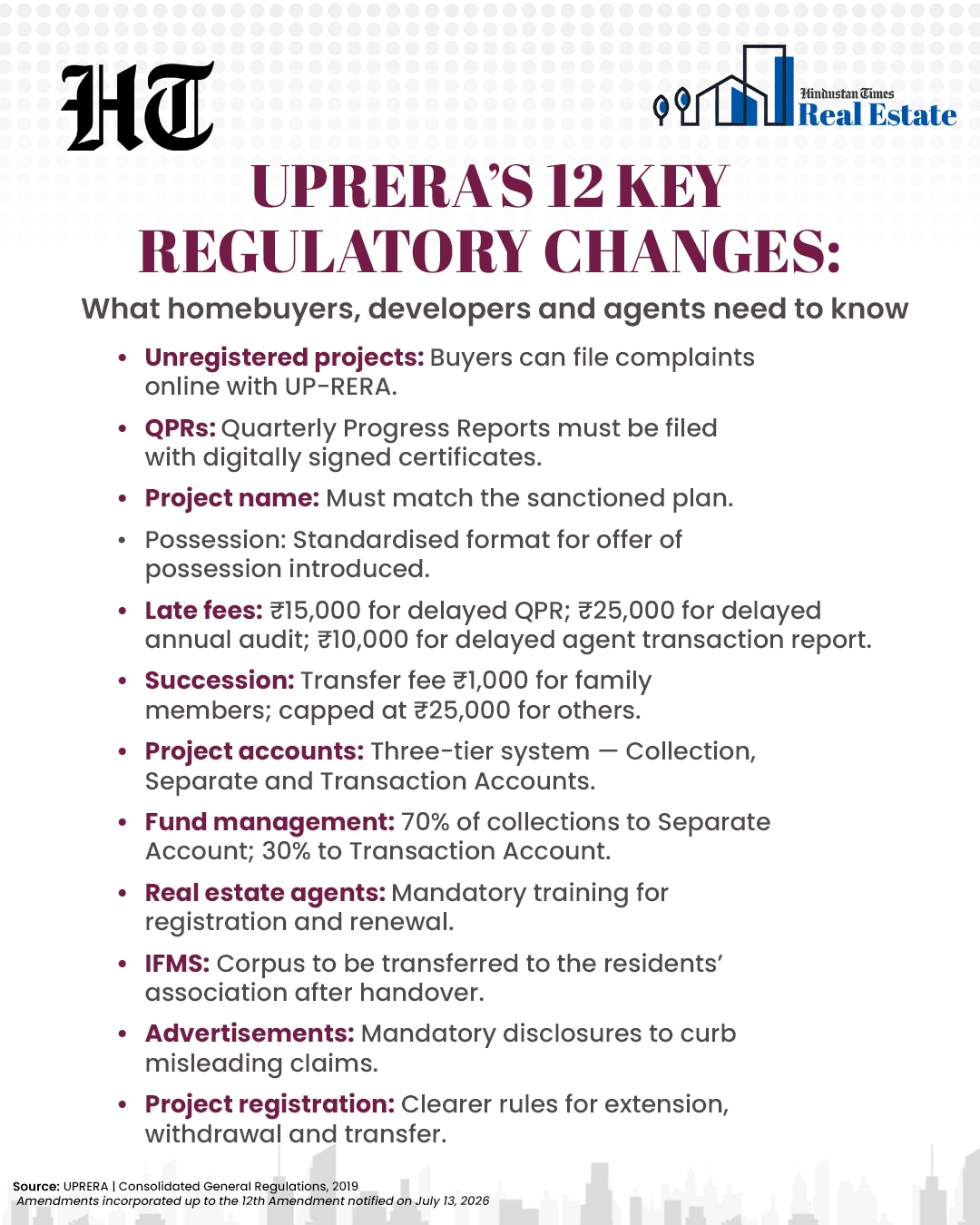
The amended regulations require promoters to provide details of key project professionals, including the architect, engineer, and chartered accountant, as well as the customer relationship manager and a dedicated contact or toll-free number. Quarterly Progress Reports (QPRs) must be filed through these professionals, accompanied by digitally signed certificates, to improve the accuracy and accountability of project progress reporting.
Promoters must also create and regularly update their profiles on the UP-RERA portal, including details of directors, partners, or trustees, the latest financial statem
Project name must match the sanctioned plan
The project title used by a promoter must correspond with the title mentioned in the sanctioned plan, enabling homebuyers and the regulator to establish a clear link between the project and its approved layout or map.
Promoters must also issue offers of possession in the format prescribed by UPRERA to minimise discrepancies in demands, accounts and other details at the time of possession.
Digital connectivity and relief for buyers
Promoters must submit a digital connectivity plan with their project registration application and provide four dedicated email addresses for registration, administrative matters, consumer complaints, and communication with allottees and agents.
The 8th Amendment provides relief to buyers of unregistered projects. Under Regulation 24, allottees can file complaints online before UP-RERA and seek relief in the same manner as buyers of registered projects. They will, however, have to provide additional details about the promoter and project.
Standardised fees and transfer charges
A late fee of ₹15,000 will apply for each delayed QPR, ₹25,000 for delayed annual audit reports for each financial year, and ₹10,000 for each delayed quarterly transaction report filed by a real estate agent.
Transfer charges for succession and assignment have also been standardised. The charge is ₹1,000 when the successor of a deceased allottee is a family member, and capped at ₹25,000 when the successor or assignee is not a family member.
Three-tier project bank account system
Under Regulation 53, promoters must maintain three project accounts — Collection, Separate and Transaction Accounts — in the project district. 70% of collections will be transferred daily to the Separate Account and 30% to the Transaction Account. There will be no lien on the Collection or Separate Account, UPRERA said.
Project loans will be credited to the Separate Account, which will operate under a defined payment protocol. The accounts must be audited annually, with the audit report uploaded on the UP-RERA website. Promoters will also be prohibited from accepting project payments in cash.
Relief for buyers of unregistered projects
One of the amendments provides a significant avenue of relief for allottees of projects that are not registered with UP-RERA. Under Regulation 24, such allottees can file complaints before the Authority through the online facility on the UP-RERA portal and seek relief in the same manner as buyers of registered projects. Complainants will, however, have to provide additional information relating to the promoter and the project to facilitate the processing and adjudication of their complaints.
Stricter norms for real estate agents
UP-RERA has made an intensive training programme mandatory for real estate agents, with a training certificate required for registration and renewal. Agents must also maintain prescribed records and file quarterly transaction reports with the Authority.
IFMS corpus to be transferred to residents’ association
The amended regulations introduce a structured framework for Interest-Free Maintenance Security (IFMS) deposits. The amount collected from allottees must be deposited in a separate account with a scheduled bank. When common areas are handed over, the promoter must transfer the entire IFMS corpus, along with the right to operate the account, to the Residents’ Welfare Association or relevant association.
Also Read: UP RERA mandates transfer of IFMS corpus to RWAs at project handover; new rules explained
The corpus may be used only for the operation, maintenance, repair, and replacement of common areas, equipment, and services. The association must maintain proper accounts and have the funds audited by a chartered accountant.
Tighter rules for project advertising
The amended regulations seek to curb misleading advertisements and false claims relating to project amenities and specifications. Promoters and agents must prominently disclose, as applicable, the project registration number, the UP-RERA website, the QR code, the Collection Account details, the project launch date, and the agent registration number in advertisements and promotional materials, UPRERA said.


