In January, ace off-spinner R Ashwin suggested that the day-night matches in the ODI World Cup should start at 11:30am — a full two hours before the usual start timing of 1:30pm. On Tuesday, the International Cricket Council (ICC) announced the tournament schedule without taking that advice into consideration. All 42 day-night games in the marquee event are scheduled to begin at 2pm while the day matches, limited to six, will start at 10.30am.
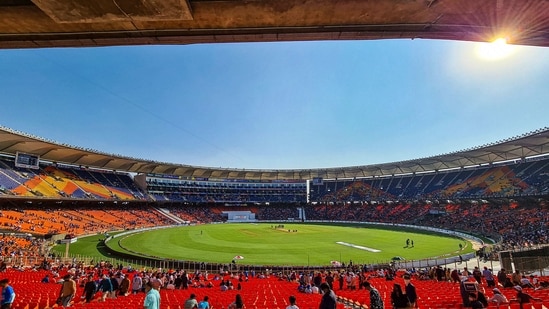
Ashwin’s rationale for an early start was to minimise the impact of dew — a phenomenon that tends to be prevalent particularly in day-night matches in the sub-continent. As a spinner who is hoping to feature in the World Cup, his concern is understandable. Because dew affects spinners the most — a wet ball under floodlights is a nightmare to grip, never mind extracting turn from the surface. For India, who have only day-night games and rely heavily on their spinners, the outcome of the toss may become far too crucial. If they are asked to bat by the opposing captain, there’s a danger of no total being safe in case their spinners are neutralised by a dew-laden outfield.
Ashwin cited the example of an ODI in Guwahati in January when India posted 373 and still laboured to victory simply because dew aided Sri Lanka’s batters against spin. Glance through the history of day-night ODIs in India and there are many examples of the result being inordinately influenced by dew.
“The difference in quality between the teams isn't coming through — dew is narrowing that gap if you happen to lose the toss,” Ashwin said on his YouTube channel. “The ICC knows very well that there will be dew, so let’s advance the game, and if we start at 11.30am, the dew factor won’t come into the game.”
{{/usCountry}}“The difference in quality between the teams isn't coming through — dew is narrowing that gap if you happen to lose the toss,” Ashwin said on his YouTube channel. “The ICC knows very well that there will be dew, so let’s advance the game, and if we start at 11.30am, the dew factor won’t come into the game.”
{{/usCountry}}Unlike the 1996 and 2011 World Cups in the subcontinent that were held in February, March and April, this year’s tournament is slated for October-November. The 1987 World Cup was also held in these months, but there were no day-night matches back then.
Prashant Rao, head curator at the M Chinnaswamy Stadium in Bengaluru, explains why the dew factor tends to be more prominent in the winter.
“There is relatively less dew in the summer compared to the winter,” says Rao. “During the summer months, there is no significant variance in the day and evening temperatures. Let’s assume the day temperature in the summer is around 45 degrees Celsius. Your evening temperature is still high, so the water vapour doesn’t condense into droplets. During winter, there is a significant change in temperature from around 6pm. So, dew naturally forms during the second innings of day-night games.”
The timing of the World Cup means winter wouldn’t have properly set in. A top BCCI curator said on condition of anonymity that it will help limit the impact of dew. “October-November is a good time for us. There is not a lot of difference in the day and night temperatures. Winter mein zyaada problem hota hai (there are more problems in winter),” he said.
Curators say that mechanisms are in place to ensure the toss doesn’t become all too decisive. While groundstaff using mopping ropes during breaks in play was a common sight earlier, more effective measures are now employed.
“We use a lot of sprays. You can’t stop the dew formation. What can be done is that the dew, instead of remaining as a droplet, should seep into the soil or fall off the grass. You can sometimes see broadcasters showing droplets on the grass leaves during a match. Those droplets make the ball wet. We spray chemicals that form a synthetic coating on the leaves. As soon as the dew falls, it slides down and the water doesn’t stay on the leaves,” says Rao.
The spraying of chemicals is done in the lead-up to a match. “It takes 3-4 hours to spray the outfield. It is not a single day process. We do it for 2-3 days before a match,” says another curator.
While expecting dew to have no effect on proceedings would be unrealistic, the curators will deserve a pat on their back if they can avoid it becoming a talking point during the tournament.