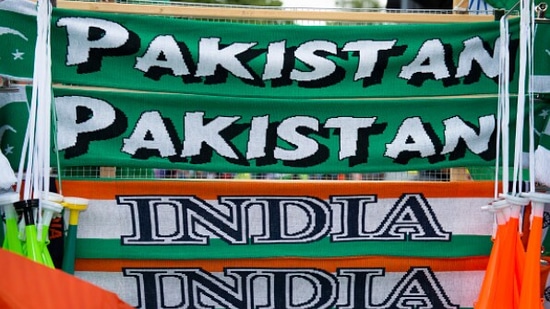
India-Pakistan cricket and its unpredictable rhythm down the decades
How often India and Pakistan play each other—or do not—is obviously dictated by the emotional and volatile political history of the sub-continent, writes Ayaz Memon, as the teams gear up for Sunday’s T20 World Cup clash.
Cricket ties between India and Pakistan define a haphazard pattern. True, bilateral sports relations between countries are not always linear and hassle free, there are stoppages and boycotts, but matters do come back to normal. However, Indo-Pak cricket has a haphazard, unpredictable rhythm, with steep troughs and crests and often long periods of inactivity which has kept cricket administrators, players and fans on edge.
India vs Pakistan: India-Pakistan cricket and its unpredictable rhythm down the decades (GETTY IMAGES)
The first Test series between the countries was played in 1952-53. Almost 70 years later, the total count of Tests is a meagre 59, which works out to less than one a year. In contrast, the only comparable cricket contest in terms of passion and intensity, the Ashes between Australia and England, tots up more than four times as many Tests in the same period.
How often India and Pakistan play each other—or do not—is obviously dictated by the emotional and volatile political history of the sub-continent. Gaps between engagements can be long, depending on the nature of the most recent conflict or fresh eruption of an old one, and how the political dispensation of that particular time tackles it.
The last Test series, for instance, was in 2007-8, when Pakistan toured India. But the 14-year break since, which must seem an eternity, is not the longest. After the 1961-62 series played in India, there was no cricket between the two countries till 1977-78. Two wars, in 1965 and 1971, obviously contributed massively to the 17-year-long cessation of cricket links, which was finally restored by the Janata Government with the then foreign minister Atal Bihari Vajpayee leading the ‘defrosting’ agenda.
In 2004, Vajpayee was prime minister of the Bharatiya Janata Party-led NDA government when the Indian team was cleared to tour Pakistan, so it’s incorrect to believe that hardline political parties have necessarily been always against cricket relations with Pakistan. If anything, suspensions and bans have been far more in Congress-ruled national governments.
While hostile political relations have been a constant threat to cricket relations, there have also been sunny periods when India and Pakistan cricket boards and the respective governments have collaborated towards a common cause. The 1987 World Cup would never have come to the sub-continent had BCCI, to teach the England Board a lesson, not found an ally in the Pakistan Cricket Board.
Cricket officials of the two countries lobbied with their respective governments for ensuring international standard infrastructure, hospitality, security and foreign exchange availability so that all objections raised by the bloc led by England in the sport would be overcome. The 1987 Reliance Cup was jointly hosted by India and Pakistan. Ironically, neither country could make it to the final, but their collaboration helped break England’s hegemony on the tournament.
At times ‘cricket diplomacy’ has helped tide over a looming crisis. In 1987, armies of the two countries were in eyeball-to-eyeball confrontation on the western border. Pakistan were touring India under Imran Khan. Zia-ul-Haq used the cricket series as an opportunity to visit India, watched a day or two of cricket and spent more time in political wrangling which helped defuse the tension.
Such fraternising has worked at the cricket level too. Captain Imran Khan reached out to BCCI to provide neutral umpires in Pakistan’s home series against world champions West Indies in 1986. Khan, a strong votary of neutral umpires, didn’t want to be accused of bias if his team beat West Indies. Piloo Reporter and VK Ramaswamy were sent on deputation for two Tests by BCCI.
Imagine a Pakistani captain asking for Indian umpires to officiate in his country! A few years later, Sunil Gavaskar became a hero in Pakistan for predicting before the tournament that Pakistan would win the 1991-92 World Cup. In current climes, Imran and Gavaskar would be slaughtered by trolls from their respective country.
The 1980s and 1990s saw BCCI and PCB offering each other support fairly often, making for a strong symbiotic relationship which redefined cricket’s power matrix. This was also the phase when Abdul Rahman Bukhatir (along with Asif Iqbal) saw the potential of Indo-Pak cricket as an off-shore venture in Sharjah, which BCCI and PCB were clever and quick to exploit.
More Indo-Pak matches, albeit ODIs, were played between 1982 and 1998 at this venue. When India withdrew from the CBFS, it made the brand value of this contest grow manifold to become the biggest blockbuster in the sport.
By the 1996 World Cup, cable TV had made massive inroads in both countries, and the value of an India-Pakistan match, in terms of spectatorship, sponsorship and TV rights has grown exponentially since.
The pressure of Indo-Pak cricket is understandably enormous on players, producing some magical as well as humdrum, boring cricket. In the 1950s and 60s, the aim of both teams would be to ensure against defeat. India won the inaugural series 2-1 in 1952-53. The next two series, in 1955 and 1961-62 produced five draws each, with players and captains showing little enterprise or desire to take risks.
The dour mindset improved dramatically when cricket ties resumed in 1978, with the keen competition provoking some outstanding performances. Imran Khan, Javed Miandad, Gavaskar and Kapil Dev reserved their best for the arch rivals. Anil Kumble took 10 wickets in an innings at Delhi in 1998-99, only the second bowler in Test history to do so.
After India beat Pakistan in the World Championship of Cricket in Australia (1985) and Rothman’s Cup (Sharjah 1985), Miandad’s last ball six to win the Australiasia Cup final in 1986 had such a massive impact on the psyche of Indian players that India would inevitably lose, sometimes from winning positions, to Pakistan wherever the two countries played.
This spell was broken a few years later when India beat Pakistan in the 1991-92 World Cup, though I believe the turnaround came a couple of years earlier, when 16-year-old Sachin Tendulkar blasted Abdul Qadir for four 6s in an over in a one-day match at Peshawar. The `fear factor’ was dispelled. India haven’t lost to Pakistan in a World Cup (ODI or T20) since.
The impact of Indo-Pak cricket on fans has ranged from the unsavoury to the delectable. In 1961-62, a hothead tried to slash Hanif Mohammad’s hand with a blade. In 1989, groups of people ran on to the ground in Karachi and roughed up some Indian players and captain Krishnamachari Srikkanth before security arrived to disperse them.
However, when Pakistan beat India at Chennai in 1999, they got a standing ovation from the packed crowd, and in 2004, when India were winning a Test series in Pakistan for the first time, they were felicitated by the home crowds like never before.
Irrespective of recurring political turmoil, on a people-to-people basis, Indians and Pakistanis have largely savoured cricket ties, despite objections of rabble rousers from either side of the border. Sport offers a sliver of hope for normalcy between the two countries which should be succoured, not spurned.


 Live Score
 Cricket Teams
 Cricket Players