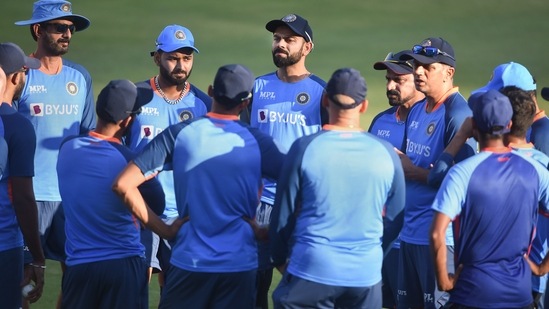
With the T20 World Cup round the corner, players are like nervous students before a tough exam.
Those appearing for career impacting exams know the feeling of corrosive uncertainty and deep stress ahead of D-day. There is hope things will work out, also fear of likely disaster. In a competitive exam or a high voltage sporting contest, one is never sure.
Exams, whether for students or professional players, require solid preparation—sleepless nights checking notes, revising texts, anticipating questions and searching
With the T20 World Cup round the corner, players are like nervous students before a tough exam.
Those appearing for career impacting exams know the feeling of corrosive uncertainty and deep stress ahead of D-day. There is hope things will work out, also fear of likely disaster. In a competitive exam or a high voltage sporting contest, one is never sure.
Exams, whether for students or professional players, require solid preparation—sleepless nights checking notes, revising texts, anticipating questions and searching for answers. The preparation must be strategic and smart—focussed to produce results. As in cricket, success is achieved through intelligence and hard work because random hit and miss strategy won’t do.
Rohit Sharma, on way to Perth (the Indian team’s pre-tournament base), is no different from anxious students in exam mode. He knows careers and reputations are at stake, expectations are high as India’s cricket trophy cupboard in multi-team events is pretty bare. Fans want the team to win and cricket’s commercial ecosystem is waiting for the next ‘chappar phad ke’ moment.
Like all diligent students, captain Rohit has prepared well, ticked the boxes. Last six months, the Indian team under him has been focussed on the shorter format and gone through a punishing schedule—matches in Ireland and England, then South Africa in India followed by the (disappointing) Asia Cup in Dubai; and now, more recently, the Proteas and Aussies at home.
During all this, the team searched for the winning strategy and weighed two options. One: Stick to tradition and attack during powerplay, build partnerships in the middle overs and then go berserk at the backend. Other option: Treat the entire 20 overs as one powerplay and attack throughout. Of course, it’s never completely this or that and experience dictates you have to respect conditions and the match situation.
For Rohit (and coach Dravid), picking the right players to get the job done was a huge headache. Players were tried for specific roles, chopped and changed, some rested and others dropped. The final 15 in the business class flight to Australia are the best available from a vast pool that auditioned.
Selecting the squad wasn’t easy. Choosing the ‘keeper (Pant vs DK) was tricky till Karthik sealed his place by grabbing the finisher’s slot. Pandya is a certainty in the middle-order but selectors hoped he’d give India four overs as the third seamer. While sorting out the team balance, some questions remain unanswered: Where and how do you fit in Ashwin? What do you do if one of five specialist bowlers has an off-day? Is Hooda good enough?
The Indian team’s preparation was hit for a six by unfortunate external issues. The team was struck by injuries—Ravindra Jadeja ruled out, KL Rahul missing games and the ultimate hammer blow with Bumrah not fit.
Top players struggling for form is another concern. Rohit hasn’t played a decisive innings for some time. Kohli experienced an extraordinary batting slump, waiting almost three years to make a hundred in an international game. Lately, he has re-discovered form but is still some distance from the ruthless No 3 we have known him to be. Perhaps, Kohli’s devoted fans must get used to the changed reality that his royal aura has faded.
But serial champions like him can never be written off. Count on him to be fully switched on in Australia where he has a wonderful record. Freed from the burden of captaincy, he thought about his batting and says the problem was he was trying to be the batsman he never was. Now, he is back to his trusted methods that have yielded a mountain of runs and 71 international hundreds. Kohli is top grade theatre, a superstar who attracts attention as much for failure as success.
But the question is—is India ready?
Only a brave person will say India is in the space where they’d want to be. Going into the World Cup, there are more dark clouds than silver linings. The greatest worry is the sorry state of death bowling, especially now when the four over fixed deposit of Bumrah is lost. Bhuvneshwar and Harshal Patel, our best bets, have had a forgettable run recently, repeatedly going for plenty. If India concede a lot, then pressure mounts on the batsmen.
What’s worrying is neither the team (collectively) nor players (individually) seems near the best. The team appears tired and unsettled, like a marathon runner who is struggling to keep pace at the 21km mark. Moreover, at this late stage, it is still looking for balance and searching for inspiration. In Indore, the last competitive game before heading to Australia, there was large scale experimentation.
Most have issues of form and fitness, but Surya Kumar is a bright spark, an artist whose bat finds angles to create shots. Clearly, he is at the top of his game, in terms of clarity as well as confidence. If the quickish tracks in Australia are his allies, a lot of India’s batting issues are resolved.
T20 games are difficult to call, and so are exams. Rohit could max this test, or miss the cut.
One Subscription.
Get 360° coverage—from daily headlines
to 100 year archives.
Archives
HT App & Website