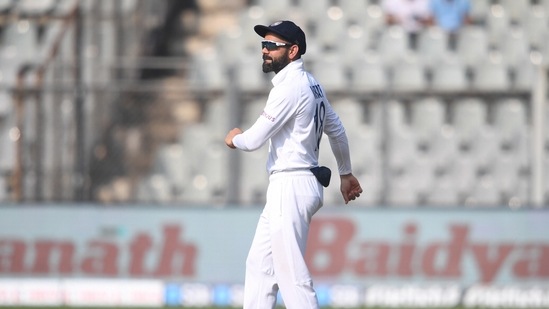
A comprehensive 372-run win—India’s biggest till date—against New Zealand in Mumbai capped Virat Kohli’s 24th win in his 31st Test as India captain at home. Since taking over as Test captain from MS Dhoni, Kohli has led India to 11 consecutive series wins of at least two Tests or more (India won the solitary Test against Afghanistan under Ajinkya Rahane’s captaincy), a record. In his seven years as Test captain so far, Kohli has notched up home series victories twice against England, South Africa and New Zealand, a feat even MS Dhoni hasn’t achieved. Now that Kohli has also surpassed Dhoni in leading most Tests in India (31), it’s a good opportunity to compare where he stands among the best captains at home.
In India, Kohli is unmatched. No India captain to have led in at least 20 Tests at home has his win record. Sourav Ganguly was credited for changing India’s outlook away from home and leading the epic turnaround against the touring Australians in 2001 but his home record (10 wins, 3 losses and 8 draws) still wasn’t better than Mohammad Azharuddin’s (13 wins, 4 losses and 3 draws). Dhoni, with 21 wins, 3 losses and 6 draws in 30 Tests, has a remarkable record but even he suffered the ignominy of losing a rare series to England in 2012 apart from drawing the South Africans in 2010. Kohli has won 12 straight series at home since taking over as captain, despite a few close games—like losing the first Test in each of the 2017 series against Australia and this year’s series against England—threatening to mar his series prospects. Those were the only two matches Kohli has lost at home till date (24 wins, 2 losses, 5 draws).
Where does Kohli rank among the greats of the game when it comes to leading at home? As a team, West Indies hold the record of most consecutive matches without a defeat (27)—between 1982 and 1984—all under Clive Lloyd. Seventeen of those Tests were overseas. At home, Lloyd did lose just two Tests like Kohli, but also drew nine matches against 13 wins. Overall, only Graeme Smith (30 wins, 15 losses and 8 draws) and Ricky Ponting (29 wins, 5 losses and 5 draws) have more victories at home but it’s also because both led in more Tests than Kohli. Still, Kohli’s win percentage (77.4) is marginally better than Ponting’s (74.35).
{{/usCountry}}Where does Kohli rank among the greats of the game when it comes to leading at home? As a team, West Indies hold the record of most consecutive matches without a defeat (27)—between 1982 and 1984—all under Clive Lloyd. Seventeen of those Tests were overseas. At home, Lloyd did lose just two Tests like Kohli, but also drew nine matches against 13 wins. Overall, only Graeme Smith (30 wins, 15 losses and 8 draws) and Ricky Ponting (29 wins, 5 losses and 5 draws) have more victories at home but it’s also because both led in more Tests than Kohli. Still, Kohli’s win percentage (77.4) is marginally better than Ponting’s (74.35).
{{/usCountry}}Another—not necessarily more accurate—way to assess captaincy at home usually is the win/loss ratio. That is where Dhoni—with a W/L of seven (seven wins for every loss)—or Viv Richards (W/L of 7.5) and Steve Smith (6.5) fare better than most other captains across generations. But with 24 wins against two defeats, Kohli now has a W/L of 12, the second best among all captains to have led in at least 20 Tests at home in the history of the game. Williamson, by virtue of losing just one Test (and winning 16) at home till date, has a better W/L ratio of 16. He also has an impressive win percentage of 72.7 but Williamson is yet to be tested in a three-match or longer series at home, something Kohli has aced several times.
No contemporary captain otherwise comes even close to what Kohli has achieved at home. Joe Root has won just 17 out of the 31 Tests he’s led England at home, losing nine and drawing eight. Smith won 13 out of 20 and Faf du Plessis won 14 out of 22 Tests (W/L ratio of 2). Going further back in history though, only Steve Waugh—with a W/L ratio of 11 at home—has displayed similar supremacy, notching 22 wins in 29 home Tests between 1999 and 2004.