Kolkata: Moises Henriques has spent most of his life being Australian. He came through its formidable cricket system, played for Australia, spent two decades building a professional cricket career in the country his parents chose because they wanted their son to have opportunities. And yet, at 39, Henriques finds himself playing international cricket for Portugal.
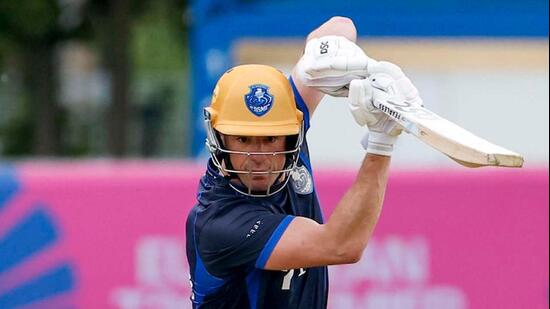
It’s not quite a new beginning. Nor, he insists, is it a rejection of the country that made him. “It definitely doesn’t feel like the beginning of another career,” Henriques says. “All I’ve done is tried to add on a little bit more time to the end of one career.”
But there is definitely something deeper happening. Henriques was born in Madeira, Portugal, and left when he was two. Last year, he returned to the island for the first time in a long while. The experience surprised him. “As soon as I flew into the airport, it felt strange that I was almost returning home,” he says. “I knew I had so much family on the island and I was really excited to meet all. And it just…there was a really warm feeling about that.”
There is, he admits, an element of coming full circle. “Getting in touch with, I guess, maybe what you’d call my ancestors and my family…where I’d never really spent much time with them.” Now he can represent that side of his family too, at the European qualifiers for the 2028 T20 World Cup.
{{/usCountry}}There is, he admits, an element of coming full circle. “Getting in touch with, I guess, maybe what you’d call my ancestors and my family…where I’d never really spent much time with them.” Now he can represent that side of his family too, at the European qualifiers for the 2028 T20 World Cup.
{{/usCountry}}Henriques is careful not to rewrite his own history. “I still feel very much Australian at heart,” he says. There is no ambiguity about what Australia means to him. As a child, there was only one cricketing dream. “When I was a kid growing up, I only ever wanted to play Test cricket for Australia,” he says. “It’s not like I ever thought about playing for anyone else.”
That distinction matters. Portugal has given him a new connection. Australia gave him the life from which that connection is now possible. Henriques remembers coming from a family with humble means but still finding cricket remarkably accessible. Clubs had equipment that children could borrow, schools had cricket gear, volunteers gave their time, the system kept opening doors.
“We’re very fortunate in Australia to be able to just access the game and play the game at a young age.”
His gratitude extends beyond cricket. He believes his parents moved to Australia because they wanted their children to have possibilities, “whether it be in school, education, corporate or sport” that might not have existed elsewhere. That is why playing for Portugal doesn’t feel like choosing one identity over another. It feels more like discovering a missing piece.
The cricket itself is almost secondary. Henriques recently scored a hundred for Portugal against Czechia, but refuses to romanticise it. His most satisfying innings remain those played against the strongest opponents and in the hardest circumstances. “I always judge my innings on the quality of opposition that you play against and how difficult the conditions or the challenges are,” he says.
The Portugal hundred may not rank alongside the innings he played against elite international opposition. But representing Portugal carries a different kind of weight. That return has coincided with another kind of transition. Henriques is also playing for Glasgow Cosmic in the European T20 Premier League, part of a growing circuit in which established international players are increasingly crossing into emerging cricket markets.
He finds the cricket less demanding than IPL or Big Bash League, partly because the external pressure is less. But he has been struck by the quality of players in Scotland, Ireland and the Netherlands, and by the possibilities opening up for cricketers outside the traditional powers. “I only see…so many more different paths for players to take now,” he says. “I feel like it’s going to spread the talent and quality around the world a little bit more.”
For Henriques, perhaps, the same thing is happening personally. The paths that once seemed separate—Australia and Portugal, the country that raised him and the country where he was born—have converged late in a long cricket career. He doesn’t regard this as starting over.
“It feels more like I’m adding time to an old career rather than starting a new one,” he says, laughing at the prospect of another full-time cricket life. “I don’t think my kids and my partner would appreciate me starting a new career after 22 years.”
In a way it isn’t reinvention but recognition. At 39, Henriques is discovering that identity need not be a choice between competing homes. He can acknowledge the country he left as a toddler without diminishing the nation that gave him his cricket, education and opportunity. Which is why it isn’t surprising that to Henriques, Portugal is a return, but Australia remains home.