Mumbai: Shane Warne and Muthiah Muralitharan are two of the greatest spinners of all time. But you wouldn’t know that if you looked at their India records in isolation. As against his career average of 25.41, Warne averaged 43.11 on the spin friendly tracks in India. Muralitharan’s record was even more surprising given that conditions in Sri Lanka are pretty similar to India — his average in India was 45.45 as compared to his career average of 22.72.
Now, the reason for their struggles in India came down to how the batters of that generation played spin. They were ready to use to their feet or the crease depending on what the ball demanded. They would hit the ball out of the rough — as VVS Laxman so famously did against Warne. And perhaps most importantly, a spinner would be milked for runs. Each of the batters had their own way of playing spin and that also meant there was no one way to bowl to them.
But the manner in which India have regularly succumbed to spinners in their own backyard suggests that perhaps their days of spin supremacy are a thing of the past; perhaps they have forgotten what once made India’s batters so great against spin.
“There is a misconception that India are good at playing spin. They are like everyone else. Gone are the days of Sachin, Ganguly, or Dravid. Now, they are the same as everyone else. As soon as a good spinner comes in, they are in trouble. We saw that in the IPL, as soon as the ball started to spin, they were in trouble and started complaining,” former NZ pacer and commentator Simon Doull said on Sports18 during the second Test.
{{/usCountry}}“There is a misconception that India are good at playing spin. They are like everyone else. Gone are the days of Sachin, Ganguly, or Dravid. Now, they are the same as everyone else. As soon as a good spinner comes in, they are in trouble. We saw that in the IPL, as soon as the ball started to spin, they were in trouble and started complaining,” former NZ pacer and commentator Simon Doull said on Sports18 during the second Test.
{{/usCountry}}It was a view shared by many other experts and fans as well. Not something the Indian team management likes to pay attention to but their struggles were a clear reflection of the space they were in. Once the hunters, they have now become the hunted.
Maybe the collapse against pace in Bengaluru could be explained, but the capitulation versus spin in Pune has exposed cracks that could hurt the Indian team in the long run. New Zealand did it through Mitchell Santner’s (13 for 157) nagging accuracy and subtle changes in speed at Pune to take an unbeatable 2-0 lead in the series. In the Mumbai Test match starting Friday, the red soil pitch will pose different questions.
These questions, centred largely around how India play spin, have been accentuated because the visiting batters have shown how runs can be scored. Devon Conway, Rachin Ravindra and Tom Latham all spent a considerable amount of time at the crease in Pune to smother spin. Except Yashasvi Jaiswal’s second innings effort (77), Indian batters had a sorry time.
India’s assistant coach Abhishek Nayar felt it was ‘harsh’ to say Indian batters are no longer good players of spin.
“New Zealand exploited the conditions well,” he said. “When we talk about intent, there will be times it will not work out for you. What Gauti bhai (Gambhir) said the other day, there are days like the one against Bangladesh when you get to fastest 50 and 100, there will also be days when it doesn’t look as good.”
Nayar went on to add India were trying to ‘play in a different way’ by ‘moving outside your comfort zone’.
“We are hoping that the transition that we are trying to have in terms of mindset and the approach, the upward curve (when it comes) will be for a long haul,” he added.
The returns in the series have been disappointing. Other than Sarfaraz Khan and Jaiswal, no Indian batter has faced more than 200 balls in four innings, whereas four Kiwi batters – Conway, Rachin, Latham and Will Young have. Only Sarfaraz – on the back of his 150 –averages above 40.
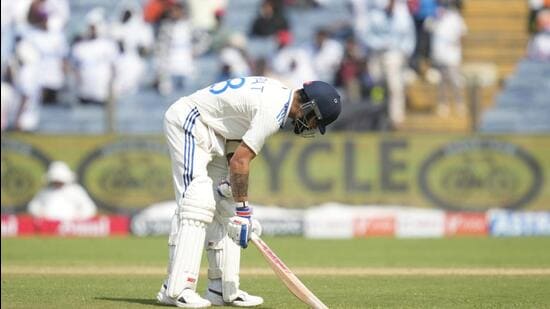
The one question Santner consistently asked of batters in Pune was which ball will turn and which one won’t . Jaiswal was able to use the sweep shot to good effect. Others were left in two minds and were ultimately caught in front of the crease. It didn’t help that the two stalwarts Virat Kohli and Rohit Sharma met the same fate. Rohit hasn’t scored many runs in the current home season. Kohli’s diminishing returns, particularly to spin in the past five years (74.6 to 28.7) are even more alarming.
“When certain balls are spinning and others going straight, it tends to play with your mind. It’s important to understand which balls are undercutting and overspinning. It’s about focusing harder. That’s the technical side of it,” said Nayar. “It’s also about the atmosphere outside, it can be intimidating. Sometimes the form you are in can get the better of you.”
India’s show of intent is simplified to thinking of scoring first, defending later. Another new age philosophy, fraught with risk when playing conditions are favourable for the bowlers. “When you lose wickets in a bunch, sometimes it is the mindset. The intent is not necessarily swinging at the ball, intent is your approach towards the ball - to score, and if you cannot, you defend it,” said Nayar. “In tough conditions, there will be time when it does not look great from the outside, but the players know what they are trying to do.”
Net bowlers over slingers
On Wednesday, a battery of young net bowlers (about 30) came out to bowl. While Mohammed Siraj and Akash Deep had a quick burst, most of the bowling was done by net bowlers. Among spinners, Ashwin and Kuldeep Yadav had one long net to Kohli; rest of the spin bowling was done by net bowlers. What was evident was lesser than usual use of the side armers. Recently, former coach Ravi Shastri had been critical of overusing slingers during net sessions as a mode of preparation.
Jasprit Bumrah didn’t turn his arm over on Wednesday. His workload will have to be closely managed with the five Test matches coming up in Australia.