There will be little appetite for appraisals in the India batting group in the aftermath of this ODI tour of New Zealand. Too many collapses, too many false shots, too many instances of promising starts dissolving into frustrating exercises for survival—India’s batting had very few reasons to cheer.
For a team trying to time how to peak ahead of the ODI World Cup, this series was a spanner in the works, exposing uncomfortable questions about India’s ability to negotiate difficult conditions away from home.
But cricket tours are also rarely remembered exclusively for what went wrong. Sometimes, the most important discoveries happen when a side is trying to survive its most uncomfortable moments. The batting was traumatic overall—Virat Kohli was the only Indian batter to cross fifty and the entire quota of fifty overs played out just once—but on the flip side, India’s bowling also offered an encouraging glimpse into the future.
The most immediate and obvious gain is Gurnoor Brar, whose imposing physical presence was matched by the hostility of his bowling, offering India a rare advantage away from home.
The consistency with which Brar tormented New Zealand’s top-order—Tim Seifert especially—was a throwback to the past when fast bowlers could bore batters with their discipline. Selection is no exact science and can be right only in hindsight. Brar’s progress however makes for a compelling insight into the benchmarks that need to be passed to make it to the team so close to an ODI World Cup.
{{/usCountry}}The consistency with which Brar tormented New Zealand’s top-order—Tim Seifert especially—was a throwback to the past when fast bowlers could bore batters with their discipline. Selection is no exact science and can be right only in hindsight. Brar’s progress however makes for a compelling insight into the benchmarks that need to be passed to make it to the team so close to an ODI World Cup.
{{/usCountry}}From here, Brar—who has also been added to the Test squad—for South Africa seems a logical call, purely because of his aggression that is in sync with the conditions. The trampoline bounce in New Zealand should be replaced by slightly harder surfaces next year, making Brar the right candidate to rile batters even in the middle overs. And while Indian conditions would demand greater precision and the patience to construct spells when the ball is not doing much, right now that might not be required of him.
If Brar's appeal lies in his physicality, Anshul Kamboj is finally living up to the promise of staying economical without being passive, maintaining control to stay relevant with an easy, no-frills run-up. Five wickets spread across four outings, backed by a decent economy, Auqib Nabi effectiveness with the older ball also makes him an interesting proposition beyond conditions that favour conventional seam or swing.
| Bowler | No of matches | Wickets taken |
|---|---|---|
| Gurnoor Brar | 3 | 9 |
| Auqib Nabi | 3 | 5 |
| Arshdeep Singh | 3 | 4 |
| Anshul Kamboj | 2 | 4 |
| Yash Thakur | 1 | 1 |
| Mohammed Siraj | 1 | 2 |
| Axar Patel | 4 | 6 |
| Kuldeep Yadav | 1 | 0 |
| Naman Dhir | 4 | 2 |
It is perhaps premature to draw sweeping conclusions from one tour, but the important point is that Brar, Nabi and Kamboj have strengthened India’s bowling pool by not being identical. With Jasprit Bumrah being rested more than ever, this variety is exactly India’s bowling attack needs in the long run.
The most intriguing development, though, might be happening with Arshdeep Singh. Well established as India’s all-weather T20 spearhead, Arshdeep’s greatest strengths lie in his ability to swing the ball and execute yorkers. But this tour suggested the making of a more rounded fast bowler who adapts his methods to the demands of a particular match setting.
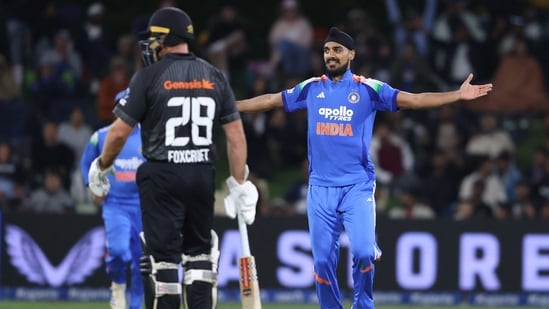
At the core of this effectiveness is the knack of hitting that length to which some batters play forward and others hang back. Sunday’s match offered a comprehensive view of that skill. From squaring up Will Young—just before he was induced into a wicket-taking pull—to foxing Dean Foxcroft with a scrambled seam delivery producing a thick edge to slip, Arshdeep tried to not conform to any particular template of bowling.
And that’s crucial considering the changing dynamics of one-day cricket. His use of the short ball was also particularly revealing. Attacking the body while making the batters guess his lengths, Arshdeep appeared more assured in sustaining pressure throughout the innings, rather than merely looking for breakthroughs with the new ball or at the death. Beyond Arshdeep’s match-winning haul at Mount Maunganui thus stood out his control, variety and match awareness brought upon by the responsibility of defending a sub-par score on a good track.
None of this should obscure India’s batting concerns though. The failure to build substantial partnerships, underlined by a vulnerability against disciplined seam bowling, means India’s batting strategy requires a serious probe.
The series was won alright but worrying is how this performance was fuelled nearly entirely by India’s seam bowlers. Perhaps that is going to be the more enduring legacy of this 3-1 series win. Travelling to New Zealand on the heels of a prolific run from the batters in the home series against West Indies, India were looking short of bowling edge. But now they leave having discovered that their white-ball fast-bowling future might be more exciting than previously imagined.