Mumbai Indians are playing Deccan Chargers at the Wankhede Stadium in a 2012 Indian Premier League match. Rohit Sharma is facing Dale Steyn. The hosts are chasing a low total, which means the batsman can take his time to settle down. Steyn is bowling his trademark out-swingers. Sharma, beaten repeatedly, breaks into a grin to acknowledge his helplessness against the moving ball.
2013. It is the Johannesburg’s Wanderers Stadium. Sharma is now playing for India and Steyn for South Africa. A repeat of Wankhede as Sharma is beaten by a series of outswingers from Steyn. In limited-overs games, the pitches are relatively flat compared to those for Tests. Yet, Sharma couldn’t figure out how to play the moving ball.
Thus when the Indian team management tried Sharma as opener in the 2019 home series against South Africa, many experts were sceptical. He scored three triple figure knocks (one double) in his first four innings.
The real test for any opener against the new ball though is in the SENA (South Africa, England, New Zealand, Australia) countries. His first big examination was expected in New Zealand in 2020. On the South Africa tour two years earlier, Sharma had a torrid time against fast bowlers and was dropped after the first two Tests. India won the final Test on a spicy Johannesburg pitch.
{{/usCountry}}The real test for any opener against the new ball though is in the SENA (South Africa, England, New Zealand, Australia) countries. His first big examination was expected in New Zealand in 2020. On the South Africa tour two years earlier, Sharma had a torrid time against fast bowlers and was dropped after the first two Tests. India won the final Test on a spicy Johannesburg pitch.
{{/usCountry}}Not many experts gave Sharma a chance against Tim Southee and Trent Boult in New Zealand. But he was injured during the one-day series and missed the Tests that India lost 2-0.
Amidst doubts over whether he could deal with the new ball on bouncy pitches in Australia, Sharma went there early this year. Injury and subsequent quarantine forced him to miss the first two Tests, but he dealt with Pat Cummins and Mitchell Starc convincingly in Sydney and Brisbane.
The question now was whether he would be able to handle the swing of James Anderson and seam of Stuart Broad in England? In Trent Bridge, he saw off the new ball to show he had no technical issues.
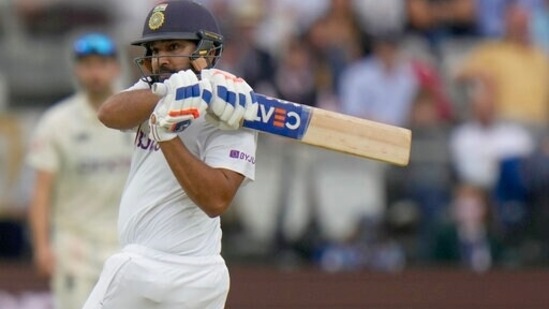
The next challenge was to build on starts and Sharma chose the opening day at Lord’s, scoring his highest score away from home with a stylish 83. A batsman who couldn’t put bat to ball in a T20 game was now so assured against the most successful swing bowler of all time, James Anderson. It was some improvement.
In between, he proved a point to those who doubted if he would handle the world’s most balanced pace attack—New Zealand—in the World Test Championship final in June. He gave good starts at Southampton, with a 68-ball 34 and 81-ball 30. This despite an overcast sky, which meant conditions were pace-friendly throughout. It wasn’t enough in the end as India lost.
So, what has changed for the batsman?
Sharma is among players who analyse their game a lot. It has helped reinvent his game. He values the inputs of video analyst CKM Dhananjay and is also seen as the successes of India batting coach Vikram Rathour.
Cricket analyst CricViz lists three points for his success in England. “He’s batting further down the crease. In 2018, his average interception point was just 1.86m from the stumps; now, it is 2.1; following the Kohli 2014-2018 model.
“He’s essentially become outstanding against full-pitched deliveries. Since the start of the Australia series, he’s averaged 110 against full- pitched pace in away Tests.”
Though Sharma looked at ease against Cummins and Starc, he got out after being set at 26, 52, 44 and 7 in that series.
He started the current England tour with three 30s (two vs NZ) before breaking the barrier at Lord’s, pacing his knock beautifully to score 83 before being undone by an Anderson special which he played on.
However, he seems to have passed the mental test. “At Lord’s, Rohit was restrained enough to play just 11% attacking shots. Only once in his Test career has he faced 100+ balls playing a lower attacking shot percentage,” says the analyst.
Essentially, in this series he has built on the success he had in the 2019 ICC World Cup, when he hit five centuries. He is also leaving the ball well. “Leaving the ball is very necessary, especially when you start of your innings; the pitch is not true, softness, sometimes there is grass cover and the ball doesn’t come as you expect it to. Balls which are outside off, you need to understand at what pace it is going, the carry, all those things are good to understand. The template I follow in ODI can help in Test cricket, it is important that you know where your off stump is and figure out from there,” Sharma said after his Lord’s first innings.
Also, his success in limited-overs cricket is built on excellent execution of attacking shots. He gets into great positions to play them, which was also a feature of his knock in the Lord’s first innings. Despite criticism of his dismissals playing the hook shot, he is clear about his game plan, backing his strengths even if there are occasional failures.
ALSO READ | 'It's a no-brainer for me': Two-time World Cup winning captain picks his favourite team to lift T20 WC
Examples were a lofted hit off Moeen Ali dancing down the track and clearing long-on, followed by the hook for six off a 93mph bouncer by Mark Woods, though the second shot flew off the bat shoulder. Sharma seemed to make a point that he will back his strokes irrespective of the result. In the only Test he played in England before this series, at Southampton in 2014, he paid the price for charging at Moeen Ali. The off-spinner’s flatter trajectory makes it risky. He had done the early hard work and reached to 28 when he holed out. His partnership with Ajinkya Rahane was broken, India went on to lose the Test and the remaining matches in the series.
It is difficult to justify his playing the hook shot even when the field is set for it. He was out hooking in the first innings at Trent Bridge and in the second innings at Lord’s. It shows he needs to keep working on his temperament.
And capitalise on his form and control with big hundreds, like in ODIs.