In September-October, when India hosted the West Indies over three ODIs, we witnessed run-fests. Needing 296 to win, India won the first game with 50 balls to spare. In the second game of the series, India became the second team in history to chase down 400 or more. During the course of his 223, India captain Shubman Gill scored the then fastest double century off 117 balls.
Then in the last game, the West Indies chased down 352 in another high-scoring contest. There was no relief for bowlers all through the series.
Also Read: First ODI: Anshul Kamboj spearheads India's strong pace showing
Deep Dive
Why did the Auckland ODI pitch help India’s fast bowlers?
How did Anshul Kamboj succeed on the Auckland pitch?
What did the Auckland ODI show about fast-bowling-friendly pitches?
Two medium pacers Auqib Nabi and Anshul Kamboj made their ODI debuts in that series and had a baptism by fire. Nabi returned figures of 0/84 in 8.5 overs in Guwahati, while Kamboj, in the next game, gave away 82 runs in nine overs and had no wickets to show for his efforts either. Questions were raised as to how good they really were, supposed to be the future flag-bearers of Indian fast bowling.
Those two were part of the Auckland ODI too, and it turned out to be a totally different experience for them and their fans. Kamboj was particularly impressive. The Eden Park pitch had a tinge of grass, and there was plenty of movement. Some rain in the lead-up and overcast conditions may have made the pitch more conducive to pacers.
{{/usCountry}}Those two were part of the Auckland ODI too, and it turned out to be a totally different experience for them and their fans. Kamboj was particularly impressive. The Eden Park pitch had a tinge of grass, and there was plenty of movement. Some rain in the lead-up and overcast conditions may have made the pitch more conducive to pacers.
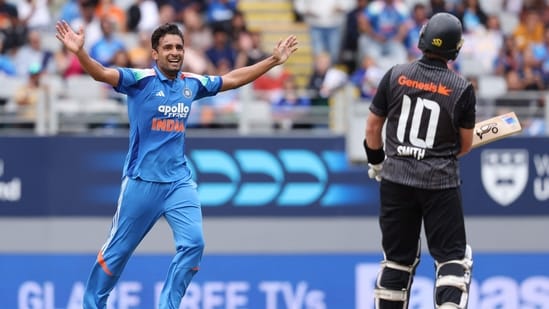
{{/usCountry}}The same Kamboj who struggled against the West Indies all of a sudden looked unplayable. He went for the Test-match length all through, and the Kiwi batters just didn't know what to do against him. He bowled 46 dot balls, an ODI record for an Indian pacer, overtaking Jasprit Bumrah's 45. The 25-year-old finished his quota of overs with superb bowling figures of 10-2-22-2.
Nabi didn't have as extraordinary a game, but he was also a bit unlucky. A miscued Tim Seifert pull shot was dropped by Naman Dhir at square leg early in the Jammu and Kashmir pacer's spell. He was denied his first international wicket. Nothing adds to a rookie pacer's confidence more than wickets.
But overall it wasn't a bad outing for Nabi. He gave away 33 runs in six overs, and in the first couple of overs of his, there were occasions when he gave a good display of swing bowling. Let's not forget Gurnoor Brar, another one who had taken a lot of beating against the West Indies with figures of 0/60, 2/96 and 1/64 in 9.1 overs but on Wednesday, he impressed with 3/44.
Short-pitched balls creating mayhem
To be fair, it was also fun to watch batters struggling a bit. The top three of the Kiwi batting line-up -- Will Young, Seifert and Henry Nicholls -- weaned on these pitches, failed to come to terms with short-pitched stuff. Gill, Virat Kohli – that, after he made a masterful 74 -- Axar Patel and Shreyas Iyer were similarly victims of short-pitched deliveries.
The Auckland ODI reinstates the importance of conditions, and how they can make one look good or bad if they are not up one's alley.
“Loving the weather here and there is good purchase off the surface. After coming from the subcontinent, when you see some life in the wickets, it's always a pleasure. And yeah, the wind is helping as well,” Arshdeep Singh, who took 4/70, said at the innings break.
Cricket will be better served if there are more such pitches. Bowlers have been at the receiving end for so many years now in white-ball cricket, especially since the advent of franchise T20 leagues in the late noughties.
The International Cricket Council (ICC) has also embraced rules that lean in favour of batters, under the impression that batting is more enjoyable and that it alone brings crowds to the stadiums or to TV.
Flat pitches, powerplays, two new balls in ODIs, just one bouncer in an over, smaller boundaries and exceptional modern bats have made bowlers look like rabbits caught in the headlights.
Maybe the ICC is right, but there has to be some balance between bat and ball. Bowlers need favourable conditions to impress in limited-overs cricket too, and it's not going to hurt the game in any way, if anything, the sport will be richer.