South Africa are preparing for the 2027 ODI World Cup with an infrastructural experiment that could influence the tournament before the first ball. Cricket South Africa’s exchangeable pitch system, or EPS, is designed to ease the strain on the country’s grounds without eroding the character that has set Johannesburg, Cape Town, Durban and Centurion apart.
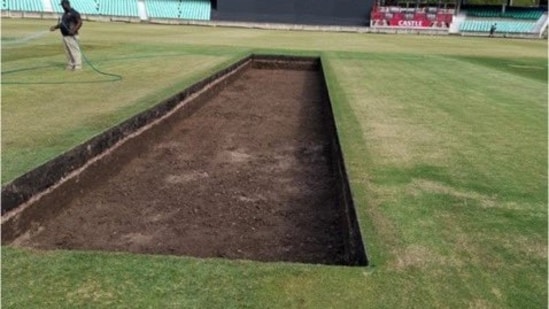
The concept differs from the conventional Australian drop-in model. Rather than producing a standardised surface for a multi-purpose stadium, South African venues are cultivating their own pitches in steel trays away from the main square, using local bulli soil, preferred Cynodon grass varieties and venue-specific preparation methods. Once mature, those surfaces can be moved into the square, used, removed and rehabilitated while another strip carries the workload.
The objective is not to manufacture uniformity, but to create flexibility. South Africa’s grounds must accommodate men’s and women’s internationals, domestic competitions and SA20 cricket, leaving groundsmen with little room to extensively rehabilitate parts of the square without sacrificing capacity.
Hilbert Smit, Cricket South Africa’s long-time pitch consultant, explained that pressure on ESPNcricinfo. “In South Africa, we haven’t really installed new pitches for many years, because we can’t. We can’t just take one of the pitches out for a season because that will reduce capacity, and we just don’t have that luxury. So we are introducing an exchangeable pitch system, and we don’t want to call it drop-ins because that’s not what it is.” The significance of that innovation becomes sharper when viewed through the prism of the 2027 World Cup.
Why EPS could matter in 2027
The obvious question is how many World Cup matches might actually be staged on exchangeable pitches. Yet that is unlikely to be the defining measure of the system’s relevance. The Wanderers is the furthest advanced and has already hosted professional cricket on an exchangeable surface, while other venues remain at different stages of development.
{{/usCountry}}The obvious question is how many World Cup matches might actually be staged on exchangeable pitches. Yet that is unlikely to be the defining measure of the system’s relevance. The Wanderers is the furthest advanced and has already hosted professional cricket on an exchangeable surface, while other venues remain at different stages of development.
{{/usCountry}}CSA have been deliberately conservative about the timetable. Their consultants regard roughly 12 to 18 months as the maturation window before a newly constructed pitch can be trusted at the elite level, an approach shaped partly by what happened in New York during the 2024 T20 World Cup. Evan Flint, also speaking to ESPNcricinfo, distilled that lesson neatly: “the one thing you can’t buy is time.”
That philosophy may prove more consequential than the technology itself. South Africa do not need EPS to dominate the World Cup for it to matter. Its greatest contribution could come before the tournament, when exchangeable pitches absorb SA20 matches, domestic fixtures or selected internationals and shield sections of the permanent square from repeated use.
For ODI cricket, that matters enormously. A fatigued surface does not always become dramatically spin-friendly or excessively slow; often, its deterioration is subtler and more disruptive. Variable pace, uneven bounce and two-paced behaviour can distort a contest by introducing uncertainty that is neither technically rewarding nor tactically humiliating.
EPS gives groundsmen a deeper inventory of viable surfaces. Rather than repeatedly returning to a heavily worked strip, a venue can rotate another pitch into service, allow an established surface to recover and preserve more options for the World Cup itself. The early Wanderers experiment is instructive because it suggests that flexibility comes at the cost of identity. The surface reportedly retained the familiar Johannesburg bounce while still offering enough purchase for spin, an equilibrium central to the system’s long-term credibility.
That matters because South African venue identity is one of the country’s great tactical assets. Johannesburg and Centurion are associated with bounce and carry; Durban has increasingly developed a slower, more spin-responsive profile, while Cape Town brings its own blend of seam, pace and climatic influence. If exchangeable pitches rendered those distinctions indistinct, CSA would solve a logistical problem only by creating a sporting one.
The system has instead been conceived around local materials and behaviour. In principle, it changes how a pitch is cultivated, rested and transported rather than prescribing how it should play. That preserves the prospect of historical venue characteristics surviving even as the maintenance model becomes more sophisticated.
For teams, preparation could become more exciting. Traditional ground trends would still matter, but coaches may need to interrogate the precise surface: how long it has been matured, when it entered the square, how much grass has been retained, how heavily it has been used, and how recently it was rehabilitated.
The 2027 World Cup is therefore unlikely to be remembered as the moment exchangeable pitches suddenly replaced South Africa’s traditional squares. Their influence could be quieter and more consequential. If EPS allows the country’s major venues to arrive at the tournament with fresher, more reliable surfaces while preserving their idiosyncrasies, the innovation may shape the World Cup without ever becoming its most visible feature.