Live Score
 Cricket Teams
 Cricket Players
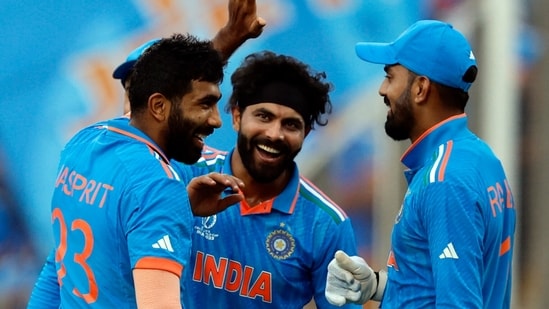
World Cup 2023: Bumrah, Jadeja and the economical way to victory
The confluence of Bumrah and Jadeja, varied in skills but never wavering in discipline, is central to why average score against India in this tournament is 238


Jasprit Bumrah’s first over in Dharamsala to New Zealand’s Devon Conway comprised outswingers on the first, second, third, fifth and sixth deliveries. The fourth delivery was an inswinger, a weapon that Bumrah has honed over the years for judicious use. Three of these deliveries landed on good length, a couple were just a tad fuller while one pitched back of a length. The outswingers followed a similar path – they started on a middle-stump line and finished on off or just outside it. The inswinger started outside the line of off stump and curved in to finish on off.
Subtle changes in length more than line, but what wasn’t on offer was a loose delivery. One that the left-handed Conway could put away or nudge for a single to open his account for the day. Conway either got beaten, defended with soft hands or left the ball alone. Maiden.
This was just the first over of one among five games that India have played in this World Cup – he didn’t even take a wicket in it -- but it’s a microcosm of how India’s pace spearhead has bowled all through this tournament. More eye-catching may be the yorker that nearly busted Mahmudullah’s toes or the off-cutter that befuddled Mohammad Rizwan, but it’s impeccable control that is fundamental to Bumrah’s modus operandi. He’s the only pacer in the World Cup with an economy of under four. He has 11 wickets too.
Control is at the core of Ravindra Jadeja’s left-arm spin too. He may rush through his overs as if he has errands to run, but Jadeja will never veer away from his length. Which is invariably in that in-between zone, neither allowing the batter to step forward and drive nor move back and cut. He’s the only spinner in the World Cup with an economy of under four. He has seven wickets too.
The confluence of Bumrah and Jadeja, varied in skills but never wavering in discipline, is central to why the average score against India in this tournament is 238. The overall average score is 288. Take out the five innings against India, and the average score is 300, which is par in one-day cricket today.
The highest total India have conceded is 273 versus New Zealand, at the HPCA Stadium in Dharamsala where containment is not easy because the ball travels further in high altitude. That total seemed set to be much more when the duo of Daryl Mitchell and Rachin Ravindra were imposing themselves in the middle phase.
For once in this tournament, Kuldeep Yadav was not having his way against two batters who provided a masterclass on how to play left-arm wrist spin. Willing to step out of the crease at the slightest sign of flight, they smothered the spin and targeted down the ground to good effect. But if Rohit Sharma never lost control of proceedings on the field at any stage of that game or indeed the whole tournament, it’s because runs have seldom leaked from both ends. When Kuldeep was taken off after his first four overs went for 35 runs, Jadeja’s six overs had cost only 25 runs. Jadeja went on to complete his spell uninterrupted, for tidy figures of 10-0-48-0.
Their excellent economy rates are a byproduct of the nagging lengths they’ve repeatedly hit. In Bumrah’s case, 66% of his deliveries are on good length, yielding six wickets at an economy of 3.06. Jadeja has bowled 92% of his deliveries on that length for all seven of his wickets.
Even when Bumrah is armed with a new Kookaburra in the Powerplay, he doesn’t usually let his consistency suffer at the altar of wickets. Unlike Siraj who attempts to entice batters into playing the expansive drive with more balls in the full zone – he has an economy of 5.9 -- Bumrah is content with bombarding that good length and letting batters commit mistakes instead. That he has an economy of 2.9 and only two wickets with the new ball provide evidence.
“See obviously in this format you have to understand what is working. So, some days there would be some swing so your lengths would change,” Bumrah had said earlier in the tournament. “We are just trying to hit the hard length, try to make it as difficult as possible and try to make them hit difficult shots. So that was the plan and probably trying to do that.”
Ditto Jadeja, who plugs away ball after ball without ennui. It allows Kuldeep to experiment just a bit more with his variations and speeds, assured in the knowledge that Jadeja is holding things tight at the other end.
It’s not just about restriction of course. Because top batters in this day and age will eventually find a way of catching up if they stay in long enough. But India’s bowlers have capitalised on the pressure created to squeeze breakthroughs at regular intervals too. In their five matches, they’ve taken 46 of 50 wickets.
This is in turn resulting in exactly the kind of chases that India, and particularly Virat Kohli, revel in. There was apprehension in the build-up to the tournament that India’s batters are behind the one-day curve when it comes to chasing 320-plus totals. That we still don’t know how India will respond to a chase in that range is credit to Bumrah, Jadeja and the entire bowling unit.