Uttarakhand government will create four open forest enclosures spread over 70 hectares (ha) with a capacity to house over 25,000 monkeys to check the growing simian menace in the Himalayan state.
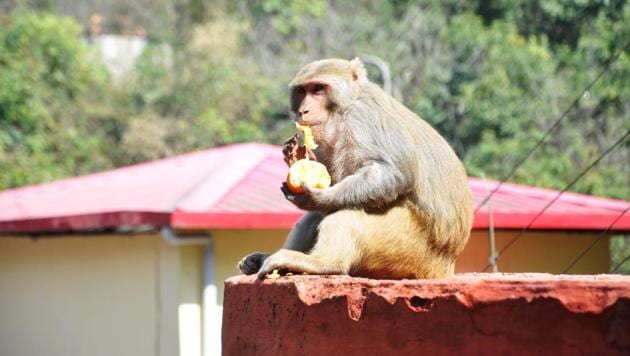
The initiative is touted to be the country’s largest project to catch monkeys and shift them to open forest enclosures.
Uttarakhand chief minister Trivendra Singh Rawat made the announcement during a press conference on Friday on the completion of three and a half years of the Bharatiya Janata Party (BJP)-led government.
He said that many wild animals such as monkeys, wild boars and elephants have been raiding agricultural fields and damaging crops and vegetable gardens, much to the dismay of the aggrieved farmers.
Rawat said the state government has decided to take some concrete steps to check the menace.
“We are setting up four rescue centres, or open forest enclosures, where around 25,000 monkeys will be kept. These enclosures will be ready for inauguration on the occasion of the state formation day on November 9 (Uttarakhand was carved out of Uttar Pradesh on this day in 2000),” the CM said.
Rawat said in a bid to check wild boars, the state government would erect around 25-kilometre (km)-long fencing in various parts of the state. “Elephants will be prevented from raiding farms and damaging crops by digging a 250-km-long trench. There will be a 13-km-long wall to block the invading pachyderms. A 15-km-long solar fencing will also be erected to contain the stray elephants,” he said.
{{/usCountry}}Rawat said in a bid to check wild boars, the state government would erect around 25-kilometre (km)-long fencing in various parts of the state. “Elephants will be prevented from raiding farms and damaging crops by digging a 250-km-long trench. There will be a 13-km-long wall to block the invading pachyderms. A 15-km-long solar fencing will also be erected to contain the stray elephants,” he said.
{{/usCountry}}JS Suhag, chief wildlife warden, Uttarakhand, said four open forest enclosures for monkeys would be constructed spread over 70 ha in Haridwar, Nainital, Almora and Pithoragarh districts.
“This is the largest project in the country to catch and shift monkeys to such open enclosures. The enclosures in Haridwar and Nainital districts will be spread over 25 ha each. These facilities will have a capacity to keep around 10,000 monkeys each. The enclosures in Almora and Pithoragarh districts will be spread over 10 ha each. The enclosures will have the capacity to house 2,500 monkeys each. Altogether, the four enclosures will have a cumulative capacity to accommodate 25,000 monkeys,” he said.
Suhag said the state government had written to the Centre earlier this year, seeking permission to declare monkeys as vermin in the hill state but the approval is still pending.
“This is the third time that Uttarakhand is seeking permission to declare monkeys as vermin. However, the Centre has asked the state government for the details of the simians killed in the past when the permission was given. As no monkeys were killed, the Centre is questioning the state government the reason behind declaring the simian as vermin,” he added.
Qamar Qureshi, a scientist at Wildlife Institute of India (WII) in Dehradun, who is working on developing an immuno-contraceptive for monkeys, said the proposed enclosures are a good move as killing monkeys by declaring them vermin would not work in the long run.
“In these open forest enclosures, monkeys can at least live the way they do in their natural habitat. This move will help check the menace in areas, where it has become a major problem. In areas, where the menace is still relatively less, the authorities should use sterilisation for birth control of monkeys,” he said.
The man-monkey conflict is increasing in the Himalayan state because the authorities have failed to come up with an effective long-term solution to curb the menace. Monkeys often stray near human habitations, roads and tourist spots in search of food, leftovers. They also raid kitchen gardens and small hill farms, as a large percentage of the hill state is under forest cover.
Farmers consider monkeys as an evil force because there is limited scope for agriculture in the hill state. In the past, farmers in some areas of the Kumaon division had started agitations against the growing monkey menace.
The state government has been conducting sporadic campaigns to catch monkeys and sterilise them. Each sterilisation procedure costs the state exchequer around Rs 700.