The Delhi government said on Sunday it expected the fresh surge in coronavirus disease (Covid-19) cases in the national capital to stabilise in 10-15 days, even as it announced measures to augment health care infrastructure in the city to tackle growing active cases and boost the critical care system at hospitals.
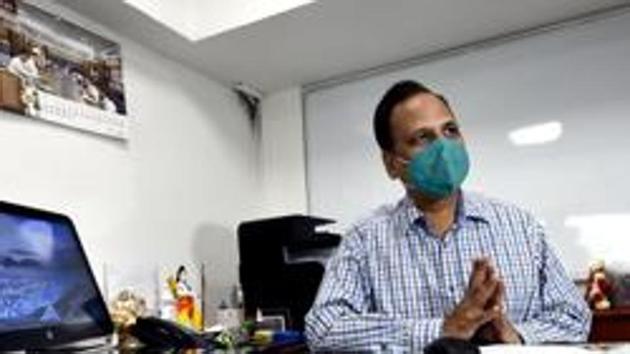
Delhi health minister Satyendar Jain ruled out further lockdown restrictions in Delhi, arguing that they were no longer a solution to the pandemic and implored the public to wear masks and maintain hygiene.
“It [the surge] is very much on expected lines, and will stabilise in 10-15 days,” he said at a digital news conference.
Jain attributed the spike to aggressive testing undertaken by the Delhi government in recent days, as well as the easing of restrictions in a bid to revive the economy, which was hit severely by the pandemic.
All private hospitals treating Covid-19 patients in Delhi have been allowed to increase their bed capacity by up to 30% and 33 major private hospitals have been asked to reserve 80% of their intensive care unit (ICU) beds for patients suffering from the viral infection.
The move to augment hospital bed capacity comes at a time when Delhi is seeing a record surge in Covid-19 cases. The Capital on Saturday added 4,321 new cases of Covid-19 — the highest single-day spike in the city so far. Another 4,235 new cases of the infection were added on Sunday.
{{/usCountry}}The move to augment hospital bed capacity comes at a time when Delhi is seeing a record surge in Covid-19 cases. The Capital on Saturday added 4,321 new cases of Covid-19 — the highest single-day spike in the city so far. Another 4,235 new cases of the infection were added on Sunday.
{{/usCountry}}He said that although around 50% Covid-19 beds in the city were vacant, ICU beds at a few major private hospitals were running out, with patients preferring private health care facilities to government-run ones.
“I held a meeting through a video conference with all private hospitals on Saturday. They have agreed to our plan. Orders have been issued to allow all Covid-19 hospitals in the city to increase their bed capacity by 30%, if required, while 33 major private hospitals have been asked to reserve 80% of their total ICU beds for Covid-19 patients. These are hospitals that have 50 beds or more. If some of these ICU beds are currently occupied with non-Covid patients, then they must be included for Covid-19 patients after the existing ones are discharged,” Jain said.
The minister explained that if a Covid-19 hospital has 100 beds, it would be allowed to increase its capacity to 130 beds, according to the latest order.
At present, Delhi has 14,372 hospital beds, of which 7,924 are lying vacant. Of these, 489 ICU beds with ventilators and 277 ICU beds without ventilators are unoccupied.
The Delhi government’s decision came after chief minister Arvind Kejriwal on September 9 asked officials to draft a plan to increase Covid-19 bed capacity in Delhi, especially ICU beds.
As HT first reported on September 9, the situation is worse in multi-speciality private hospitals in the national capital. Over 89% of ICU beds with ventilators in 11 private hospitals were occupied until Friday, while 82% of ICU beds without ventilators in eight private hospitals were also filled on that day.
Delhi recorded the highest-ever total hospitalisation due to the contagion in a single day on Friday after 6,294 people were admitted. The previous record was 6,264 during the Covid-19 surge in the city in June-July.
“Wearing masks reduces the chances of spreading and contracting Covid-19 significantly. The public should wear masks. The government is also running an intensive awareness campaign on the importance of masks. Everyone should wear a mask and follow strict social distancing norms. We have moved far away from the times of lockdown. That (lockdown) is not going to happen again,” Jain added.
Hospitals and mohalla clinics are also testing asymptomatic people amid a boost in testing in the Capital.
However, the count of the reverse transcription-polymerase chain reaction (RT-PCR) tests, considered to be the most accurate to diagnose Covid-19, continued to remain low in comparison with the less accurate rapid antigen detection (RAD) test.
Data showed 9,182 swab samples — 15% of all the tests — were tested on Friday using the RT-PCR method, according to Saturday’s health bulletin.
Jain said the results of the third serological survey, which was conducted in Delhi between September 1 and 5, would be announced in a few more days as the study of the samples is still in progress.
He added that the test positivity ratio of Delhi of a single day is 7.19%, whereas the national test positivity rate is about 8.8%. “Delhi recorded 28 deaths as per Saturday’s bulletin which brings down the mortality rate of the last 10 days in Delhi to about 0.68%, which is much lower when compared to the national average of 2.23%,” Jain said.
The Delhi government’s decision to reinforce hospital bed capacity is on the right track, said Dr Lalit Kant, former head of epidemiology and infectious disease at the Indian Council of Medical Research (ICMR).
“It is good that the government has finally done something about the low availability of ICU beds in major private hospitals. The government, however, should also simultaneously improve its contact-tracing exercise. Also, surveillance should be strengthened further and suspected [Covid-19-positive] persons outside containment zones need to be checked for Covid-19 with an RT-PCR test,” he said.
Private health care providers cautioned that the move could endanger the lives of non-Covid patients in need of emergency or other life-saving care. Some associations plan to make a representation to the Delhi government on Monday and take legal recourse, if necessary.
“The patients who had been delaying their surgeries and other planned procedures have started coming into the hospitals in the last one month, with most of the big private hospitals running at least 90% of their total ICU capacity. If you look at the statistics from these bigger hospitals in the last three months, they received about 2.5 times non-Covid-19 patients than Covid-19 patients. This means the government would be jeopardising the lives of these non-Covid-19 patients,” said Girdhar Gyani, director general of the Association of Healthcare Providers (India).
“Apart from that, this move is also penalising the private hospitals economically. When they say 80% of the ICU beds have to be reserved, it means the beds have to be reserved even if there aren’t any Covid-19 patients. But, the government would not be paying the hospitals. It is one thing to say ‘reserve 500 beds and we will pay for it’. Besides, why should ICU beds be kept vacant when someone else might need it,” said Gyani.
Sir Ganga Ram Hospital, one of the 28 that has been directed to reserve beds, already has a high percentage of beds set apart for Covid-19 patients and the problem is one of sufficient staff, according to hospital authorities.
“We had been asked to create a 100-bed ICU initially when we had met the health minister even before the June surge. So, we have been slowly able to ramp up our capacity. Now, we have 117 of 167 beds reserved for Covid-19 patients, but with almost all big hospitals doing so there will be a problem for non-Covid-19 patients. For us, the challenge will be manpower, more staff is needed for Covid-19 ICUs so we are in the process of hiring more nurses. Our doctors are also exhausted now,” said Dr DS Rana, chairperson of the board of governors at the hospital.
Stay updated with all top Cities including, Bengaluru, Delhi, Mumbai and more across India. Stay informed on the latest happenings in World News along with Delhi Election 2025 and Delhi Election Result 2025 Live, New Delhi Election Result Live, Kalkaji Election Result Live at Hindustan Times.
Stay updated with all top Cities including, Bengaluru, Delhi, Mumbai and more across India. Stay informed on the latest happenings in World News along with Delhi Election 2025 and Delhi Election Result 2025 Live, New Delhi Election Result Live, Kalkaji Election Result Live at Hindustan Times.