Monsoon is a celebration of the green. So every year, the city authorities dedicate the season to planting saplings. This time, though, Delhi’s greening drive is getting a bigger push and higher targets. The Delhi government, which started its annual plantation exercise on Friday, aims to plant at least one million new trees and half a million shrubs by next spring.
In the past, government’s plantation drives favoured non-native varieties because of their pretty looks. But the exotic ones grew up to be resource-hungry bullies and often edged out the native species. The authorities are wiser now. So this time, the plan is to plant only native species such as Amaltas, Kadam, Sakar, Peepal and Shahtoot.
For any plantation drive to be successful, the authorities have to ensure that the saplings survive. But no more than 20%-30% live to see the next season. After failing to enforce a third-party audit last year, chief minister Arvind Kejriwal has promised tougher inspections at all plantation sites this monsoon.
As an old Chinese proverb goes, the best time to plant a tree was 20 years ago. The second best time, of course, is now. If the past mistakes have been a lesson, Delhi should have many more saplings growing up to become robust trees in the coming years. But one wishes there was also a plan to resuscitate the existing ones.
Trees have been the worst casualty in Delhi’s urbanisation. More than one lakh trees were cut between 2006 and 2014 to make way for the metro, roads, flyovers and government buildings, the Delhi high court was informed last year. Proposals to cut more are awaiting approvals.
{{/usCountry}}Trees have been the worst casualty in Delhi’s urbanisation. More than one lakh trees were cut between 2006 and 2014 to make way for the metro, roads, flyovers and government buildings, the Delhi high court was informed last year. Proposals to cut more are awaiting approvals.
{{/usCountry}}Freeing up roadside trees from concrete has been another battle. There have been at least three court cases — the latest one in the National Green Tribunal. There are government guidelines against harming trees, a tree preservation law, and numerous affidavits filed by public utilities swearing “compliance”.
Harming a tree attracts prison term of up to one year or a fine of up to `1,000 or both. Still, at least 200 full-grown trees die every year due to water scarcity, excessive concretisation and diseases. A large number of New Delhi’s neglected avenue trees are 80-100 years old, planted at the time the British built the Capital. Many cities across the world treat trees of such vintage as they treat heritage buildings.
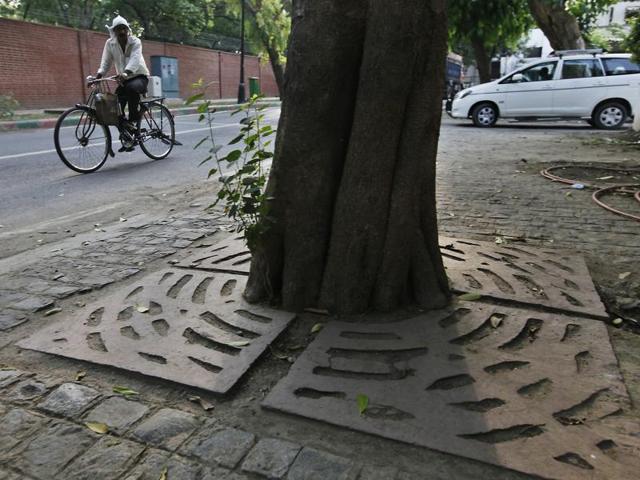
It is mandatory to leave 6x6 feet open space around each tree while paving footpaths. But most city trees are sealed with cement or impaled, lopped and hammered to put metal boards. Wheel traffic, overflowing wastewater and construction rubble have such compacting effect on the top soil that nutrients and water do not reach the roots. The result is stunted, drought-stressed trees even in the best of monsoon.
The Delhi Preservation of Trees Act, notified in 1994, calls for a tree count but the first city-wide survey is yet to be conducted. In 2005-06, the New Delhi Municipal Council did count the roadside trees in the VIP zone, studied their health and also got itself a tree ambulance, the only such facility in Delhi.
Having long waited for the government, residents of Sarvodaya Enclave were the first to conduct a tree census in 2013. Gulmohar Park and Vasant Vihar are following suit. More than numbers, the health of the trees is the priority of these residents. But elsewhere in Delhi, the roadside trees are still waiting for a medical check-up.
Trees are an asset. They deal with atmospheric pollution, a dire problem in Delhi that houses nine million vehicles. Studies show that a single tree releases enough oxygen to sustain two people. Trees also replenish groundwater, which could be a boon in a city like Delhi that has already been sucked dry.
A hundred mature trees can reduce runoff caused by rainfall by up to 100,000 gallons, says the US Department of Agriculture. Delhi spends `500 crore annually on waterlogging and flood control measures. Yet, one downpour turns Delhi’s streets into streams.
One of the world’s greenest capitals, Delhi has been lucky to have an enviable tree density. With its river and air turning noxious, the last thing the city can afford today is to lose that insurance.
Stay updated with all top Cities including, Bengaluru, Delhi, Mumbai and more across India. Stay informed on the latest happenings in World News along with Delhi Election 2025 and Delhi Election Result 2025 Live, New Delhi Election Result Live, Kalkaji Election Result Live at Hindustan Times.
Stay updated with all top Cities including, Bengaluru, Delhi, Mumbai and more across India. Stay informed on the latest happenings in World News along with Delhi Election 2025 and Delhi Election Result 2025 Live, New Delhi Election Result Live, Kalkaji Election Result Live at Hindustan Times.