On Tuesday, the world’s most powerful rocket ever was launched from the Kennedy Space Center in Florida, United States. SpaceX’s Falcon Heavy was successfully tested on its first attempt, an achievement that is important for two reasons: One, Falcon Heavy, which is essentially an assembling of three Falcon 9s (SpaceX’s workhorse), is now way ahead — and by ahead, really ahead — of competition in the so-called heavy-lift category. It can place about 64 tonnes payload, which is more than twice the payload of its nearest competitor ULA’s Delta 4 Heavy, in a single launch into the Lower Earth Orbit (LEO). The scientific and commercial windows this opens are many. It will enable the launch of heavier payloads, encourage the private sector to participate in space-related missions, and also, as seen across social media, get planetary scientists discussing its impact. Simply put, Falcon Heavy is a game changer in the space race.
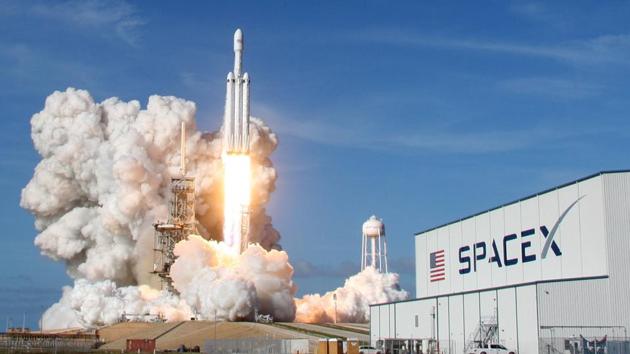
Second, SpaceX , a company promoted by Elon Musk, has shown that it can not only easily reach the LEO (and go beyond), but has also done this using reusable boosters which will drastically cut the costs of launching satellites. At an estimate of about $90 million per launch, it already costs only about a fourth the current rate for launches in that payload category.
It’s not that the launch was a complete success. There were a few hiccups. Mr Musk’s Tesla Roadster, the mock payload on Falcon Heavy, which was supposed to revolve around the Sun at a distance of the Mars’ orbit, has overshot its trajectory and is now in the asteroid belt, between Mars and Jupiter and precariously close to the Ceres’ orbit. The second hiccup — one which should be bothering Mr Musk more — is the failure of the main booster to dock on the drone ship, showing that the rocket’s ocean-borne landing is yet to be perfected.
With Tuesday’s launch, Mr Musk proved that he is not only an entrepreneur, but also a great public relations tactician (and, of course, fan-boy par excellence) . The Roadster can be seen as space junk, because except for its novelty factor, there’s no scientific or academic purpose for sending an automobile into space. Adding to this is the fact that the mannequin in the driver’s seat is wearing a SpaceX spacesuit, and David Bowie’s Space Oddity is playing in endless loop on the radio in the car, and the glove compartment has a copy of Douglas Adams’ The Hitchhiker’s Guide To The Galaxy. The car’s dashboard also has a message that says “Don’t Panic”, the enduring tenet of the Hitchhiker books.
{{/usCountry}}With Tuesday’s launch, Mr Musk proved that he is not only an entrepreneur, but also a great public relations tactician (and, of course, fan-boy par excellence) . The Roadster can be seen as space junk, because except for its novelty factor, there’s no scientific or academic purpose for sending an automobile into space. Adding to this is the fact that the mannequin in the driver’s seat is wearing a SpaceX spacesuit, and David Bowie’s Space Oddity is playing in endless loop on the radio in the car, and the glove compartment has a copy of Douglas Adams’ The Hitchhiker’s Guide To The Galaxy. The car’s dashboard also has a message that says “Don’t Panic”, the enduring tenet of the Hitchhiker books.
{{/usCountry}}As Mr Musk said: “It’s kind of silly and fun, but silly and fun things are important.”