As KP Sharma Oli prepares for his fourth stint as Nepal’s prime minister, it would be instructive to recall that no premier of that country has completed a full term since 1990. Oli is back after the fall of the government led by former prime minister Pushpa Kamal Dahal “Prachanda”, who couldn’t survive a vote of confidence in Parliament after Oli’s Communist Party of Nepal-Unified Marxist-Leninist (CPN-UML) joined hands with Sher Bahadur Deuba’s Nepali Congress (NC) to form a new
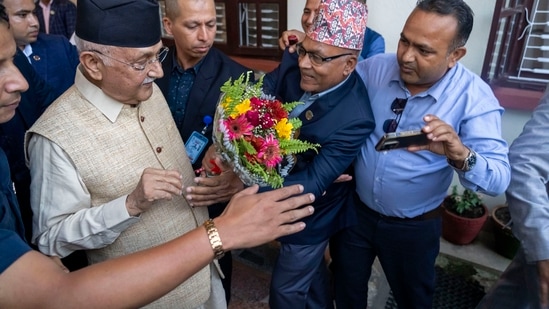
As KP Sharma Oli prepares for his fourth stint as Nepal’s prime minister, it would be instructive to recall that no premier of that country has completed a full term since 1990. Oli is back after the fall of the government led by former prime minister Pushpa Kamal Dahal “Prachanda”, who couldn’t survive a vote of confidence in Parliament after Oli’s Communist Party of Nepal-Unified Marxist-Leninist (CPN-UML) joined hands with Sher Bahadur Deuba’s Nepali Congress (NC) to form a new coalition. Under a power-sharing agreement, the post of prime minister will rotate between Oli and Deuba for the remaining term of the current House of Representatives. The CPN-UML and Nepali Congress, despite being political rivals and having different ideologies, have shared power about half a dozen times in the past, the most recent being a decade ago.
Occupying the post of prime minister in Nepal has become akin to a game of musical chairs over the past decade, with most occupants, other than Oli and Dahal, having exceptionally short stints. This political instability, arising mostly from the fractured mandates produced by successive elections, has had wide-ranging impacts on Nepal’s economy and overall development. In his last term, Oli moved his country closer to China and triggered a row with India by issuing a new political map that sought to claim territories controlled by India. The Indian side will be hoping that the presence of the Nepali Congress, which has had long-standing ties with India’s political leadership, will help balance the new government’s foreign policy stance.
For India, against the backdrop of its strained ties with China, it will be essential that the new dispensation in Kathmandu maintains a balanced position between the two Asian giants. New Delhi will also do well to step up various initiatives aimed at creating physical, transport and energy connectivity between India and Nepal.
One Subscription.
Get 360° coverage—from daily headlines
to 100 year archives.
Archives
HT App & Website