To dominate a country as culturally and linguistically diverse and geographically massive as India, a political party needs to have a robust organisation. Key cogs in this structure might not always get the media limelight that ministers and lawmakers do, but they are often no less powerful and consequential, wielding enormous powers to decide the party’s strategy, issues, manifestoes, candidates, and funds. Over the past decade, even as the BJP faced some electoral setbacks, it rarely floundered on organisation —
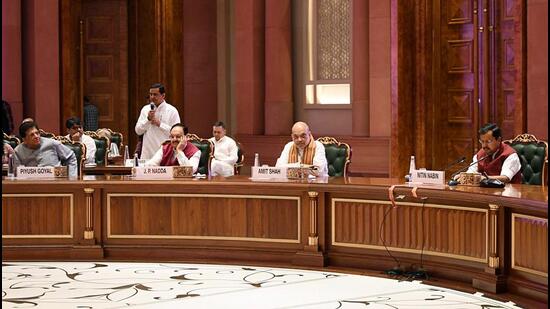
To dominate a country as culturally and linguistically diverse and geographically massive as India, a political party needs to have a robust organisation. Key cogs in this structure might not always get the media limelight that ministers and lawmakers do, but they are often no less powerful and consequential, wielding enormous powers to decide the party’s strategy, issues, manifestoes, candidates, and funds. Over the past decade, even as the BJP faced some electoral setbacks, it rarely floundered on organisation — swapping chief ministers with ease when other parties made a mess, tightly controlling Rajya Sabha polling when the Opposition routinely failed to tamp down on dissidence, and enforced intra-party discipline with an iron hand.
This is one of the two reasons why the long-pending announcement of the BJP’s new organisational structure — roughly seven months after party chief Nitin Nabin took over — is important. The new team sees the return of Union minister Piyush Goyal as national treasurer, and by turning to an experienced and senior hand, the party may be strengthening what it sees as a relative weakness. The team also comprises people making a significant comeback — Ram Madhav and Tirath Singh Rawat as vice-presidents, and Smriti Irani as general secretary key among them — alongside an influx of young and women leaders. Six of the 13 vice-presidents are women, helping the BJP make the case that it is following the spirit of women’s reservation in its internal appointments and increasing the pressure on other parties to follow suit. Some party wings — such as those for women or young people — have new chiefs, as does the party’s IT cell, which was criticised by many as being out of step with young people during the recent student protests. By bringing back some heavyweight leaders, retaining key figures, and inducting a host of young faces — including rewarding turncoats such as Sandip Pathak — the party is attempting continuity while reflecting its expanded geographical reach by giving representation to regions such as West Bengal and the Northeast.
The other reason is that this announcement is a pivotal step leading to the long-awaited Cabinet reshuffle. PM Narendra Modi is usually reticent with ministerial changes, preferring big-bang reshuffles over incremental tweaks. Since the NDA government took oath for the third time in 2024, the BJP has won landmark electoral battles and decimated the Opposition but also faced improbable resistance from unorganised young people and simmering discontent over jobs and education. As a party with multiple feedback channels, the BJP must be forging a new strategy to surmount these new challenges. Monday’s announcements give a glimpse of this new plan, and suggest possible openings and changes. The whole picture will likely be unveiled by a refreshed Cabinet.
One Subscription.
Get 360° coverage—from daily headlines
to 100 year archives.
Archives
HT App & Website