A court-ordered survey of a section of the Kashi Vishwanath Temple-Gyanvapi Masjid complex in Varanasi has sparked off yet another controversy. What persuaded a local civil court to order the videography and inspection of the religious site was a demand to collect triable evidence as to whether Hindu religious structures were partially razed to build the 17th-century mosque. The plaintiffs, five Hindu women, have asserted their constitutional right under Article 25 to worship in the mosque area, where they say,
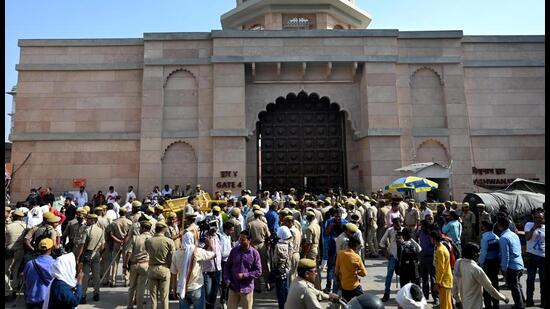
A court-ordered survey of a section of the Kashi Vishwanath Temple-Gyanvapi Masjid complex in Varanasi has sparked off yet another controversy. What persuaded a local civil court to order the videography and inspection of the religious site was a demand to collect triable evidence as to whether Hindu religious structures were partially razed to build the 17th-century mosque. The plaintiffs, five Hindu women, have asserted their constitutional right under Article 25 to worship in the mosque area, where they say, various visible and invisible deities existed.
The court entertained the civil suit despite a Constitution bench of the Supreme Court (SC) unequivocally delineating the contours of the 1991 Places of Worship Act, when it ruled on the Ayodhya land dispute in 2019. The Act laid down that a religious place will retain the same character it had on August 15, 1947 and that no suit or legal proceedings can be initiated in this regard. The Ram Janmabhoomi-Babri Masjid dispute was specifically kept outside the applicability of the Act and hence, the trial in the Ayodhya case could proceed. The 2019 verdict by the top court cemented into the sphere of Indian constitutional jurisprudence the principle of “non-retrogression” of rights as it underscored that it is not open to raking up all kinds of disputes, pertaining to the religious nature of a place of worship, at any time. The non-retrogression principle holds that the government may extend protection beyond what the Constitution requires, but it cannot retreat from that extension once made. In preserving the character of places of public worship, Parliament has mandated that history and its wrongs shall not be used as instruments to oppress the present and the future, highlighted the apex court.
The Constitution bench was emphatic that the Act is a constitutional basis for healing the injustices of the past by providing confidence to every religious community that their places of worship will be preserved. However, the civil court has accepted the plaintiffs’ argument that it is imperative to first ascertain the “religious character” of a place of worship before ascertaining the protection available under the Act. The approach of the civil court – and another petition filed in the Allahabad high court, yet to be heard, on opening 20 rooms in the Taj Mahal to check for the presence of Hindu idols – is fraught with the perils of not only opening a Pandora’s Box of unending disquiet between communities but also negating the objective of the Places of Worship Act. Further, it falls foul of the principle of non-retrogression, which the SC has termed a foundational feature of fundamental constitutional principles.
One Subscription.
Get 360° coverage—from daily headlines
to 100 year archives.
Archives
HT App & Website