The record price for a Raja Ravi Varma painting — ₹167.20 crore for his 1890s work, Yashoda and Krishna — reveals the enduring attraction for this pioneering artist from Kerala as well as the shifting aesthetic choices among art collectors. Until now, it was mostly artists such as MF Husain, Vasudeo Gaitonde, Tyeb Mehta, Sayed Haider Raza, Francis Newton Souza, all of them affiliated with the then Bombay-centred Progressive Artists’ Group, and also, Amrita Sher-Gil, who commanded attention in
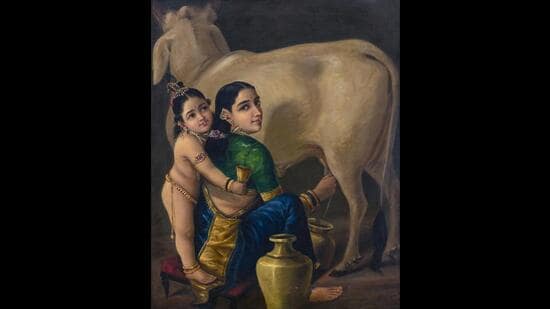
The record price for a Raja Ravi Varma painting — ₹167.20 crore for his 1890s work, Yashoda and Krishna — reveals the enduring attraction for this pioneering artist from Kerala as well as the shifting aesthetic choices among art collectors. Until now, it was mostly artists such as MF Husain, Vasudeo Gaitonde, Tyeb Mehta, Sayed Haider Raza, Francis Newton Souza, all of them affiliated with the then Bombay-centred Progressive Artists’ Group, and also, Amrita Sher-Gil, who commanded attention in Indian art auctions. Now, a Mumbai-based collector has brought back Raja Ravi Varma to the centre stage.
Raja Ravi Varma, who was influenced both by the work of European Renaissance artists and the Kerala mural traditions, drew his material mostly from the Hindu puranas and epics. His oleographs and their cheap reproductions in calendars and other form pop cultural expressions found a pan-Indian audience. His images and narrations also led to reimagining Hindu deities among the emerging middle class in the late 19th and 20th centuries. It is for this reason that many decried his work as revivalist, and groups such as the Bombay Progressives opted for a more updated and secular language of modernism. It fitted well with the ethos of Nehruvian India and its ideas of nation-building that engaged with European modernity while rooted in Indian traditions, especially popular narrative traditions and abstract aspects of rituals.
Market preferences also reveal the subterranean politics that influence cultural norms and choices. It is only normal that Raja Ravi Varma’s Hindu-themed art finds resonance in today’s India, which is deeply invested in investigating its cultural past. It will be inappropriate to evaluate Raja Ravi Varma’s art merely through his themes, of course — his language of art was layered and contemporary for his time, and his contribution to establishing the agency of the artist, and his interventions in art production and art popularisation make him an important cultural figure.
One Subscription.
Get 360° coverage—from daily headlines
to 100 year archives.
Archives
HT App & Website