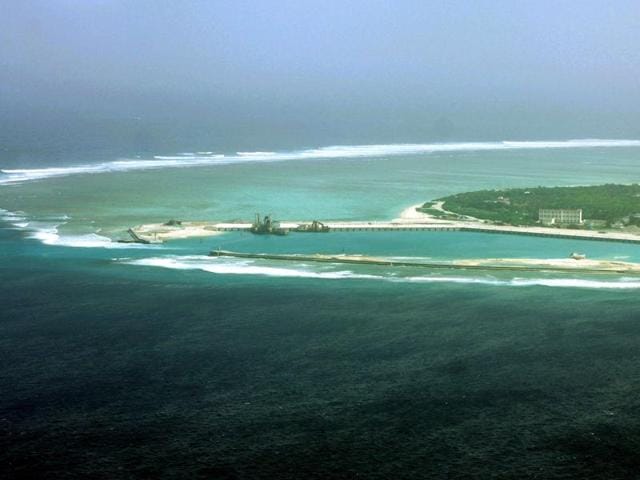
The reported Chinese installation of missiles on Woody Island, one of the many disputed islets in the South China Sea that have been effectively taken over and converted into military bases by Beijing, is a not unexpected escalation in what is easily the world’s most geopolitically sensitive territorial dispute.
China’s infamous “nine dashed lines” claim on 80% of what is otherwise an international water body is remarkable not only for the amount of territory being claimed but also the audacity with which Beijing is going about it. There is no attempt by Beijing to nibble away at other’s claim, as it does on the boundary with India.
There is also a far greater degree of military muscle-flexing in enforcing the claims on the South China Sea than the world is used to with Beijing.
The world can only hypothesise what internal dynamics pushed Beijing to put a torch to three territorial powder kegs six or seven years ago — the Indian border, the Senkaku island dispute with Japan and the South China Sea. And why it now pursues aggressively only the last.
However, the external dynamic of this seems clear. Beijing has been open about its desire to become the dominant power in the western Pacific. By definition this means pushing the United States out of this area.
{{/usCountry}}However, the external dynamic of this seems clear. Beijing has been open about its desire to become the dominant power in the western Pacific. By definition this means pushing the United States out of this area.
{{/usCountry}}The South China Sea has become Beijing’s test run for this larger programme. Unfortunately, it has been extremely successful in this regard. One, the US has been slow to respond to Chinese pressure. In two cases, most notably over the Scarborough Shoal, the US declined to back its own ally in a standoff against China. Two, China now has a very strong position on the ground. By seizing and arming many disputed islands, Beijing has reminded the world that possession is nine-tenths of international law as well. Three, Beijing’s actions and the weakness of the US’s response mean that the US alliance structure in the region is beginning to fragment. The Southeast Asian countries have been unable to form a common front. It is obvious why: some believe China is the geopolitical future of their region and prefer to hedge their bets. India should take note. If China concludes its capture of the South China Sea, it has only two other remaining territorial disputes — and one of them is with India.