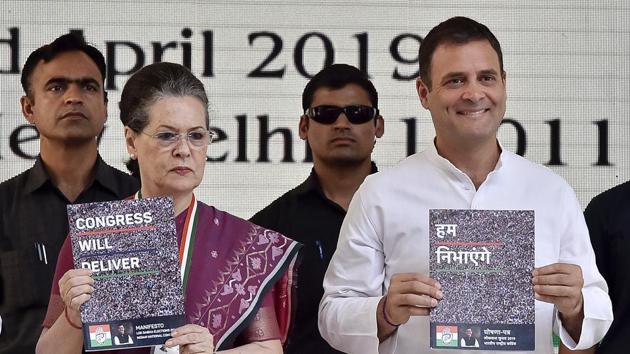
The Congress party unveiled its manifesto on Tuesday. Even though manifestos have been reduced to a ritual during elections, with parties investing little in them and most voters ignoring them, they have a special importance in a democratic set up. In theory, the entire election is fought on the basis of competing manifestos which reflect competing visions for governance. Any effort to bring back the election discourse to serious policy issues is most welcome. The Congress claims to have embarked on a participatory and inclusive process to draft the manifesto and this can only bode well for the political system.
More substantively, there are two broad strands in the Congress manifesto. The first focuses primarily on the economy and livelihoods. Since the Gujarat elections of 2017, the party sensed that its most potent line of critique against the Narendra Modi government revolves around unemployment and agrarian distress. But the question that emerged was what the Congress would do about it. The manifesto has some — but not all — answers. As a welfare measure, the party has promised Nyuntam Aay Yojna (NYAY): A minimum income of ₹6000 per month to 20% of India’s poorest citizens. Details remain sketchy, however, and funding mechanisms or the mode of selecting beneficiaries are not clear. The party has also committed to filling government recruitments (a good step, but will it be enough?); and removing all regulations in starting an enterprise (again, a good idea because many permits are unnecessary, but is an entirely regulation-free process possible?). On agriculture, it has promised a kisan (farmer) budget and committed to converting non-payment of farm loans into a civil offence rather than a criminal one. These are incremental steps, but what agricultural requires are far deeper structural changes.
The second strand in the manifesto is constructing a more liberal political order, with checks on State power. From dropping the sedition law, reviewing the Armed Forces Special Powers Act (AFSPA), holding police and district administrations accountable for negligence in case of riots and hate crimes, bringing in a law on privacy, and restricting the use of Aadhaar, the party has made a range of promises. The Bharatiya Janata Party (BJP) was quick to criticise some of the security-related measures — particularly the promise to review the AFSPA — as steps which would weaken India, and aid terror. But that would be a hasty judgment. The Indian State has adequate power and authority to meet its obligations; what is instead needed is more freedom for citizens. With the Congress laying out its road map, the ball is now in the BJP’s court to tell the country what it will do if re-elected to power.
{{/usCountry}}The second strand in the manifesto is constructing a more liberal political order, with checks on State power. From dropping the sedition law, reviewing the Armed Forces Special Powers Act (AFSPA), holding police and district administrations accountable for negligence in case of riots and hate crimes, bringing in a law on privacy, and restricting the use of Aadhaar, the party has made a range of promises. The Bharatiya Janata Party (BJP) was quick to criticise some of the security-related measures — particularly the promise to review the AFSPA — as steps which would weaken India, and aid terror. But that would be a hasty judgment. The Indian State has adequate power and authority to meet its obligations; what is instead needed is more freedom for citizens. With the Congress laying out its road map, the ball is now in the BJP’s court to tell the country what it will do if re-elected to power.
{{/usCountry}}