HT reported Monday that the Centre has decided to shelve a scheme mooted by the 15th Finance Commission to build eight greenfield cities. The funds, ₹8,000 crore, are now likely to be utilised to improve infrastructure in cities with a population of up to 100,000. Interestingly, at least 26 proposals for new cities were in consideration when the scheme was abandoned. The binary of greenfield versus brownfield cities makes no sense in the Indian context.
India is urbanising at
HT reported Monday that the Centre has decided to shelve a scheme mooted by the 15th Finance Commission to build eight greenfield cities. The funds, ₹8,000 crore, are now likely to be utilised to improve infrastructure in cities with a population of up to 100,000. Interestingly, at least 26 proposals for new cities were in consideration when the scheme was abandoned. The binary of greenfield versus brownfield cities makes no sense in the Indian context.
India is urbanising at great speed and existing cities are unable to carry the burden of ever-expanding populations. Existing cities need a massive infusion of capital to augment creaking infrastructure to withstand the inflow of people. Spatial differences are vanishing so much that planners now speak about urban conglomerations that subsume peri-urban areas — multiple towns, cities and villages — in existing metropolises. Schemes such as JNNURM and the current AMRUT mission have attempted to fix the infrastructure gaps. This must continue.
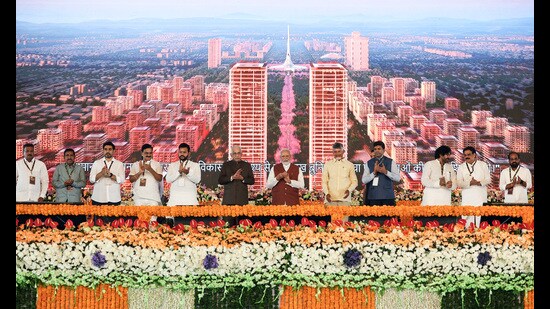
But these efforts need to be complemented with greenfield cities that can be sustainable in terms of water and energy use. The case of Amaravati is interesting; the city was conceived as not just the administrative capital of Andhra Pradesh but also as a potential economic hub. India needs more Amaravatis. Cities are not merely the built-up area; they can become living spaces only if the physical infrastructure enables economic activities. Just as roads and rail networks to sewage systems and garbage disposal are needed, cities, greenfield and brownfield, must provide uninterrupted power and clean drinking water, ensure law and order, and build soft infrastructure such as educational institutions and provide entertainment options. Old cities have achieved such ‘organicity’ over decades if not centuries: City builders of the past considered urban spaces as cultural and economic hubs and made provisions for it. Greenfield projects in India may need tweaks so that they plug into the idea of a layered urban living space rather than elite enclaves — but they are an idea worth exploring.
One Subscription.
Get 360° coverage—from daily headlines
to 100 year archives.
Archives
HT App & Website